
Repairit Audio Repair and Audacity often appear in the same conversation when people need to fix noisy, distorted, or corrupted audio. Audacity is a well-known free editor with basic repair and cleanup tools, while Repairit Audio Repair focuses on guided file-level repair for damaged or unplayable audio. Understanding how each tool handles simple cleanup, manual workflows, and severely corrupted recordings helps you decide which one fits your real projects.
Repair Corrupted Audio Files With Repairit Audio Repair
 Security Verified. Over 7,302,189 people have downloaded it.
In this article
- Repairit Audio Repair vs Audacity: Quick Verdict
- Repairit Audio Repair vs Audacity: Key Differences
- Repairit Audio Repair vs Audacity: Comparison Table
- What Repairit Audio Repair and Audacity Are Best For
- Repairit Audio Repair vs Audacity: Audio Repair Capabilities
- Repairit Audio Repair vs Audacity: Supported Audio Formats and Use Cases
- Repairit Audio Repair vs Audacity: Workflow and Ease of Use
- Repairit Audio Repair vs Audacity: AI Processing and Automation
- Repairit Audio Repair vs Audacity: Pricing and Accessibility
- Who Should Choose Repairit Audio Repair
- Who Should Choose Audacity
- Pros and Cons of Repairit Audio Repair and Audacity
- How to Repair Corrupted Audio Files After Choosing the Right Tool
Repairit Audio Repair vs Audacity: Quick Verdict
The main difference is that Repairit Audio Repair is oriented around repairing corrupted or unplayable audio files, while Audacity focuses on free editing, basic cleanup, and flexible multitrack work.
In most real-world cases, Repairit Audio Repair is more suitable when your main problem is that an audio file refuses to play correctly, sounds severely damaged, or other editors struggle to open it. Audacity may be enough if your recordings already play but need trimming, volume balancing, or simple noise reduction.
Beginners who feel overwhelmed by technical sliders often find that Repairit Audio Repair reduces guesswork, because the workflow is upload, let the tool process, then Preview and save. Audacity gives more editing freedom, but the repair quality depends heavily on how you tweak effects and filters.
Repairit Audio Repair vs Audacity: Key Differences
The key difference is that Repairit Audio Repair centers on file-level audio repair, while Audacity is primarily an editor with some cleanup tools.
From a repair perspective:
- Repair depth:Repairit Audio Repair focuses on restoring damaged audio playback and repairing corrupted audio files that may glitch or fail in other apps, whereas Audacity is more about denoise, de-click, and level fixes on audio that already opens and plays.
- Workflow:Repairit Audio Repair uses a short, guided flow with minimal settings, while Audacity expects you to work manually with tracks, selections, and effect parameters.
- Skill level:Repairit Audio Repair suits users who want a straightforward way to fix damaged recordings, while Audacity rewards users who are comfortable experimenting with plugins and audio concepts.
- Use cases:Repairit Audio Repair can be a better fit when you must rescue important calls, interviews, or voice notes that will not play smoothly, while Audacity shines when you want to edit podcasts, demos, or simple music projects on a budget.
Repairit Audio Repair vs Audacity: Comparison Table
This comparison table summarizes how Repairit Audio Repair and Audacity differ for typical audio repair and cleanup tasks.
| Dimension | Repairit Audio Repair | Audacity |
|---|---|---|
| Best for | Users who need guided repair of corrupted, unplayable, or badly damaged audio files | Beginners needing free audio editing and basic audio cleanup |
| Ease of use | Simplified, step-based repair flow with fewer manual decisions | Easy to start, but repair and cleanup depend on manual settings and editing |
| Repair depth | Focuses on repairing damaged playback and fixing corrupted audio files | More suited to basic denoise and edits than to repairing severely corrupted files |
| AI capability | Leans on automated processing for repairing damaged audio playback | Mainly manual filters and effects with no integrated AI repair engine |
| Workflow | Upload, let the tool process, then Preview and save repaired audio | Manual and basic workflow built around multitrack editing and effect chains |
| Strengths | Guided repair of corrupted audio, simple interface, clear before and after | Free, open-source, flexible editing and basic noise reduction options |
| Weaknesses | Less suited for detailed multitrack editing or complex production | Manual process, limited advanced repair for heavily corrupted or unplayable files |
What Repairit Audio Repair and Audacity Are Best For
The main difference is that Repairit Audio Repair is best for salvaging corrupted or unplayable audio, while Audacity is best for free editing and straightforward cleanup on files that already work.
According to the overview, Audacity is an open-source audio editor with basic repair tools, best for beginners needing free audio editing and simple cleanup. Repairit Audio Repair is better aligned with fixing corrupted or unplayable audio, while Audacity shines when you want flexible editing, cutting, and simple noise reduction without cost.
In practice, this means:
- Choose Repairit Audio Repair when the recording is important but refuses to play smoothly, glitches partway through, or sounds obviously damaged.
- Choose Audacity when the recording is technically fine but noisy, too loud or quiet in parts, or needs trimming and arrangement.
Repairit Audio Repair vs Audacity: Audio Repair Capabilities
Repairit Audio Repair is more suitable when you need deeper file-level audio repair, while Audacity may be enough if you only need light cleanup and editing.
The core features comparison shows that Audacity offers core editing, recording, and basic cleanup tools, while Repairit Audio Repair concentrates on streamlined file-level repair for damaged or unplayable audio that goes beyond everyday editing.
Key capability differences include:
- Audacity provides cut, copy, trim, and basic mixing for spoken word and music tracks, plus simple noise reduction, click removal, and volume normalization. These are helpful once the audio plays reliably.
- Repairit Audio Repair offers a guided workflow to import, process, and export repaired audio files, focusing on correcting playback issues in corrupted audio files that normal editors may fail to open or play correctly.
- Audacity supports plug-ins and advanced editing chains for custom cleanup, but these remain manual and depend on your skill with audio tools.
- Repairit Audio Repair emphasizes automatic analysis that can help when users are unsure which technical settings to tweak yet still need to restore damaged audio playback.
For users dealing with heavily glitched, unplayable, or partially corrupted files, Repairit Audio Repair can be a stronger choice, while Audacity remains a useful companion for enhancement after the file is already repaired.
Repairit Audio Repair vs Audacity: Supported Audio Formats and Use Cases
The key difference is less about formats and more about how each tool uses those formats in real projects.
In most cases, both tools can work with common audio formats such as MP3, WAV, M4A, AAC, or FLAC, which covers podcasts, voice notes, and music exports from phones or cameras. Audacity is used widely on desktop systems for editing, while Repairit Audio Repair focuses on taking these same kinds of files and repairing corrupted or unplayable versions for reliable playback again.
This matters if you have:
- Voice memos or call recordings from a phone that will not play cleanly.
- Podcast episodes or interviews exported from another app that became corrupted during transfer.
- Music or performance recordings that play with severe glitches or dropouts.
In scenarios like these, Repairit Audio Repair is aimed at getting the file back into a usable state. Once that is done, you can move the repaired file into Audacity for editing, fades, or final cleanup if needed.
Repairit Audio Repair vs Audacity: Workflow and Ease of Use
The key difference is that Audacity expects a hands-on, track-based workflow, while Repairit Audio Repair guides you through a short, task-focused repair process.
The workflow information highlights that Audacity relies on a manual and basic workflow built around tracks, selections, and effects. In contrast, Repairit Audio Repair guides you through a short, task-focused repair flow.
Users often notice that:
- Audacity requires experimenting with effect settings such as threshold, sensitivity, and reduction amounts. This gives control but can be confusing if you are unfamiliar with audio repair concepts.
- Repairit Audio Repair reduces guesswork when the goal is simply to fix distorted, noisy, or damaged audio playback, asking for fewer manual decisions.
For beginners or busy users who mainly care about making an unusable recording playable again, Repairit Audio Repair can feel more approachable. For users who enjoy tweaking every detail and doing full edits, Audacity remains attractive.
Repairit Audio Repair vs Audacity: AI Processing and Automation
The main difference is that Repairit Audio Repair leans more on automated analysis for repair, while Audacity relies mostly on manual filters and plugins.
Because this comparison centers on basic cleanup, automation matters less for creativity and more for not getting stuck on technical sliders. Repairit Audio Repair leans on automated processing to repair corrupted audio files and restore damaged audio playback with minimal setup, while Audacity relies mostly on manual filters and effect chains for denoise or cleanup, which can be harder for beginners to tune.
In most real-world cases:
- Repairit Audio Repair is helpful when you want the tool to inspect the file and attempt repair without requiring deep audio knowledge.
- Audacity works well when you are prepared to test different noise profiles, thresholds, and EQ curves until the result sounds acceptable.
This difference becomes important when you only have one chance to fix a critical recording and lack time for trial and error.
Repairit Audio Repair vs Audacity: Pricing and Accessibility
The key difference is that Audacity is free and open-source, while Repairit Audio Repair is paid software with trial options.
Audacity is completely free and open-source, which is why many beginners install it for quick edits. Repairit Audio Repair is a commercial tool, typically offering trial or limited-use options so you can test repairing corrupted or unplayable audio before committing.
From a budget perspective:
- Audacity is attractive for zero-budget projects, student work, and hobby recording where you mainly need editing and light cleanup.
- Repairit Audio Repair becomes appealing when free options cannot reliably fix damaged recordings, and the audio is important enough to justify a dedicated repair tool.
This cost distinction often leads users to try Audacity first, then move to Repairit Audio Repair when they hit limits with heavily corrupted or unplayable files.
Who Should Choose Repairit Audio Repair
Repairit Audio Repair is more suitable when your priority is repairing corrupted or unplayable audio rather than editing already-healthy recordings.
Based on the provided guidance, Repairit Audio Repair is a strong fit for:
- Users facing corrupted, unplayable, or badly damaged audio files that basic editors cannot fix.
- People who prefer a simple, guided repair process instead of manual filter tweaking.
- Creators who need clearer before and after results without diving into complex editing.
- Anyone who already tried Audacity for cleanup but still has clicks, distortion, or playback issues.
In these scenarios, the value of Repairit Audio Repair is that it focuses on making broken audio usable again, while leaving advanced editing to other tools if needed.
Who Should Choose Audacity
Audacity may be enough if you mainly need free editing and basic audio cleanup on files that already open and play correctly.
The guidance for Audacity points to users who:
- Are beginners needing free audio editing with basic noise reduction and trimming.
- Are comfortable with a manual and basic workflow for applying effects and filters.
- Are producing podcasts, voice-overs, or demos on a tight or zero budget.
- Mainly need editing and simple cleanup, not deep repair of corrupted files.
In these cases, Audacity can handle the entire workflow from recording to export, as long as the audio is not severely corrupted at the file level.
Pros and Cons of Repairit Audio Repair and Audacity
The main difference in pros and cons is that Repairit Audio Repair trades broad editing features for deeper repair focus, while Audacity trades deep repair focus for free and flexible editing.
Repairit Audio Repair Pros and Cons
Audacity Pros and Cons
How to Repair Corrupted Audio Files After Choosing the Right Tool
After comparing Repairit Audio Repair and Audacity, the next step is actually repairing the corrupted or noisy audio file so it becomes usable again.
In many workflows, users decide which tool fits their situation, then start with file-level repair before moving on to editing. Repairit Audio Repair is a practical guided option for this first stage, especially when standard editors struggle to open the file or the playback is heavily distorted.
Once the file plays cleanly, you can still bring it into Audacity for extra trimming, fades, or manual noise reduction if you want even more control.
Key Features
For users who need to repair damaged recordings instead of just polishing them, Repairit Audio Repair offers several focused capabilities:
- Guided file-level repair aimed at fixing corrupted or unplayable audio recordings.
- Automated processing that reduces the need for manual effect chains and technical tweaking.
- Preview-based workflow so you can compare original and repaired audio before saving.
Step-by-step guide
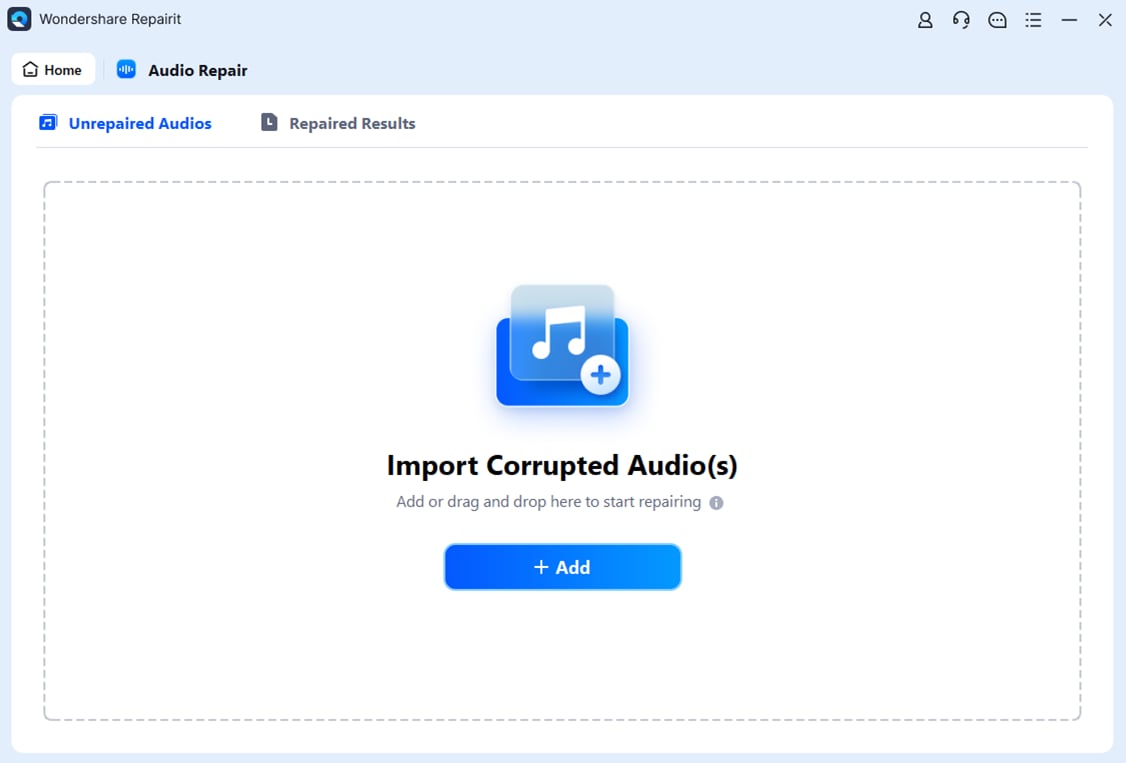
Step 1. Import the damaged audio files you want to fix into Repairit Audio Repair to begin the repair process smoothly.
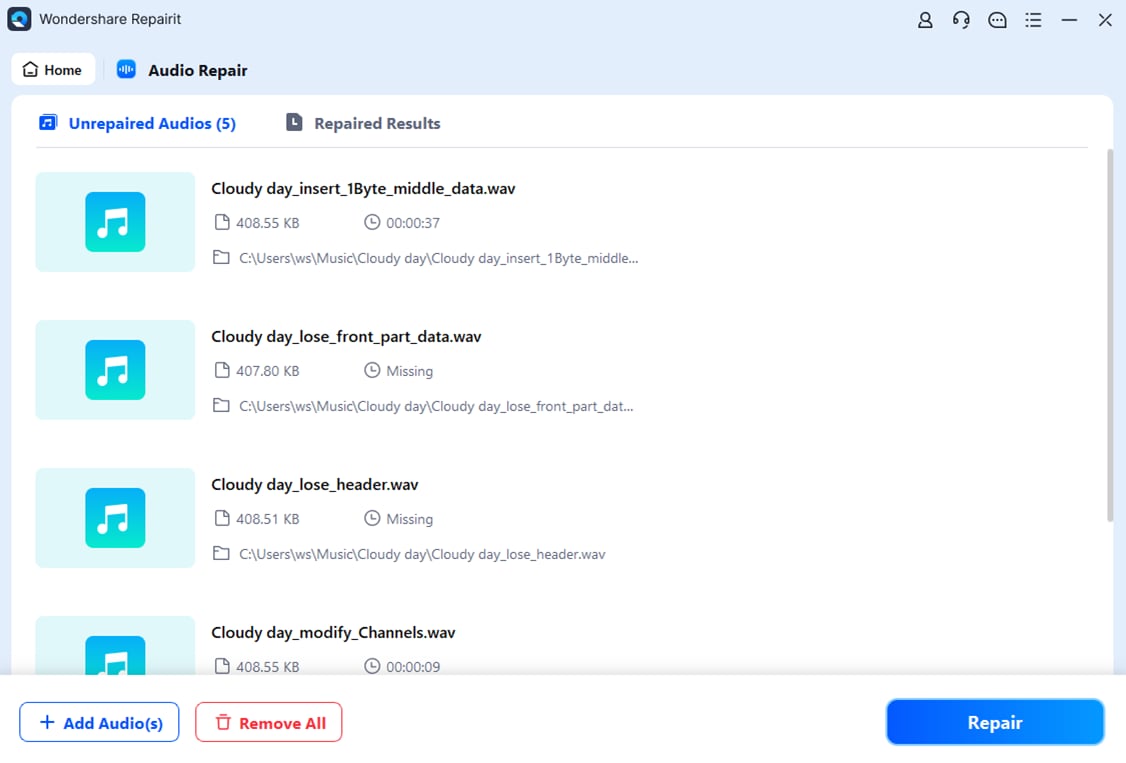
Step 2. Click the repair button to let Repairit Audio Repair automatically analyze and repair the corrupted audio files efficiently.
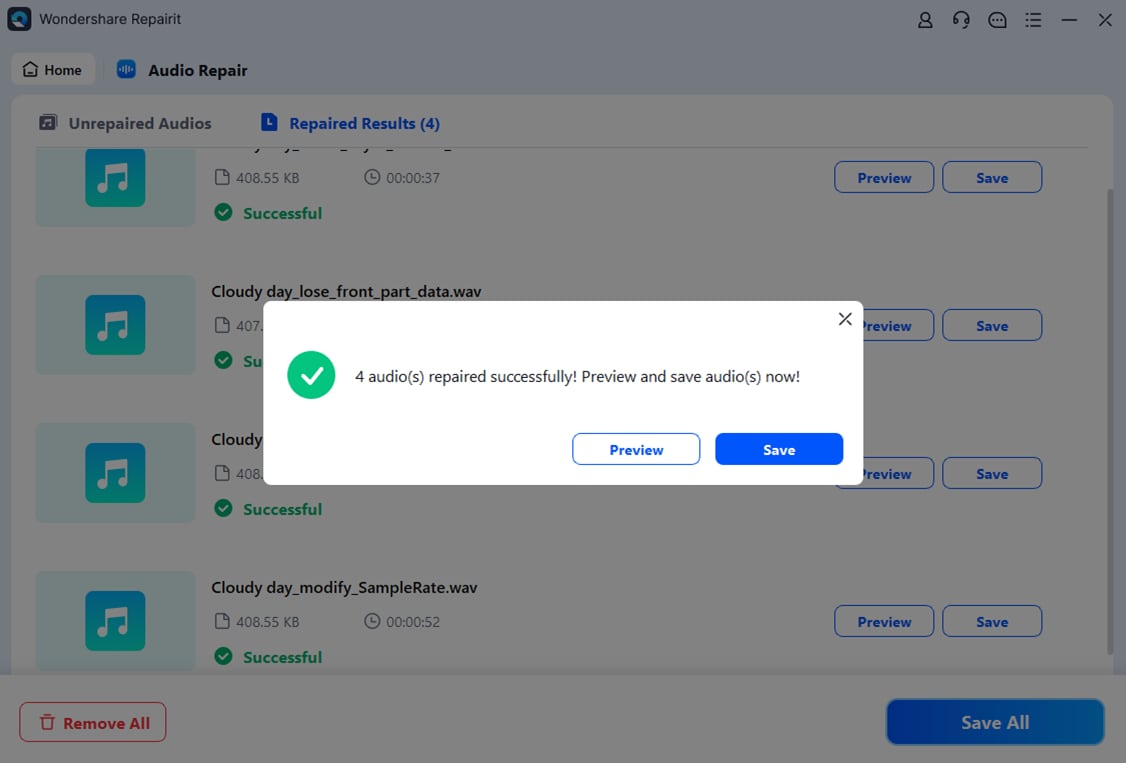
Step 3. Preview the repaired audio results, then save the successfully repaired files to your device.
Final Verdict
The main difference between Repairit Audio Repair and Audacity is how they approach audio problems: one focuses on repairing damaged playback, the other on editing and basic cleanup.
Audacity may be enough if you mainly need free editing, simple trimming, and basic noise reduction on recordings that already play correctly. Its manual tools are flexible but require time and some technical understanding to tune effectively.
Repairit Audio Repair is more suitable when the issue is deeper than everyday cleanup, such as corrupted audio files, unplayable recordings, or severe distortion that basic filters cannot solve. In those cases, its guided workflow and automated repair steps can save you from hours of trial and error while giving you a usable version of an otherwise damaged recording.
For many users, the most practical approach is to combine both tools: let Repairit Audio Repair handle the heavy lifting of file-level repair, then move into Audacity for fine-tuning, editing, and final polish.
Next: Repairit Audio Repair vs Ocenaudio
FAQ
-
1. Is Audacity good for repairing corrupted or unplayable audio files?
Audacity is strong for basic editing and cleanup, but it is not specialized in repairing corrupted or unplayable audio files. In most real-world cases, it works well when the file opens and plays, and you just need noise reduction or level adjustments. When the file itself is damaged or keeps glitching, a repair-focused tool like Repairit Audio Repair is usually more appropriate. -
2. When should I use Repairit Audio Repair instead of Audacity?
Use Repairit Audio Repair when you are dealing with corrupted audio files, damaged recordings that refuse to play smoothly, or severe distortion that basic filters do not fix. It is designed around a guided process to repair damaged audio playback. Audacity remains helpful afterward if you want to trim, mix, or further edit the repaired file. -
3. Can I use both Audacity and Repairit Audio Repair in the same workflow?
Yes. A common workflow is to first run problematic recordings through Repairit Audio Repair to fix unplayable or corrupted audio, then open the repaired files in Audacity for trimming, fades, or additional manual cleanup. This combination lets Repairit Audio Repair handle the heavier repair work while Audacity covers flexible editing and basic polish.