Repairit Audio Repair vs WavePad is a common comparison for users who need either simple audio cleanup or help with corrupted, unplayable files. WavePad is a consumer-friendly audio editor for trimming, cleanup, and basic effects, while Repairit Audio Repair is built to repair corrupted audio files, fix unplayable audio, and restore damaged playback when a basic editor is not enough.
In most real-world cases, you might start with an everyday recording that plays fine and only needs noise reduction, or you might be dealing with a file that will not open, skips, or sounds badly glitched. This article explains when to use each tool, how they fit into a beginner-friendly workflow, and which one is more suitable depending on your audio repair needs.
Repair Corrupted Audio Files With Repairit Audio Repair
 Security Verified. Over 7,302,189 people have downloaded it.
In this article
- Repairit Audio Repair vs WavePad: Quick Verdict
- Repairit Audio Repair vs WavePad: Key Differences
- Repairit Audio Repair vs WavePad: Comparison Table
- What Repairit Audio Repair and WavePad Are Best For
- Repairit Audio Repair vs WavePad: Audio Repair Capabilities
- Repairit Audio Repair vs WavePad: Supported Audio Formats and Use Cases
- Repairit Audio Repair vs WavePad: Workflow and Ease of Use
- Repairit Audio Repair vs WavePad: AI Processing and Automation
- Repairit Audio Repair vs WavePad: Pricing and Accessibility
- Who Should Choose Repairit Audio Repair
- Who Should Choose WavePad
- Pros and Cons of Repairit Audio Repair and WavePad
- How to Repair Corrupted Audio Files After Choosing the Right Tool
Repairit Audio Repair vs WavePad: Quick Verdict
The key difference between Repairit Audio Repair and WavePad is that Repairit Audio Repair focuses on fixing corrupted or unplayable audio files, while WavePad centers on straightforward editing and cleanup for recordings that already play correctly.
In most cases, Repairit Audio Repair is more suitable when you need file-level repair for damaged recordings that skip, fail to open, or contain heavy glitches. WavePad may be enough if you mainly perform simple trims, fades, level adjustments, and basic noise reduction on clean, working audio.
Many users find that combining both approaches works well: first repair serious playback issues in Repairit Audio Repair, then send the fixed file into WavePad or another editor for final polishing and creative adjustments.
Repairit Audio Repair vs WavePad: Key Differences
The main difference between these tools is how they handle damaged sound versus everyday edits: Repairit Audio Repair analyzes and repairs structural audio problems, while WavePad gives you manual editing tools for cleanup and enhancement.
Repairit Audio Repair specializes in situations where a file will not play properly, is heavily distorted, or shows signs of corruption. WavePad is designed more as a general-purpose, beginner-friendly editor suited to trimming podcasts, cleaning up voice memos, or adjusting volume on clips that are already stable.
This matters because the tool you choose should match the condition of your audio and your experience level: beginners facing corrupted files often benefit from a guided repair workflow, while casual users doing light edits may prefer the familiar waveform editing environment in WavePad.
Repairit Audio Repair vs WavePad: Comparison Table
This comparison table summarizes how Repairit Audio Repair and WavePad differ across key decision factors such as best use case, workflow, and repair depth.
| Dimension | Repairit Audio Repair | WavePad |
|---|---|---|
| Best for | Repairing corrupted or unplayable audio files and restoring damaged playback | Casual users doing simple edits, cuts, and basic noise cleanup on working audio |
| Ease of use | Very guided, focused on a simple step-by-step repair process | Beginner-friendly editor but with more menus and tools to learn |
| Repair depth | Specialized file-level repair for playback issues and damaged recordings | Mainly waveform editing and enhancement, limited for severe corruption |
| AI capability | Uses guided processing to analyze and repair damaged audio structure | Primarily manual tools and effects with user-controlled adjustments |
| Workflow | Import, repair, preview, and export with minimal setup | Open file, edit on timeline, apply effects, and export manually |
| Strengths | Handles corrupted, distorted, or unplayable files that editors struggle with | Fast setup, straightforward interface, good for everyday cleanup tasks |
| Weaknesses | Not a full multitrack or creative editing suite | Limited depth for advanced restoration and cannot fix heavily corrupted files well |
What Repairit Audio Repair and WavePad Are Best For
The main difference is that Repairit Audio Repair is best for repairing corrupted audio files and restoring damaged playback, while WavePad is best for simple editing and cleanup of recordings that already play normally.
WavePad works well when you want to trim silence from a voice memo, cut unwanted sections from a podcast, or apply basic noise reduction to a functioning recording. Its consumer-friendly editor layout makes it approachable for users who mainly need everyday audio cleanup tasks like fades, level balancing, or light denoise.
Repairit Audio Repair, by contrast, is suited to scenarios where the original file has deeper problems: it may refuse to play, crash your usual player, or contain severe glitches, crackles, or dropouts. In these cases, Repairit Audio Repair aims to fix the underlying playback issues first so the audio becomes listenable again and ready for further editing elsewhere if needed.
Repairit Audio Repair vs WavePad: Audio Repair Capabilities
The key difference is that Repairit Audio Repair focuses on file-level audio repair, whereas WavePad mainly offers cleanup and enhancement within a traditional audio editor.
Repairit Audio Repair is designed to:
- Repair corrupted or unplayable audio files that fail in standard players.
- Address issues like severe distortion, crackling, glitches, or inconsistent playback.
- Use guided processing so users without technical audio knowledge can still attempt repairs.
WavePad, on the other hand, is oriented around:
- Editing waveforms for tasks such as trimming, splitting, or merging clips.
- Applying noise reduction, EQ, or simple effects to improve sound quality.
- Cleaning up hum or background noise in recordings that already open and play correctly.
In most real-world cases, this means Repairit Audio Repair is a stronger choice when the main problem is that the file itself is damaged or unplayable. WavePad may be enough if the audio is structurally fine but needs cosmetic improvements like lower noise or smoother fades.
Repairit Audio Repair vs WavePad: Supported Audio Formats and Use Cases
The main difference in format handling is less about which extensions you can open and more about how each tool treats problematic files.
Both Repairit Audio Repair and WavePad can work with common audio formats such as MP3, WAV, M4A, AAC, and FLAC in typical scenarios. This covers most recordings from phones, handheld recorders, online downloads, and basic studio workflows.
The distinction is in use cases:
- Repairit Audio Repair focuses on opening and repairing corrupted or partially damaged files that may not play smoothly or may produce severe artifacts.
- WavePad is usually used once the file already opens and plays as expected, and you want to clean, cut, or enhance it rather than repair corruption.
This matters if you frequently receive files from unreliable sources, deal with interrupted transfers, or work with recordings that have been poorly exported. In those situations, Repairit Audio Repair can help make the file usable, after which editing and polishing can happen in WavePad or another editor.
Repairit Audio Repair vs WavePad: Workflow and Ease of Use
The key difference is that Repairit Audio Repair offers a narrow, guided workflow focused on repair, while WavePad uses a more traditional timeline-based editing environment with more tools to manage.
WavePad provides a straightforward interface for an audio editor, but users still need to:
- Open the file and navigate the waveform timeline.
- Select regions manually to cut, trim, or apply effects.
- Choose and adjust cleanup tools such as noise reduction or EQ by hand.
Repairit Audio Repair streamlines things further for users focused on repair:
- The workflow is centered on importing a damaged file, starting the repair, then previewing and exporting.
- Most technical decisions are handled automatically, which reduces guesswork for non-engineers.
- Beginners facing a serious issue like unplayable audio can follow a clear step-by-step process instead of learning full editing concepts.
In practice, this means WavePad may feel more flexible for ongoing editing work, while Repairit Audio Repair feels easier when your single priority is to fix a broken recording quickly without diving into complex menus.
Repairit Audio Repair vs WavePad: AI Processing and Automation
The key difference is how much manual control you need to exercise: Repairit Audio Repair leans on guided, automated processing, while WavePad relies more on user-driven adjustments.
For basic cleanup tasks, WavePad generally expects you to:
- Select problem areas in the waveform.
- Apply noise reduction or other effects.
- Tweak parameters until the result sounds acceptable.
Repairit Audio Repair instead focuses on:
- Analyzing the underlying audio structure of a corrupted or unplayable file.
- Automatically attempting to fix playback issues with limited manual setup.
- Providing a guided sequence where you mainly choose the file and review the repaired result.
This becomes important when users do not know which settings to change or how to diagnose what is wrong with a damaged recording. In those situations, the guided automation of Repairit Audio Repair can be more approachable than manually tuning multiple cleanup tools in WavePad.
Repairit Audio Repair vs WavePad: Pricing and Accessibility
The main difference in pricing and accessibility is tied to how frequently you need corrupted-file repair versus everyday editing.
WavePad, available from NCH Software, is offered in different editions, and users can typically test it before committing. This setup can work well if you are a casual editor who mainly trims, cleans, and exports audio that already plays correctly.
Repairit Audio Repair also provides accessible entry options, allowing users to try repairing corrupted or distorted audio without a large upfront cost. For users who occasionally face serious file damage and cannot open or play important recordings, even limited access to a dedicated repair workflow can be valuable.
Instead of comparing exact prices, it is more practical to think in terms of your primary need: if you mostly edit clean audio, WavePad may cover your day-to-day tasks, but if repairing broken files is critical even a few times a year, including Repairit Audio Repair in your toolkit can save sessions that a standard editor struggles with.
Who Should Choose Repairit Audio Repair
Repairit Audio Repair is more suitable when your main challenge is broken or corrupted audio rather than routine editing.
- You have audio files that are corrupted, glitchy, or will not play properly in standard players.
- You want a guided workflow to repair damaged recordings with minimal setup or technical knowledge.
- You care more about restoring broken audio than detailed multitrack or creative sound design.
- You need a focused tool to fix distorted or noisy audio before doing final cleanup in another editor.
In these situations, using Repairit Audio Repair first can help you turn an unplayable or heavily glitched recording into something stable enough to edit and deliver.
Who Should Choose WavePad
WavePad may be enough if your audio already plays correctly and you mainly need simple editing and cleanup.
- You are a casual user doing trims, fades, level adjustments, and other straightforward edits.
- You mainly need to clean up hum or background noise in recordings that are structurally fine.
- You prefer a familiar, consumer-friendly editor layout with a visible waveform and timeline.
- You only occasionally encounter corrupted files and can live with the limitations of handling them in an editor.
In these cases, using WavePad as your main editor can cover most everyday tasks, while you can still bring in more specialized tools like Repairit Audio Repair if you run into severe corruption that normal editing cannot fix.
Pros and Cons of Repairit Audio Repair and WavePad
The main difference in pros and cons comes down to specialization: Repairit Audio Repair concentrates on corrupted-file repair, while WavePad focuses on accessible editing and light restoration.
Repairit Audio Repair Pros and Cons
WavePad Pros and Cons
How to Repair Corrupted Audio Files After Choosing the Right Tool
After comparing Repairit Audio Repair vs WavePad, the next step is actually repairing any corrupted or unplayable audio files you have, rather than just editing what already works. Once you know that a normal editor struggles with your damaged recording, using a guided repair tool becomes the practical move.
In most real-world cases, the workflow looks like this: you first repair the file so it plays from start to finish, then you decide whether to bring the repaired version into WavePad or another editor for extra cleanup or creative changes. For the repair stage, Repairit Audio Repair offers a focused, beginner-friendly process.
Key Features
In the context of a corrupted-file workflow, several Repairit Audio Repair capabilities stand out:
- Analyzes and repairs damaged or unplayable audio so it can be listened to again in common players.
- Targets distortion, glitches, and severe artifacts that basic editors often cannot resolve effectively.
- Provides a clear, step-by-step repair process with minimal manual configuration, suitable for beginners.
- Supports practical formats used by phones, recorders, and simple studio exports so you can repair everyday recordings.
- Fits neatly into a two-stage workflow: repair with Repairit Audio Repair, then fine-tune with an editor like WavePad if desired.
Step-by-step guide
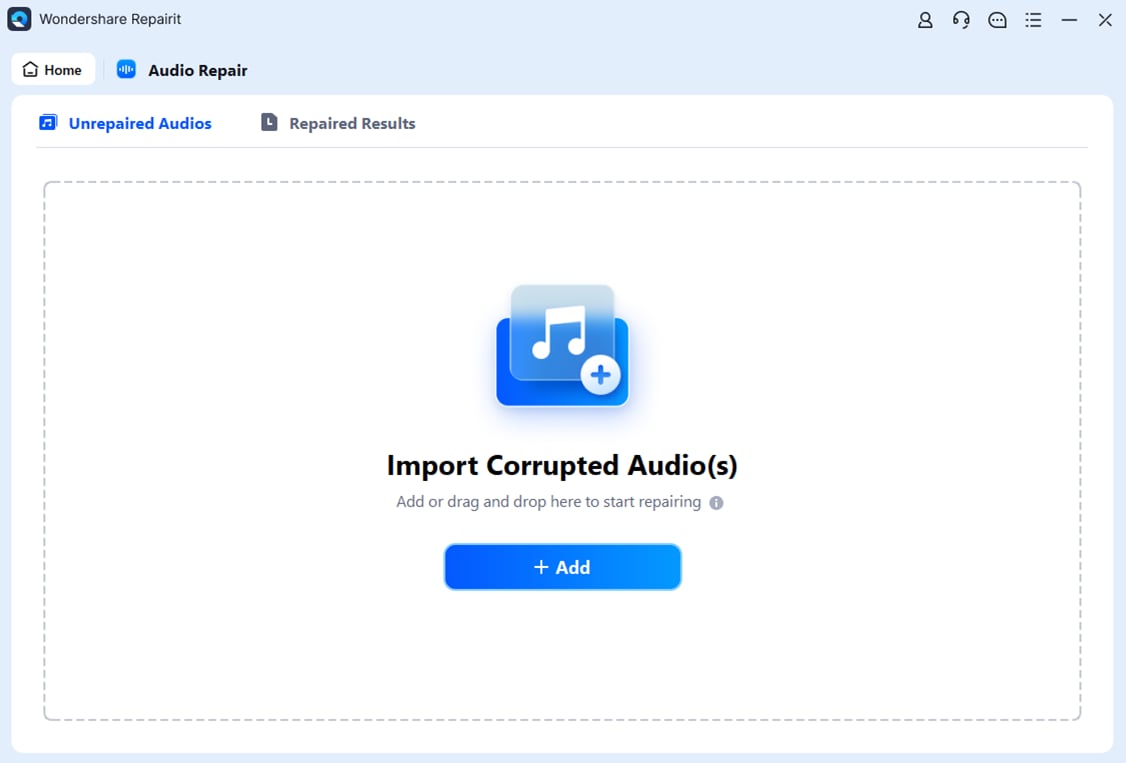
Step 1. Import the damaged audio files you want to fix into Repairit Audio Repair to begin the repair process smoothly.
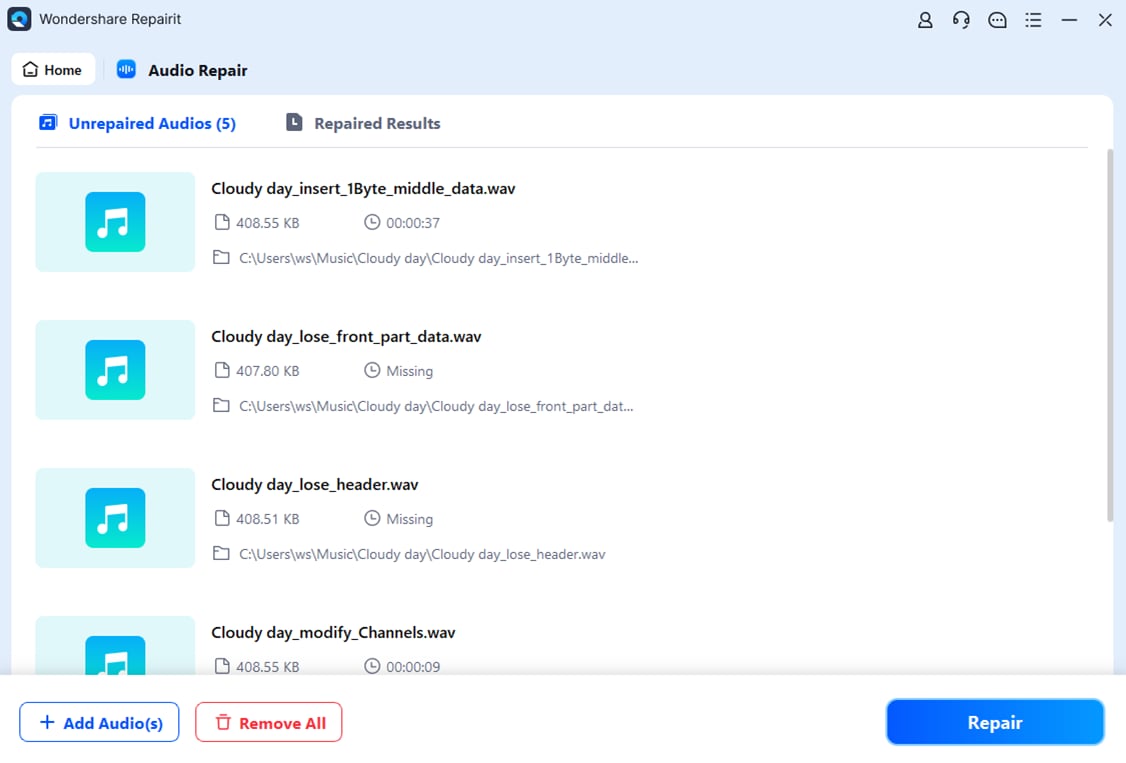
Step 2. Click the repair button to let Repairit Audio Repair automatically analyze and repair the corrupted audio files efficiently.
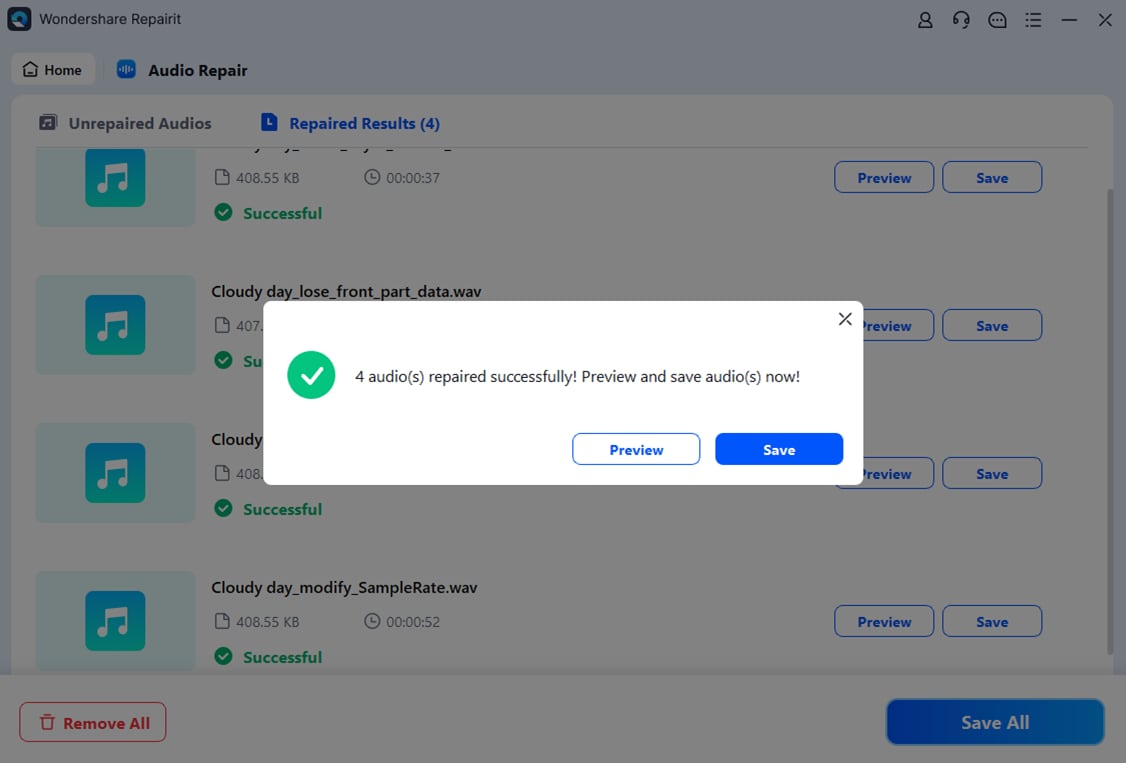
Step 3. Preview the repaired audio results, then save the successfully repaired files to your device.
Final Verdict
The key difference between Repairit Audio Repair and WavePad is what they prioritize: Repairit Audio Repair focuses on repairing corrupted, unplayable, or badly damaged audio files, while WavePad centers on simple waveform editing, trimming, and noise cleanup for recordings that already play correctly.
Repairit Audio Repair is more suitable when your main problem is broken audio playback, such as files that will not open, contain heavy glitches, or sound severely distorted. WavePad may be enough if you mainly work with clean recordings and just need a consumer-friendly editor for routine trimming, fades, and basic denoise.
For many users, the most practical approach is to use Repairit Audio Repair to fix severe damage first, then send the repaired file into WavePad or another editor for final polishing. Thinking in terms of workflow, you repair structure with Repairit Audio Repair and refine sound character with editing tools, giving you a balanced way to handle both emergencies and everyday audio tasks.
Next: Repairit Audio Repair vs Tenacity
FAQ
-
1. Is WavePad good for repairing corrupted or unplayable audio files?
WavePad can help with basic cleanup and enhancement on audio that already opens and plays, but it is not focused on repairing corrupted or unplayable audio files. If the file will not open, skips badly, or is heavily damaged, Repairit Audio Repair is generally more suitable because it targets structural playback issues rather than only surface-level editing. -
2. When should I use Repairit Audio Repair instead of WavePad?
You should use Repairit Audio Repair when your audio file is corrupted, fails to play correctly, or has severe glitches and distortion that typical editors cannot fix. WavePad is better suited for recordings that already play normally, where you mainly need trimming, simple noise reduction, or basic effects rather than deep repair. -
3. What is the difference between audio repair and audio enhancement or cleanup?
Audio repair focuses on fixing corrupted audio files, restoring damaged playback, and making unplayable or heavily glitched recordings listenable again. Audio enhancement or cleanup, such as what you often do in WavePad, deals with improving a file that already plays by reducing noise, de-clicking, de-humming, or adjusting levels without changing the underlying file structure.