When you need to fix corrupted, noisy, or unplayable recordings, choosing between Repairit Audio Repair and Acon Digital Restoration Suite comes down to repair depth and workflow. Repairit Audio Repair focuses on guided file-level repair, while Acon Digital Restoration Suite offers plugin-based tools for detailed restoration inside a DAW. This comparison walks through how each handles deep repair, spectral-style cleanup, and everyday production tasks so you can match the right tool to your real projects.
In the plugin-based audio repair tools space, Repairit Audio Repair and Acon Digital Restoration Suite target different parts of the workflow. Acon Digital Restoration Suite suits audio engineers who need restoration plugins inside a DAW, while Repairit Audio Repair focuses on file-level repair of corrupted or unplayable recordings. The main difference is whether you want deep, plugin-style control or a guided, standalone repair process.
Repair Corrupted Audio Files With Repairit Audio Repair
 Security Verified. Over 7,302,189 people have downloaded it.
In this article
- Repairit Audio Repair vs Acon Digital Restoration Suite: Quick Verdict
- Repairit Audio Repair vs Acon Digital Restoration Suite: Key Differences
- Repairit Audio Repair vs Acon Digital Restoration Suite: Comparison Table
- What Repairit Audio Repair and Acon Digital Restoration Suite Are Best For
- Repairit Audio Repair vs Acon Digital Restoration Suite: Audio Repair Capabilities
- Repairit Audio Repair vs Acon Digital Restoration Suite: Supported Audio Formats and Use Cases
- Repairit Audio Repair vs Acon Digital Restoration Suite: Workflow and Ease of Use
- Repairit Audio Repair vs Acon Digital Restoration Suite: AI Processing and Automation
- Repairit Audio Repair vs Acon Digital Restoration Suite: Pricing and Accessibility
- Who Should Choose Repairit Audio Repair
- Who Should Choose Acon Digital Restoration Suite
- Pros and Cons of Repairit Audio Repair and Acon Digital Restoration Suite
- How to Repair Corrupted Audio Files After Choosing the Right Tool
Repairit Audio Repair vs Acon Digital Restoration Suite: Quick Verdict
The main difference between Repairit Audio Repair and Acon Digital Restoration Suite is that Repairit Audio Repair focuses on repairing corrupted or unplayable audio files at the file level, while Acon Digital Restoration Suite focuses on plugin-based cleanup inside a DAW session. This distinction matters because your choice depends on whether your audio file will not play properly at all or already opens and just needs noise and artifact reduction.
In most real-world cases, Repairit Audio Repair is more suitable when a client sends you a damaged export, an interview that will not play smoothly, or a recording with glitches that suggest underlying file issues. Acon Digital Restoration Suite may be enough if the audio opens normally in your DAW and you mainly want to reduce hiss, hum, clicks, or background noise as part of mixing or post production.
Repairit Audio Repair vs Acon Digital Restoration Suite: Key Differences
The key difference between these tools is file-level audio repair versus in-DAW restoration. Repairit Audio Repair is built to repair corrupted audio files and restore damaged audio playback without requiring a DAW, while Acon Digital Restoration Suite is designed as a set of plugins for engineers who already work inside a DAW and need detailed restoration control.
Both can improve problematic audio, but they approach the problem from opposite ends:
- Repairit Audio Repair prioritizes making a broken or unstable audio file playable again, addressing issues that prevent normal playback or cause obvious dropouts and glitches.
- Acon Digital Restoration Suite focuses on shaping and cleaning audio that already plays back correctly, with module-style controls for noise, clicks, and artifacts at the track level.
This becomes important when deciding whether your immediate problem is that the file will not play reliably, or that it plays but simply sounds too noisy for professional use.
Repairit Audio Repair vs Acon Digital Restoration Suite: Comparison Table
This comparison table summarizes how Repairit Audio Repair and Acon Digital Restoration Suite differ in workflow, repair depth, and typical use cases so you can quickly see which one fits your current project.
| Dimension | Repairit Audio Repair | Acon Digital Restoration Suite |
|---|---|---|
| Best for | File-level repair of corrupted or unplayable audio and quick restoration without a DAW. | In-DAW restoration and detailed cleanup for audio engineers using plugin-based workflows. |
| Ease of use | Simpler guided interface designed for repairing damaged files directly. | More complex; assumes experience with DAWs and plugin routing. |
| Repair depth | Strong for repairing playback of damaged files and stabilizing obvious defects. | High control over noise, clicks, and artifacts for deep, surgical restoration inside mixes. |
| AI capability | Uses automated analysis to guide file-level repair decisions. | Focuses more on algorithmic plugin processing than guided AI style workflows. |
| Workflow | Standalone, file-based workflow with focused repair steps. | Plugin-based workflow that requires loading modules in a compatible DAW or editor. |
| Strengths | Directly repairs corrupted audio files and restores damaged playback with minimal setup. | High-quality processing and precise control suited to professional restoration chains. |
| Weaknesses | Less suited to intricate, multi-track restoration inside large sessions. | Requires a DAW and plugin knowledge, and does not directly repair unreadable files. |
What Repairit Audio Repair and Acon Digital Restoration Suite Are Best For
Repairit Audio Repair is more suitable when your main issue is a corrupted or partially unplayable audio file, while Acon Digital Restoration Suite is better suited when the audio plays fine but needs advanced cleanup within a mix. Thinking in terms of where the problem lives helps clarify which tool should come first in your workflow.
- Use Repairit Audio Repair when the file itself is unstable, fails to play properly, or contains structural problems that basic denoise or EQ cannot touch.
- Use Acon Digital Restoration Suite when you are already working in a DAW and want module-style processing for hiss, hum, clicks, crackle, or other artifacts that sit on top of otherwise playable audio.
In practice, many engineers combine them: first stabilizing the file with Repairit Audio Repair, then applying track-level cleanup with Acon Digital Restoration Suite as part of a broader processing chain.
Repairit Audio Repair vs Acon Digital Restoration Suite: Audio Repair Capabilities
The main difference in audio repair capabilities is that Repairit Audio Repair emphasizes deep file-level repair, while Acon Digital Restoration Suite emphasizes fine-grained cleanup within a DAW. This distinction affects what type of damage each tool handles most effectively.
Both tools address unwanted noise and damaged recordings, but Repairit Audio Repair emphasizes repairing corrupted audio files at the file level, while Acon Digital Restoration Suite emphasizes high-quality plugin processing for detailed cleanup inside professional sessions.
- Shared capabilities:
- Remove common noise and artifacts from problem recordings.
- Improve clarity on dialogue, voice, and location sound.
- Help restore damaged audio playback to a usable state.
- Advanced and workflow-specific capabilities:
- Repairit Audio Repair provides deep repair options for fixing unplayable or glitchy audio files by analyzing the file structure and stabilizing playback.
- Acon Digital Restoration Suite provides targeted processing for clicks, crackle, hum, and complex noise issues, giving engineers nuanced, parameter-based control.
- Both can sit inside professional workflows, but Acon Digital Restoration Suite is typically chained with other mix tools, while Repairit Audio Repair is used as a pre-mix repair stage.
For users who regularly receive exports that will not play, Repairit Audio Repair is a stronger choice; for users who mainly handle already-playable multitrack sessions, the plugin approach of Acon Digital Restoration Suite may feel more natural.
Repairit Audio Repair vs Acon Digital Restoration Suite: Supported Audio Formats and Use Cases
The key difference in format support is that Repairit Audio Repair handles audio formats directly at the file level, while Acon Digital Restoration Suite relies on whatever formats your DAW or editor supports. This matters if clients send you consumer-style formats that you simply need to repair and return quickly.
Repairit Audio Repair works at the file level with typical formats like MP3, WAV, M4A, AAC, or FLAC, which is convenient when a client sends a single damaged file. Acon Digital Restoration Suite operates as plugins in a DAW or editor, so supported formats depend on the host application, but in most real-world cases users work with standard uncompressed or compressed formats handled by their DAW.
- Repairit Audio Repair typical use cases:
- Broken podcast exports or interview files that will not play cleanly.
- Problem voice notes or phone recordings in compressed formats.
- Music or mixdown files that exhibit glitches after export.
- Acon Digital Restoration Suite typical use cases:
- Track-level noise reduction inside a DAW session.
- Cleaning dialogue on a video timeline where the file itself is stable.
- Fine-tuning archival transfers that already import correctly into the editor.
Repairit Audio Repair vs Acon Digital Restoration Suite: Workflow and Ease of Use
The key difference in workflow is that Repairit Audio Repair provides a standalone, guided process, while Acon Digital Restoration Suite expects a DAW-centric, plugin-based workflow. This directly affects learning curve and setup time for simple repair tasks.
The key difference in workflow is that Repairit Audio Repair is a standalone, guided process, ideal when you just need to repair a corrupted file and export. Acon Digital Restoration Suite requires a DAW and is inserted as plugins, so it fits engineers who prefer building chains, automating parameters, and treating noise alongside EQ, compression, and other mix tools.
- Repairit Audio Repair workflow:
- Open the application, add corrupted or unplayable files, and follow clear repair steps.
- No need to manage plugin slots, routing, or automation.
- Well suited for quick turnarounds and for non-technical users who still need reliable repairs.
- Acon Digital Restoration Suite workflow:
- Load modules as inserts on tracks or buses in your DAW or editor.
- Tune parameters, automate key sections, and integrate with other mix tools.
- Best for engineers who already understand plugin gain staging and routing.
Users often notice that Repairit Audio Repair gets them from broken file to usable export faster, whereas Acon Digital Restoration Suite rewards those who are comfortable spending more time fine-tuning settings inside the session.
Repairit Audio Repair vs Acon Digital Restoration Suite: AI Processing and Automation
The main difference in automation is that Repairit Audio Repair leans more on automated file-level analysis, while Acon Digital Restoration Suite emphasizes manual, algorithmic control inside each plugin. This influences how hands-on you need to be during a repair.
For deep_repair tasks, Repairit Audio Repair leans on automated analysis to diagnose and repair corrupted or unplayable audio at the file level, which users often notice speeds up tough fixes. Acon Digital Restoration Suite focuses on high-quality algorithms with manual control, so the engineer decides how far to push noise reduction, transient repair, or spectral-style cleanup rather than relying on fully automated AI decisions.
- Choose Repairit Audio Repair if you prefer guided decisions and want the software to take the first pass at stabilizing the file.
- Choose Acon Digital Restoration Suite if you want to tweak thresholds, reduction amounts, and time-frequency behavior manually for each track.
Repairit Audio Repair vs Acon Digital Restoration Suite: Pricing and Accessibility
The key difference in accessibility is that Repairit Audio Repair is offered as a standalone application with trial options, while Acon Digital Restoration Suite is sold as a plugin bundle that depends on a compatible DAW. This can influence cost of entry and how easily non-engineers can get started.
Repairit Audio Repair is typically offered as standalone software with trial options so you can test file-level repair on your own material before committing. Acon Digital Restoration Suite is sold as a plugin bundle, and a common approach is to install a demo through the official site to check compatibility with your DAW and evaluate processing quality on real sessions before purchase.
- If you do not own a DAW or prefer a single-purpose repair tool, Repairit Audio Repair is usually more straightforward to adopt.
- If you already work daily in a DAW and invest in plugin bundles, adding Acon Digital Restoration Suite may fit your existing purchasing pattern.
Who Should Choose Repairit Audio Repair
Repairit Audio Repair is more suitable for users whose main problem is corrupted or unplayable audio files rather than subtle noise issues inside a large session. It focuses on stabilizing the file itself so you can then move into editing or mixing with a repaired source.
- Users who need to repair corrupted or unplayable audio files without opening a DAW.
- Video creators and podcasters who want a straightforward, guided repair workflow.
- Professionals who receive problem files from clients and must quickly restore playback.
- Anyone who prefers a standalone tool for deep file-level repair instead of plugins.
In most real-world cases, if the file will not play cleanly or refuses to import into your main tools, getting it through Repairit Audio Repair first is a practical way to avoid troubleshooting multiple plugins and DAW settings.
Who Should Choose Acon Digital Restoration Suite
Acon Digital Restoration Suite is more suitable for audio engineers and editors who already build restoration chains inside a DAW and want detailed control over noise, clicks, and artifacts at the track level. It assumes comfort with plugin workflows rather than a guided repair interface.
- Audio engineers who live inside a DAW and want plugin-based restoration tools.
- Post production mixers needing precise noise, click, and artifact control on tracks.
- Users comfortable automating parameters and building complex processing chains.
- Studios that already own compatible DAWs and want to expand in-session restoration.
Acon Digital Restoration Suite may be enough if your files already open and play correctly, and your main request from clients is cleaner, quieter, and more polished audio within a mix rather than fixing files that refuse to play.
Pros and Cons of Repairit Audio Repair and Acon Digital Restoration Suite
The main trade-off between Repairit Audio Repair and Acon Digital Restoration Suite is convenience versus granular control. Repairit Audio Repair prioritizes quick, guided file-level repair, while Acon Digital Restoration Suite offers more detailed, track-level tuning inside a DAW at the cost of extra setup.
Repairit Audio Repair Pros and Cons
Acon Digital Restoration Suite Pros and Cons
How to Repair Corrupted Audio Files After Choosing the Right Tool
After comparing Repairit Audio Repair and Acon Digital Restoration Suite, the next step is actually repairing the corrupted audio file that triggered your search. In most real-world cases, it makes sense to start with a dedicated file-level repair so that any later plugin-based cleanup works on a stable, playable source.
This is where Repairit Audio Repair acts as a practical first stage: it focuses on making damaged or unplayable files workable again, before you decide whether you still need further noise reduction or enhancement inside a DAW.
Key Features
Repairit Audio Repair focuses on practical, real-world repair tasks that often appear in production and post workflows.
- Repairs corrupted or partially unplayable audio files so they can be opened and listened to again.
- Targets glitches, dropouts, and distortion that often appear in real-world recordings.
- Provides a guided repair workflow suitable for both technical and non-technical users.
Compared with plugin-only solutions, this approach is especially helpful when your client does not care about the exact processing chain and simply needs a broken file repaired so that it plays back consistently.
Step-by-step guide
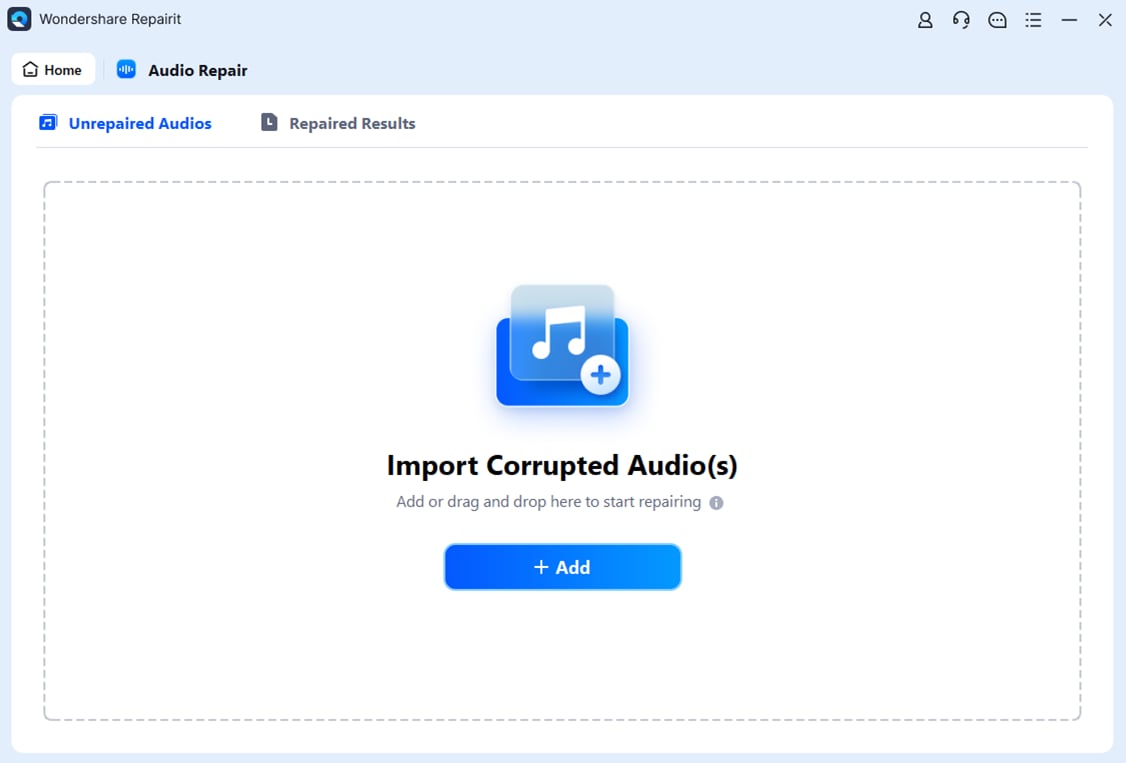
Step 1. Import the damaged audio files you want to fix into Repairit Audio Repair to begin the repair process smoothly.
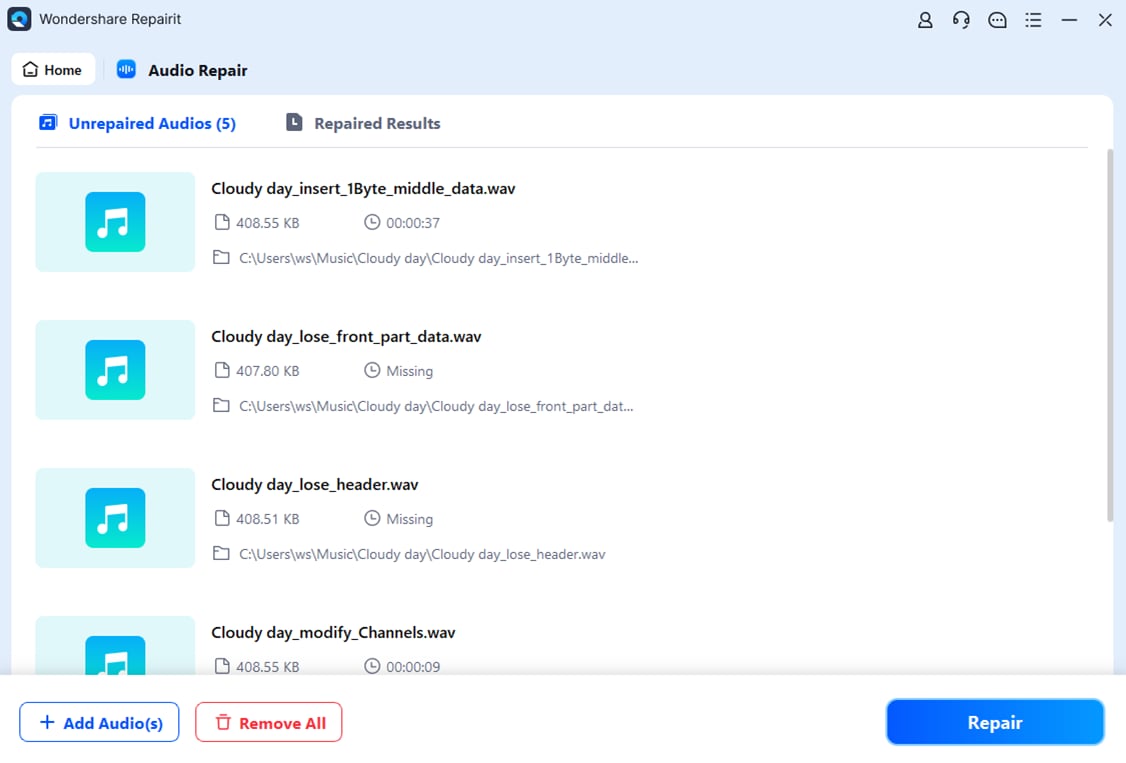
Step 2. Click the repair button to let Repairit Audio Repair automatically analyze and repair the corrupted audio files efficiently.
Step 3. Preview the repaired audio results, then save the successfully repaired files to your device.
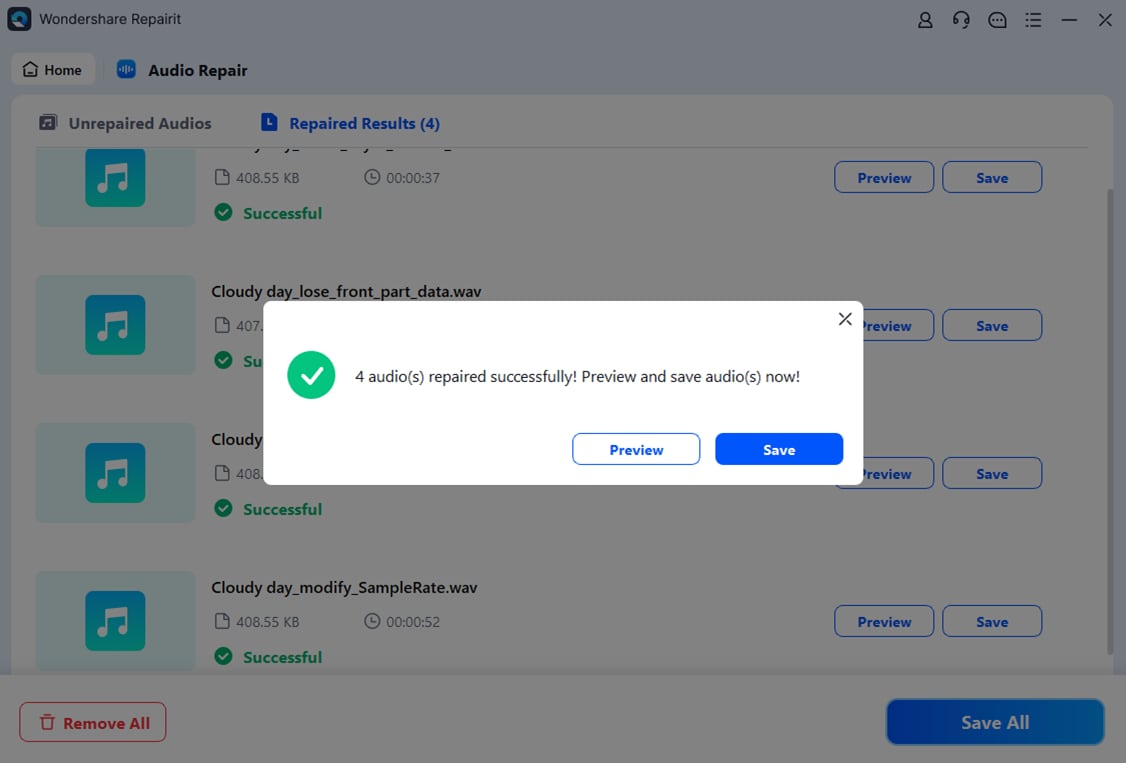
Once your files are repaired and play reliably, you can optionally bring them into a DAW and, if needed, use tools like Acon Digital Restoration Suite for additional spectral-style cleanup, denoising, or click reduction.
Final Verdict
The main difference between Repairit Audio Repair and Acon Digital Restoration Suite is where in the workflow they live. Repairit Audio Repair is stronger when you are facing corrupted or unplayable files and want a focused, standalone process that repairs the file itself before any mixing or editing. This matters if clients send you damaged exports, field recordings, or interview files that will not play cleanly.
Acon Digital Restoration Suite may be enough if your audio already opens in a DAW and you need high-quality, plugin-based processing for noise, clicks, and spectral-style cleanup during mixing. Many engineers use a combination: Repairit Audio Repair to stabilize and repair the file, then Acon Digital Restoration Suite for fine-tuning inside the session.
If you regularly confront audio that simply will not play or sounds obviously broken from the start, anchoring your workflow around Repairit Audio Repair as the first repair step is a practical, project-friendly strategy.
Next: Repairit Audio Repair vs Antares Soundsoap
FAQ
-
1. Is Repairit Audio Repair a plugin like Acon Digital Restoration Suite?
No. Repairit Audio Repair works as a standalone, file-based tool focused on repairing corrupted or unplayable audio files. Acon Digital Restoration Suite is a set of plugins that you load inside a DAW or audio editor for track-level restoration. -
2. When should I use Repairit Audio Repair instead of Acon Digital Restoration Suite?
Use Repairit Audio Repair when the main problem is that a file is corrupted, partially unplayable, or full of severe glitches that prevent normal playback. Use Acon Digital Restoration Suite when the file already opens in your DAW and you want to fine-tune noise, clicks, and artifacts inside a larger mix or post production project. -
3. Can I combine Repairit Audio Repair and Acon Digital Restoration Suite in one workflow?
Yes. In most real-world cases, you can first use Repairit Audio Repair to repair corrupted audio files and restore stable playback. After exporting a repaired version, you can bring that file into your DAW and use Acon Digital Restoration Suite plugins for detailed noise reduction, de-clicking, and other restoration tasks within the mix.