

Repairit Audio Repair vs Tenacity is a common comparison for people who are unsure whether they only need simple cleanup or must repair seriously damaged audio files. Repairit Audio Repair and Tenacity both help when your recordings do not sound right, but they approach audio repair very differently. Tenacity is an open-source, Audacity-based editor aimed at users who like manual, hands-on cleanup. Repairit Audio Repair focuses more on guided file-level repair to fix unplayable or corrupted audio and restore damaged audio playback. Understanding these differences matters if you are deciding how to handle noisy, distorted, or unplayable recordings from real-world sessions.
Repair Corrupted Audio Files With Repairit Audio Repair
 Security Verified. Over 7,302,189 people have downloaded it.
In this article
- Repairit Audio Repair vs Tenacity: Quick Verdict
- Repairit Audio Repair vs Tenacity: Key Differences
- Repairit Audio Repair vs Tenacity: Comparison Table
- What Repairit Audio Repair and Tenacity Are Best For
- Repairit Audio Repair vs Tenacity: Audio Repair Capabilities
- Repairit Audio Repair vs Tenacity: Supported Audio Formats and Use Cases
- Repairit Audio Repair vs Tenacity: Workflow and Ease of Use
- Repairit Audio Repair vs Tenacity: AI Processing and Automation
- Repairit Audio Repair vs Tenacity: Pricing and Accessibility
- Who Should Choose Repairit Audio Repair
- Who Should Choose Tenacity
- Pros and Cons of Repairit Audio Repair and Tenacity
- How to Repair Corrupted Audio Files After Choosing the Right Tool
Repairit Audio Repair vs Tenacity: Quick Verdict
The main difference is that Repairit Audio Repair focuses on repairing corrupted or unplayable audio files, while Tenacity focuses on editing and basic cleanup of audio that already plays correctly.
In most real-world cases, Repairit Audio Repair is more suitable when you need to fix unplayable, distorted, or corrupted audio and restore damaged audio playback. Tenacity may be enough if the file opens and plays, and your priority is manual editing, trimming, or simple denoising in a free, open-source environment.
- Best for: Repairit Audio Repair is better suited to users who need guided file-level repair to fix corrupted or unplayable audio. Tenacity is better suited to users who want manual, track-based editing and simple cleanup.
- Ease of use: Repairit Audio Repair offers a streamlined, guided repair pipeline. Tenacity assumes you will choose and tune individual effects, which can feel more technical.
- Repair depth: Repairit Audio Repair targets file-level issues that break playback. Tenacity is mainly for waveform editing and surface-level cleanup.
- Automation: Repairit Audio Repair uses more automated processing to detect and correct common corruption symptoms. Tenacity relies largely on manual control.
Repairit Audio Repair vs Tenacity: Key Differences
The key difference is that Repairit Audio Repair is built around repairing corrupted audio files so they play reliably, whereas Tenacity is built around editing already-playable audio on a timeline.
From an audio engineer perspective, this affects how you approach a problem file. With Repairit Audio Repair, you typically add a damaged file, let the tool analyze it, and then preview repaired output. With Tenacity, you open the file on a waveform, run effects like noise reduction, EQ, or click removal one by one, and manually judge whether each pass helped.
- Problem type: Repairit Audio Repair focuses on playback failures, heavy distortion, and corruption artifacts. Tenacity focuses on cleaning and editing material that is technically intact.
- Workflow style: Repairit Audio Repair offers a focused repair pipeline with fewer technical controls. Tenacity offers many individual tools that you combine as you see fit.
- User skill level: Repairit Audio Repair favors users who do not want to learn detailed audio engineering. Tenacity favors users who like hands-on control and are comfortable with trial-and-error.
- Role in a toolkit: Repairit Audio Repair often acts as a front-end repair step before editing. Tenacity often acts as the workspace for arranging and polishing audio that is already usable.
Repairit Audio Repair vs Tenacity: Comparison Table
Repairit Audio Repair and Tenacity overlap in basic cleanup, but their strengths diverge once audio becomes corrupted or unplayable.
| Dimension | Repairit Audio Repair | Tenacity |
|---|---|---|
| Best for | Users who need to repair corrupted or unplayable audio and restore damaged audio playback with guided steps. | Users preferring open-source alternatives and manual editing for basic noise reduction and simple cleanup. |
| Ease of use | More guided and streamlined, with fewer technical options to learn before fixing a damaged file. | Familiar to Audacity users but can feel technical for beginners and requires learning individual effects. |
| Repair depth | Focuses on file-level repair to fix unplayable, distorted, or corrupted audio in common scenarios. | Mainly suited for waveform editing and surface-level cleanup rather than deep repair of damaged files. |
| AI capability | Uses more automated processing to detect issues in corrupted audio and guide the repair process. | Primarily manual; users must choose and tune effects for noise, clicks, and other artifacts. |
| Workflow | Import, repair, then Preview and save in a focused repair pipeline. | Manual workflow built around tracks, tools, and effects in a classic editor layout. |
| Strengths | Simplifies repairing corrupted files and fixing unplayable audio without deep editing skills. | Free, open-source, and familiar to anyone comfortable with Audacity-style audio editing. |
| Weaknesses | Less suited for detailed editing or multi-track production beyond repair tasks. | Limited when audio is severely corrupted, refuses to play, or needs more than basic cleanup. |
What Repairit Audio Repair and Tenacity Are Best For
Repairit Audio Repair is more suitable when your main problem is a corrupted or unplayable file, while Tenacity may be enough if you only need basic cleanup and editing.
In most real-world cases, users reach for Repairit Audio Repair when a recording will not open, stops partway through, or contains obviously damaged audio that does not respond to normal editing. Tenacity is often used for trimming podcast episodes, adjusting volume, and applying straightforward noise reduction to recordings that already play from start to finish.
- Repairit Audio Repair: Fixing damaged recordings from phones, cameras, or recorders that produce errors, heavy distortion, or unstable playback.
- Tenacity: Cleaning up interview tracks, voice notes, or music stems that are noisy but technically intact.
- Combined workflows: Many creators first repair a troublesome file with Repairit Audio Repair, then fine-tune levels, fades, and EQ inside Tenacity.
Repairit Audio Repair vs Tenacity: Audio Repair Capabilities
The main difference is that Repairit Audio Repair targets file-level audio repair, while Tenacity mainly handles audio cleanup and editing.
Repairit Audio Repair is designed to repair corrupted audio files and restore damaged audio playback when conventional editors cannot even play the material correctly. It focuses on symptoms like unplayable sections, harsh digital distortion from corruption, and glitches that break up the waveform.
Tenacity, by contrast, excels at surface-level improvements. You can run noise reduction to tame background hiss, use EQ to rebalance tone, or remove clicks and pops. These are enhancement and cleanup tasks applied to audio that already opens and plays; they are not the same as repairing a deeply corrupted file.
- Repairit-level tasks: Fixing unplayable audio, addressing corruption artifacts, stabilizing damaged playback, and making files open more reliably.
- Tenacity-level tasks: Reducing steady background noise, trimming silence, adding fades, and manually removing problem sections.
- Practical takeaway: If your issue is that the file itself seems broken, Repairit Audio Repair is a stronger choice. If your issue is that a playable file simply sounds rough, Tenacity may be enough.
Repairit Audio Repair vs Tenacity: Supported Audio Formats and Use Cases
Repairit Audio Repair and Tenacity both work with common consumer audio formats, but they target different stages of the workflow.
In most real-world cases, both tools will work with formats like MP3, WAV, M4A, AAC, or FLAC from phones, recorders, and desktops. Repairit Audio Repair focuses on repairing corrupted audio files so they play back reliably, while Tenacity focuses on editing and cleaning audio that is already playable.
- Typical Repairit Audio Repair use cases: Voice recordings that cut out or will not play, exported mixes that suddenly produce errors, or audio from memory cards that open but sound badly damaged.
- Typical Tenacity use cases: Podcasts, lectures, and music demos that need trimming, level balancing, and noise reduction before publishing.
- Decision factor: When a file will not open or play correctly, a repair-focused tool like Repairit Audio Repair is more practical than a general editor such as Tenacity.
Repairit Audio Repair vs Tenacity: Workflow and Ease of Use
The key difference is that Repairit Audio Repair uses a guided repair pipeline, while Tenacity uses a classic, manual editor workflow.
Repairit Audio Repair follows a simple path: add your damaged file, start the repair, then Preview and save. This matters if you do not want to learn complex audio concepts before fixing issues. The tool is built so that even non-engineers can move from problem file to usable audio with minimal configuration.
Tenacity, by comparison, expects you to inspect the waveform and decide what to do. You might select a noisy region, run noise reduction, test a few settings, then try EQ or compression. This offers detailed control but also introduces more decisions and more time spent previewing changes.
- Repairit Audio Repair workflow: Focused, step-by-step, with fewer parameters and less risk of making the file worse through aggressive manual changes.
- Tenacity workflow: Flexible, track-based, and suited to users who enjoy experimenting with multiple effects.
- Ease-of-use takeaway: For users under time pressure or without audio training, Repairit Audio Repair tends to feel more approachable. Tenacity rewards users who are willing to learn editing tools in depth.
Repairit Audio Repair vs Tenacity: AI Processing and Automation
Repairit Audio Repair is more suitable when you want automated analysis to handle corrupted audio, while Tenacity relies mainly on manual processing and user decisions.
With a basic cleanup focus, Repairit Audio Repair leans on more automated analysis to locate and fix common corruption symptoms and playback problems without many manual controls. Users often notice that they can repair distorted or unplayable audio faster because the tool does more of the heavy lifting.
Tenacity, in contrast, is largely about manual control. You choose noise reduction, click removal, EQ, and other effects, then dial in thresholds and amounts yourself. This can be ideal if you want fine-grained control over the sound, but it can feel slow when the underlying file is severely damaged.
- Repairit Audio Repair automation: Helps users follow a guided path where the software analyzes the file and applies targeted repair.
- Tenacity control: Gives you individual tools that you combine and tweak, which is helpful for fine-tuning but less focused on broken playback.
- Practical impact: For urgent repairs on heavily corrupted files, Repairit Audio Repair can save time. For subtle cleanup on already-usable recordings, Tenacity offers hands-on shaping.
Repairit Audio Repair vs Tenacity: Pricing and Accessibility
The main difference is that Tenacity is free and open-source, while Repairit Audio Repair is a commercial tool that typically offers trial options.
Tenacity is attractive if you want to avoid ongoing license costs and are comfortable investing time into a manual workflow. It can be installed on multiple systems without additional purchase decisions, which is appealing for hobbyists and students.
Repairit Audio Repair involves a financial cost, but the trade-off is time and learning effort. By focusing on guided repair rather than full-scale production features, it can help users repair corrupted audio files and fix unplayable clips without spending hours tweaking individual parameters.
- Tenacity advantage: No purchase needed, ideal for budget-conscious users who mainly need cleanup and editing.
- Repairit Audio Repair advantage: Commercial tool with a focused feature set that can reduce trial-and-error on difficult repairs.
- Decision factor: If you only occasionally clean up light noise, Tenacity may be enough. If you regularly handle problematic client recordings, investing in Repairit Audio Repair can make more sense.
Who Should Choose Repairit Audio Repair
Repairit Audio Repair is more suitable when you frequently deal with corrupted or unplayable audio and want a guided way to restore damaged playback.
According to common user scenarios, Repairit Audio Repair fits people who need reliable results more than they need deep editing features. It is often used as a utility you reach for the moment a file refuses to play correctly.
- Users dealing with corrupted or unplayable audio files that will not open or play correctly.
- People who prefer a guided repair process instead of deep manual editing.
- Creators who value quick, reliable repair of damaged recordings over extensive editing tools.
- Users who regularly receive problematic client recordings and need a focused repair workflow.
- Teams that want a dedicated tool they can hand to non-technical colleagues when recordings misbehave.
Who Should Choose Tenacity
Tenacity may be enough if your audio already plays and you mainly need a free, open-source editor for basic cleanup and arrangement.
Because Tenacity builds on the familiar Audacity-style interface, it appeals to users who like track-based editing and do not mind learning how each effect behaves. It is suited to workflows where the audio is technically fine but needs polishing.
- Open-source supporters who want a free, Audacity-style editor for everyday audio work.
- Users comfortable with manual noise reduction and EQ for basic cleanup tasks.
- People who mainly edit podcasts, voice notes, or music that already plays correctly.
- Beginners who want to explore editing at no cost and do not yet need deep repair of corrupted files.
- Editors who prefer a timeline view where they can cut, move, and layer clips freely.
Pros and Cons of Repairit Audio Repair and Tenacity
Repairit Audio Repair and Tenacity each have clear pros and cons once you separate corrupted-file repair from simple cleanup.
Repairit Audio Repair Pros and Cons
Tenacity Pros and Cons
How to Repair Corrupted Audio Files After Choosing the Right Tool
Once you understand how Repairit Audio Repair vs Tenacity compare, the next step is actually repairing the corrupted or unplayable audio files causing problems in your workflow.
For files that refuse to play, show corruption symptoms, or sound severely distorted, a guided tool such as Repairit Audio Repair can act as a practical first stage before any detailed editing in Tenacity. This approach lets you restore stable playback first, then move on to fine-tuning noise and levels if needed.
Key Features
Both Repairit Audio Repair and Tenacity can improve problematic recordings, but they serve different roles: Repairit Audio Repair focuses on repairing corrupted audio files and restoring damaged playback, while Tenacity centers on manual editing and basic cleanup inside an open-source environment.
- Repairit Audio Repair offers guided steps to fix corrupted or unplayable audio without complex editing.
- Tenacity provides manual tools for trimming, volume changes, and simple noise reduction on a familiar timeline.
- Both can help reduce noise and improve clarity in everyday recordings, though with different levels of automation.
- Repairit Audio Repair targets file-level issues that stop audio from playing correctly or introduce severe distortion.
- Tenacity can chain multiple effects and edits, but relies on user skill rather than dedicated deep repair modules.
- Repairit Audio Repair emphasizes streamlined repair workflows, while Tenacity emphasizes flexible, open-source editing.
- Focused on repairing corrupted or unplayable audio rather than general-purpose editing.
- Streamlined, step-by-step interface suitable for beginners and busy creators.
- Automated analysis that helps fix distorted, noisy, or damaged audio without manual effect chains.
Step-by-step guide
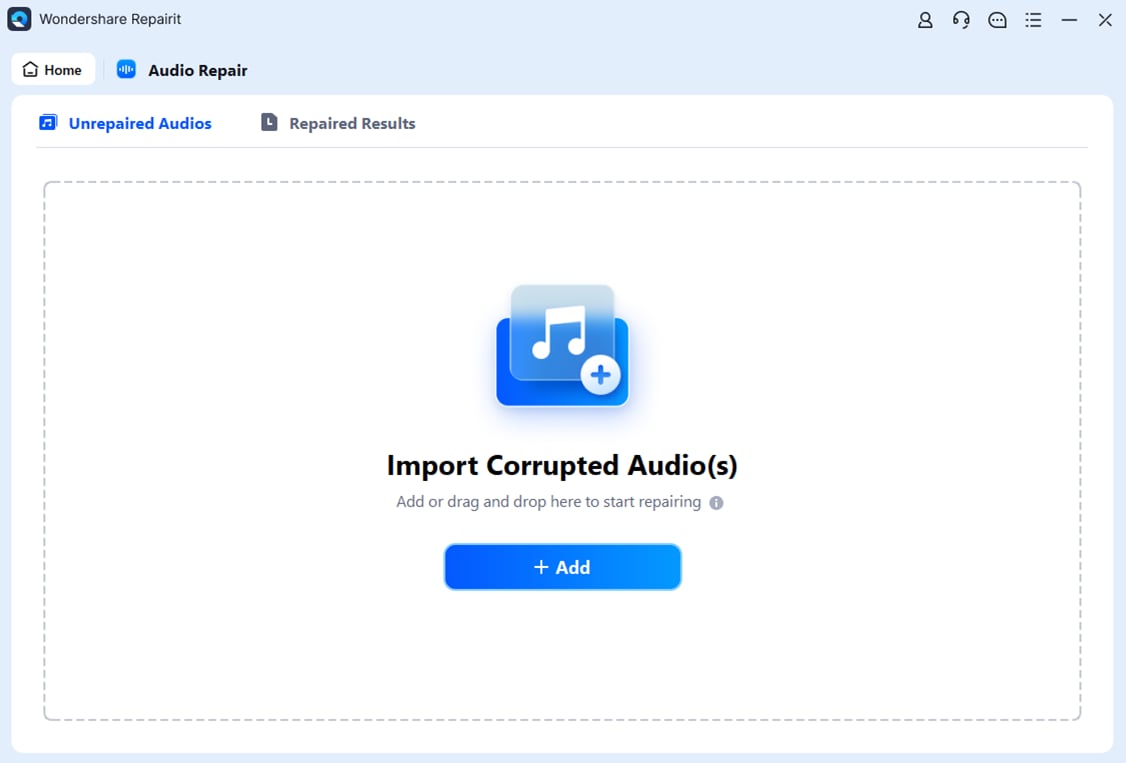
Step 1. Import the damaged audio files you want to fix into Repairit Audio Repair to begin the repair process smoothly.
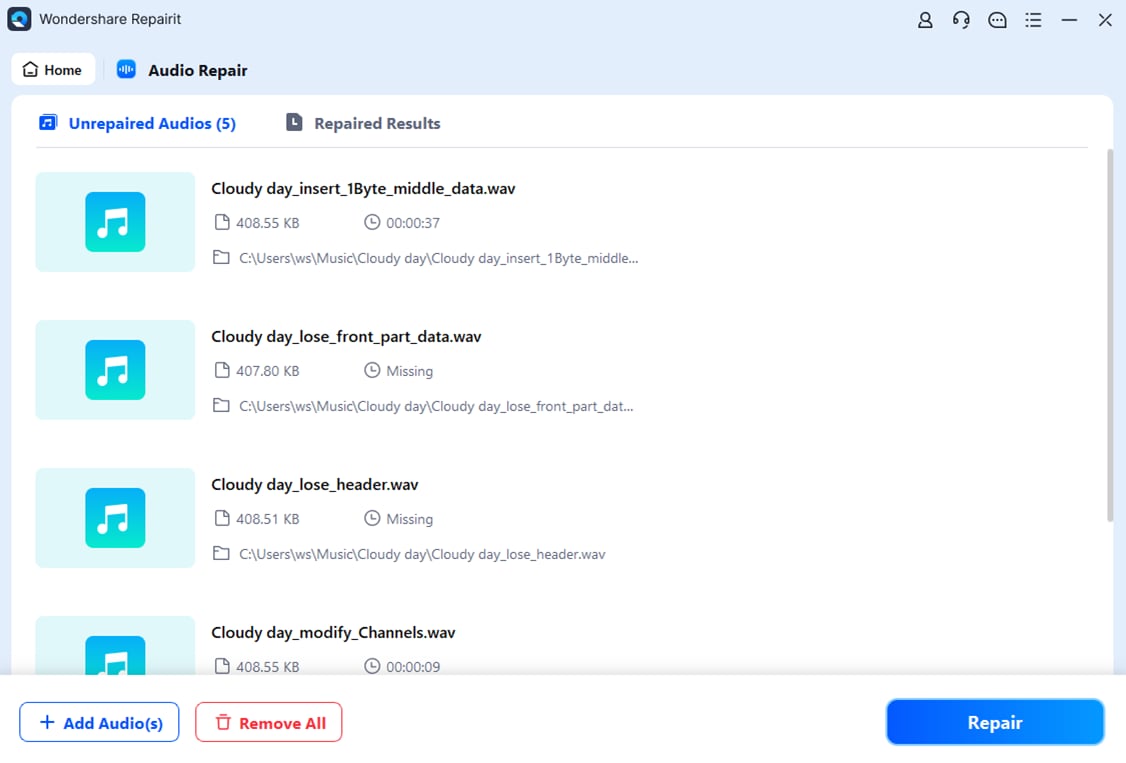
Step 2. Click the repair button to let Repairit Audio Repair automatically analyze and repair the corrupted audio files efficiently.
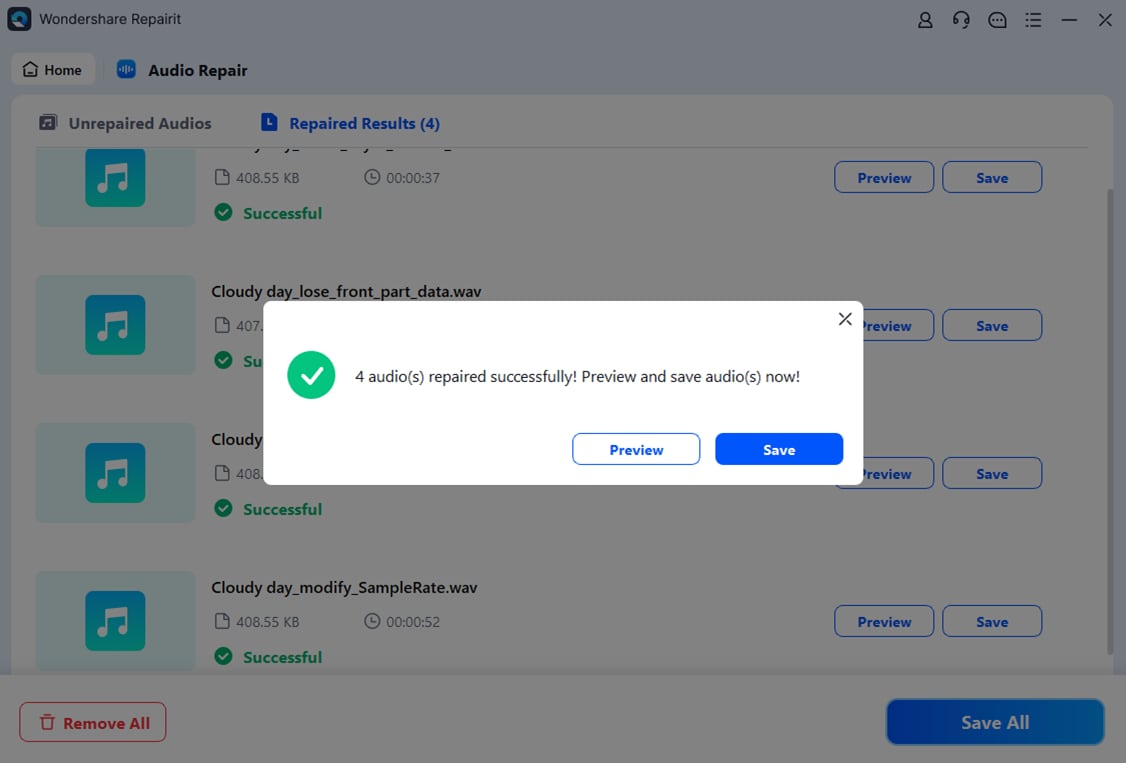
Step 3. Preview the repaired audio results, then save the successfully repaired files to your device.
Final Verdict
Repairit Audio Repair is more suitable when you need to repair corrupted audio files, fix unplayable clips, or restore damaged audio playback with a guided, mostly automated process. This becomes important when a file will not open correctly or sounds severely broken, and manual cleanup in an editor is no longer enough.
Tenacity may be enough if your audio already plays and you mainly want free, open-source tools for basic cleanup, trimming, and manual noise reduction. In many real-world cases, creators use Tenacity for routine editing and turn to Repairit Audio Repair when simple cleanup cannot rescue a damaged recording.
Next: Repairit Audio Repair vs Acon Digital Restoration Suite
FAQ
-
1. Is Tenacity good for repairing corrupted or unplayable audio files?
Tenacity is strong for basic cleanup, editing, and manual noise reduction on audio that already plays, but it has limited advanced repair tools. When a file is severely corrupted or will not play correctly, a dedicated repair tool like Repairit Audio Repair is usually more effective. -
2. What is the difference between audio repair and audio enhancement or cleanup?
Audio repair focuses on fixing fundamental problems with the file or playback, such as corruption, severe distortion, or audio that will not play. Audio enhancement or cleanup, which tools like Tenacity handle well, focuses on improving a playable recording by reducing noise, clicks, hum, or adjusting tone and levels. -
3. Can I use both Repairit Audio Repair and Tenacity in the same workflow?
Yes. In most real-world cases, you can first use Repairit Audio Repair to fix corrupted or unplayable audio and restore stable playback. After that, you can open the repaired file in Tenacity to perform additional manual tasks like trimming, fades, EQ, or more detailed noise reduction. -
4. When should I choose a manual editor like Tenacity instead of Repairit Audio Repair?
Choose Tenacity when your audio files already open and play, and your main tasks are cutting, arranging, basic noise reduction, and level balancing in a free, open-source environment. Choose Repairit Audio Repair when the priority is to repair damaged recordings or fix unplayable audio before any detailed editing.