Repairit Audio Repair and Antares SoundSoap both help users clean up noisy recordings without needing a studio engineer, but they do not approach audio repair in the same way. One leans toward guided file-level audio repair for corrupted or unplayable clips, while the other focuses on fast, manual noise cleanup using sliders and presets. If you often deal with hissy voice notes, hum in podcast episodes, or occasional glitchy files, understanding how these tools differ in repair depth, workflow, and handling of corrupted or unplayable audio will help you choose the right option for your real-world recordings.
Repair Corrupted Audio Files With Repairit Audio Repair
 Security Verified. Over 7,302,189 people have downloaded it.
In this article
- Repairit Audio Repair vs Antares SoundSoap: Quick Verdict
- Repairit Audio Repair vs Antares SoundSoap: Key Differences
- Repairit Audio Repair vs Antares SoundSoap: Comparison Table
- What Repairit Audio Repair and Antares SoundSoap Are Best For
- Repairit Audio Repair vs Antares SoundSoap: Audio Repair Capabilities
- Repairit Audio Repair vs Antares SoundSoap: Supported Audio Formats and Use Cases
- Repairit Audio Repair vs Antares SoundSoap: Workflow and Ease of Use
- Repairit Audio Repair vs Antares SoundSoap: AI Processing and Automation
- Repairit Audio Repair vs Antares SoundSoap: Pricing and Accessibility
- Who Should Choose Repairit Audio Repair
- Who Should Choose Antares SoundSoap
- Pros and Cons of Repairit Audio Repair and Antares SoundSoap
- How to Repair Corrupted Audio Files After Choosing the Right Tool
Repairit Audio Repair vs Antares SoundSoap: Quick Verdict
The main difference is that Repairit Audio Repair is more suitable when you need to repair corrupted or unplayable audio as well as clean up noise, while Antares SoundSoap is mainly aimed at quick noise and hum reduction on files that already play correctly.
In most cases, users who face skipping, glitching, or partially unplayable audio will benefit more from the guided, file-level repair approach in Repairit Audio Repair. Users whose recordings are basically intact, but covered in steady background noise, may find SoundSoap fast and familiar for everyday cleanup.
For someone who regularly receives voice notes from phones, screen recordings, or basic interviews with occasional corruption, Repairit Audio Repair can be a better long-term fit. For users who just want to clean up room tone, AC hum, or light hiss around podcasts and home videos, SoundSoap can be enough.
Repairit Audio Repair vs Antares SoundSoap: Key Differences
The key difference is that Repairit Audio Repair combines guided cleanup with file-level repair workflows, whereas Antares SoundSoap focuses on manual, ear-driven noise reduction using simple controls.
Both tools target non-engineers, but they assume different starting points for your audio:
- Repair depth: Repairit Audio Repair is oriented toward corrupted, glitchy, or partially unplayable audio, not just noisy tracks.
- Cleanup focus: SoundSoap is designed around quick noise, hiss, and hum cleanup for recordings that already play from start to finish.
- Workflow style: Repairit Audio Repair uses a structured, step-based flow, while SoundSoap favors realtime sliders and knobs.
- Automation level: Repairit Audio Repair leans on guided decisions to reduce guesswork; SoundSoap leans on user-controlled presets and manual tweaking.
- Use-case fit: Repairit Audio Repair is practical when you must fix unplayable audio; SoundSoap fits better when you just want to polish otherwise healthy files.
Repairit Audio Repair vs Antares SoundSoap: Comparison Table
This comparison table summarizes how Repairit Audio Repair and Antares SoundSoap differ in everyday audio repair and cleanup scenarios.
| Dimension | Repairit Audio Repair | Antares SoundSoap |
|---|---|---|
| Best for | Users who need guided repair to fix corrupted or unplayable audio and improve noisy clips in one place | Users cleaning noisy recordings quickly with simple controls and light manual tweaking |
| Ease of use | Very beginner friendly with step-by-step, task-based repair flow | Simple sliders and presets; feels like a classic manual noise cleanup tool |
| Repair depth | Better when recordings are damaged, glitchy, or partially unplayable | Suited to surface-level cleanup; limited for severely corrupted audio |
| AI capability | Leans on guided, automated decisions for common repair problems | Primarily manual parameter control and presets, not automation focused |
| Workflow | Upload, analyze, repair, then preview in a structured workflow | Real-time knobs and sliders inside a simple, guided cleanup interface |
| Strengths | Handles both noisy and damaged files, with intuitive repair steps | Fast noise reduction and hum removal for reasonably clean source audio |
| Weaknesses | Less granular than full editing suites for advanced engineers | Struggles with seriously corrupted, clipped, or unplayable files |
What Repairit Audio Repair and Antares SoundSoap Are Best For
Repairit Audio Repair is more suitable when you need a tool that can both repair corrupted audio files and clean up noisy sections, while Antares SoundSoap is best when your goal is straightforward noise reduction on already-playable recordings.
According to the overview, SoundSoap is known as a consumer audio cleanup tool that focuses on simple controls and quick results. It works well on podcasts, talking-head videos, and voice notes that only suffer from hiss, hum, or room tone.
In contrast, Repairit Audio Repair fits users who face messier real-world problems, such as:
- Audio that skips, stutters, or will not play all the way through.
- Files that open but produce harsh artifacts or unstable playback.
- Recordings that are both noisy and structurally damaged.
If your daily work is light cleanup for content that already plays, SoundSoap can be a comfortable option. If you need to restore damaged audio playback and also tidy up noise, Repairit Audio Repair offers a more complete path.
Repairit Audio Repair vs Antares SoundSoap: Audio Repair Capabilities
The main difference in capabilities is that Repairit Audio Repair adds file-level repair pathways for corrupted or unplayable audio, while Antares SoundSoap mainly focuses on denoising and basic enhancement.
From the core features summary, both tools aim to make everyday audio cleanup accessible, but they diverge once a file becomes unstable or corrupted:
- Repairit Audio Repair offers guided modes aimed at restoring damaged audio playback, managing glitches, and keeping the file usable. It combines noise reduction, enhancement, and repair logic in one process.
- Antares SoundSoap focuses on noise, hiss, and hum control with intuitive sliders and listening-based adjustments. It improves sound quality but is not primarily described as a way to fix seriously corrupted or unplayable files.
In most real-world cases, that means:
- If your audio is simply too noisy, with fans, traffic, or electrical buzz, SoundSoap can help you polish it quickly.
- If your audio file refuses to play smoothly, drops out, or feels structurally damaged, Repairit Audio Repair is a stronger choice because it is built around repairing corrupted audio files, not only cleaning surface noise.
Repairit Audio Repair vs Antares SoundSoap: Supported Audio Formats and Use Cases
Both tools typically support common consumer formats like MP3, WAV, M4A, AAC, or FLAC, but Repairit Audio Repair places more emphasis on handling problematic files from a wide range of devices.
In typical workflows, creators and everyday users bring audio from phones, cameras, portable recorders, and screen capture tools. As described, both Repairit Audio Repair and SoundSoap work with these usual formats, which is enough for most podcast, voice-over, and personal recording scenarios.
Where they differ is how they treat those files when something goes wrong:
- Repairit Audio Repair aims to accept a broad range of consumer audio files so it can repair corrupted audio or fix unplayable audio regardless of whether it came from a phone, webcam, or simple handheld recorder.
- Antares SoundSoap is generally used when those same files already open and play reliably, and the main goal is to reduce noise, hiss, or hum rather than fix structural file problems.
This matters if you often receive audio from multiple collaborators or devices and cannot control recording quality. In those cases, having Repairit Audio Repair as a safety net for damaged playback can be more reassuring than relying only on a cleanup tool.
Repairit Audio Repair vs Antares SoundSoap: Workflow and Ease of Use
The key difference in workflow is that Repairit Audio Repair uses a structured, step-based repair flow, whereas Antares SoundSoap relies on simple realtime controls that you adjust by ear.
From the description of workflow and ease of use:
- SoundSoap uses a simple guided interface built around sliders, toggles, and quick previews. You drag a noise reduction slider, toggle hum removal, and listen until it sounds right.
- Repairit Audio Repair takes you through a sequence: add the file, let the tool analyze issues, then apply repair or cleanup based on what it finds.
For beginners with no audio engineering background, this difference changes how it feels to work:
- If you like to tweak manually and trust your ears, SoundSoap gives you immediate feedback through knobs and sliders.
- If you are not sure what to tweak and need guidance, Repairit Audio Repair helps by pointing you toward relevant repair options, especially when the file is distorted, damaged, or partially unplayable.
Users often notice that the structured approach in Repairit Audio Repair reduces trial-and-error when they are under time pressure with a broken clip, while SoundSoap feels quicker when the task is light, repeatable cleanup.
Repairit Audio Repair vs Antares SoundSoap: AI Processing and Automation
Repairit Audio Repair leans more on guided automation to identify problems, while Antares SoundSoap mostly depends on manual settings and presets that you control yourself.
Because this comparison focuses on basic cleanup, automation is mainly about reducing guesswork rather than heavy AI magic. The description notes that:
- Antares SoundSoap relies heavily on user-controlled sliders and presets. You listen, adjust, and stop when the balance between noise reduction and sound quality feels acceptable.
- Repairit Audio Repair analyzes for issues such as glitches, artifacts, or playback problems and suggests suitable repair paths. This guidance helps users who are not sure which parameters to adjust for a specific problem.
In practice, this means beginners can offload more decisions to Repairit Audio Repair when working with unstable or corrupted audio, while more hands-on users may prefer the tactile, manual feel of SoundSoap for steady, predictable noise.
Repairit Audio Repair vs Antares SoundSoap: Pricing and Accessibility
Both tools are typically paid products, but they target slightly different expectations and usage patterns.
The information provided indicates that both are available through paid licenses and that trials or demos can vary by promotion and platform. SoundSoap is positioned as an accessible consumer-level cleanup tool, while Repairit Audio Repair is offered as a focused repair and cleanup product.
For buyers, the main decision factors are:
- Nature of your audio issues: If most of your work is simple cleanup, a consumer cleanup tool may feel sufficient. If you frequently repair corrupted audio files or fix unplayable audio, investing in a repair-focused solution can save more time.
- Frequency of use: Regular podcasters or video creators might rely on SoundSoap for routine denoising, while support teams, educators, or journalists dealing with unpredictable recordings might lean toward Repairit Audio Repair.
- Platform and bundles: Since pricing and bundles can change, users should always check each vendor for current plans, platform support, and any trial options before deciding.
Who Should Choose Repairit Audio Repair
Repairit Audio Repair is more suitable when your main challenge is keeping problematic recordings usable and listenable, not just a bit cleaner.
Based on the provided guidance, you should consider Repairit Audio Repair if:
- You often deal with corrupted or partially unplayable audio files from phones, cameras, or recorders.
- You want a guided workflow that handles both noise cleanup and file-level repair so you do not need to jump between different tools.
- You are a beginner or casual user who prefers clear steps and automatic analysis over detailed parameter tweaking.
- You handle varied real-world recordings with clicks, glitches, distortion, or other artifacts that simple noise reduction cannot fix alone.
In these situations, using Repairit Audio Repair as your main repair environment can help stabilize playback first, then refine overall sound quality without requiring deep audio expertise.
Who Should Choose Antares SoundSoap
Antares SoundSoap may be enough if your recordings already play correctly from start to finish and you mainly want to reduce background noise quickly.
You are more likely to benefit from SoundSoap when:
- You mainly need to reduce background noise, hum, or hiss on otherwise healthy recordings.
- You prefer a simple, hands-on interface with sliders and quick preview rather than choosing among different repair modes.
- You create podcasts, screen recordings, or home videos where the problems are light fan noise, room tone, or basic hiss rather than broken playback.
- You rarely encounter severely corrupted, clipped, or unplayable audio files and do not need deeper file-level repair.
In most real-world content-creation workflows, that makes SoundSoap a convenient option for everyday noise control, while you might keep Repairit Audio Repair in mind for more serious damage or unstable audio.
Pros and Cons of Repairit Audio Repair and Antares SoundSoap
The key difference in pros and cons is that Repairit Audio Repair trades some granular, plugin-style control for more guidance and deeper repair options, while Antares SoundSoap emphasizes direct manual control but offers less help when files are corrupted or unplayable.
Repairit Audio Repair Pros and Cons
Antares SoundSoap Pros and Cons
How to Repair Corrupted Audio Files After Choosing the Right Tool
After comparing Repairit Audio Repair and Antares SoundSoap, the next step is actually repairing the corrupted or noisy audio that caused the search in the first place. If you decide that file-level repair is important for your workflow, using Repairit Audio Repair as a practical, guided option can help you move from a broken or unstable recording to something usable and clearer.
Key Features
The core features of Repairit Audio Repair focus on balancing accessibility with practical repair depth for damaged or noisy recordings.
- Guided repair modes for restoring damaged audio playback and fixing glitchy or unstable files without deep technical knowledge.
- Noise reduction and enhancement options that work alongside file-level repair so you can both fix structural issues and improve clarity.
- Support for common consumer formats, allowing you to fix audio from phones, cameras, screen recorders, and portable devices in one place.
Together, these features make it easier to treat the typical problems that show up in voice notes, interviews, remote meetings, and quick on-location recordings.
Step-by-step guide
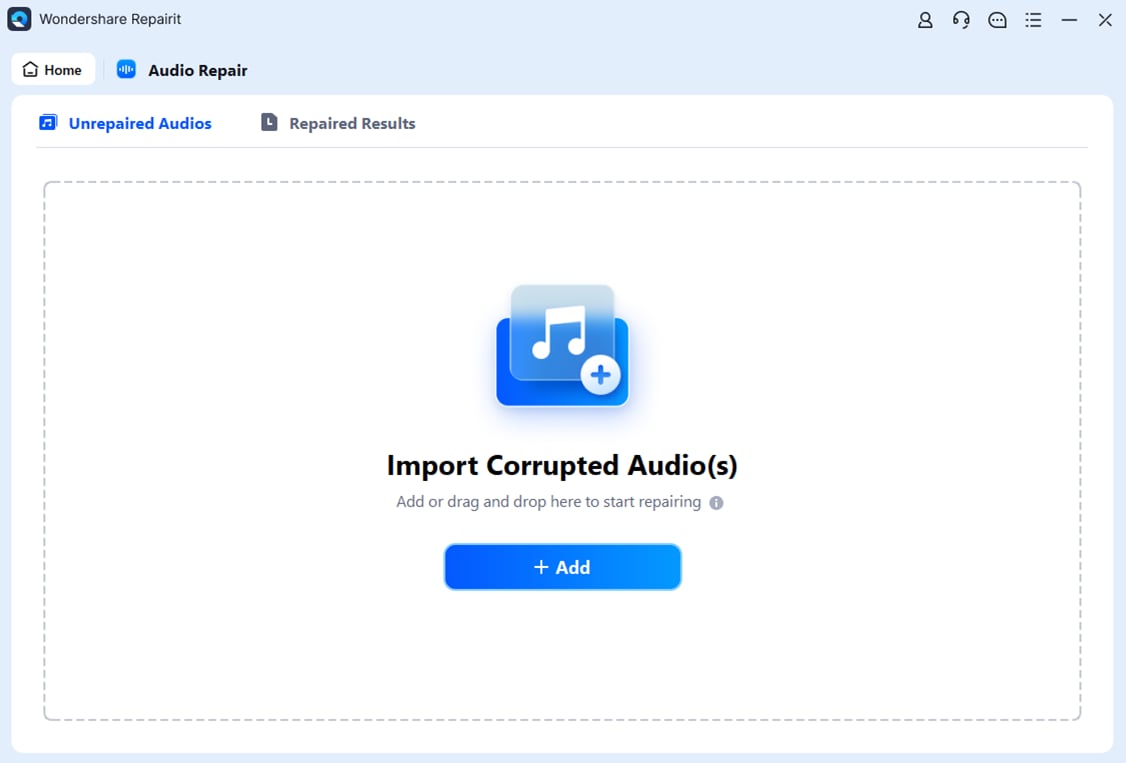
Step 1. Import the damaged audio files you want to fix into Repairit Audio Repair to begin the repair process smoothly.
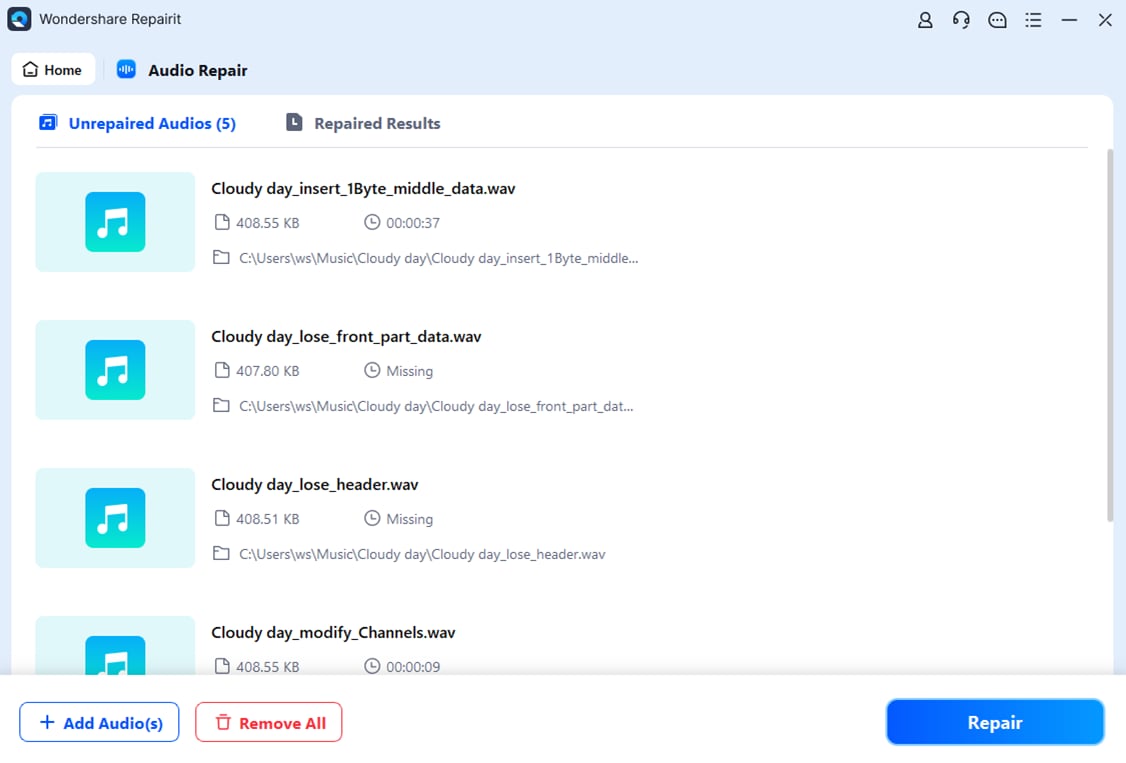
Step 2. Click the repair button to let Repairit Audio Repair automatically analyze and repair the corrupted audio files efficiently.
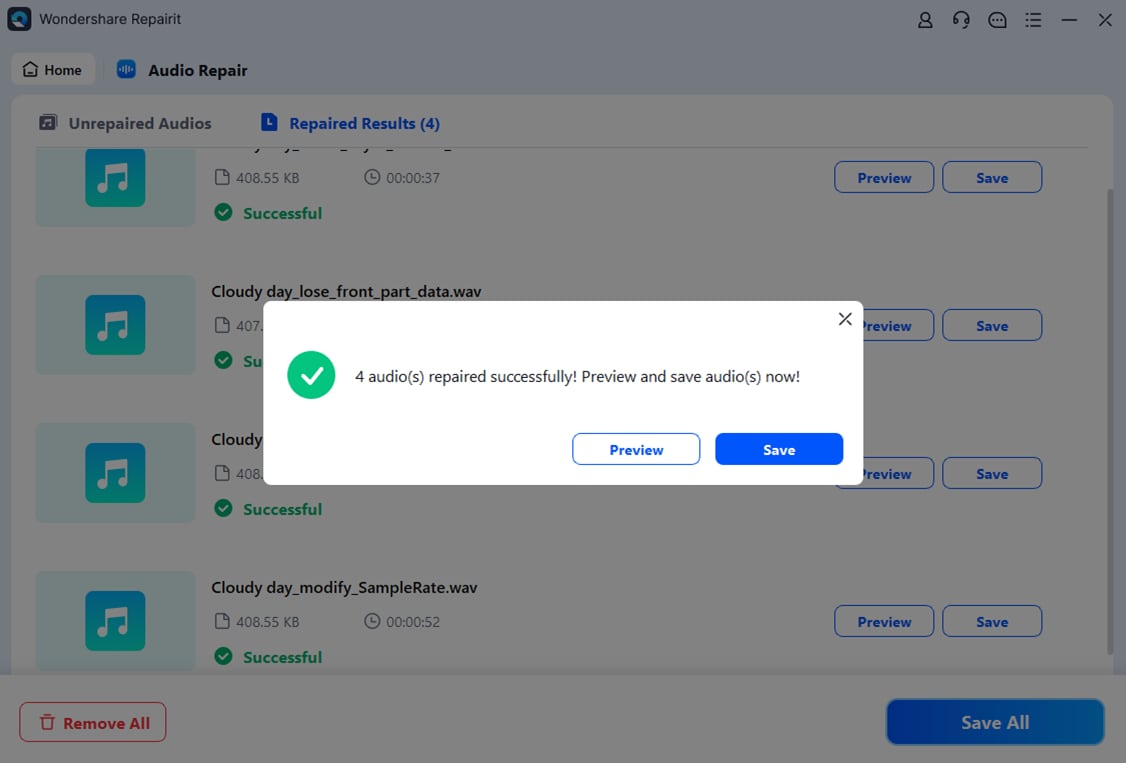
Step 3. Preview the repaired audio results, then save the successfully repaired files to your device.
Final Verdict
Repairit Audio Repair is a stronger choice when you need both straightforward noise cleanup and the ability to repair corrupted audio files, restore damaged audio playback, or deal with clips that refuse to play properly. Its guided workflow is designed for users who want clear steps from problem to result instead of guessing which settings to change.
Antares SoundSoap may be enough if your audio is basically intact and you mainly want to reduce background noise, hum, or hiss quickly using a simple, familiar interface. For light everyday cleanup on podcasts, home videos, and screen recordings, its slider-based approach works well, as long as the underlying file is stable.
In practice, many users benefit from thinking of SoundSoap as a noise cleanup helper and Repairit Audio Repair as a file-level repair and cleanup environment. If you regularly encounter glitchy, skipping, or unplayable audio from everyday devices, leaning on Repairit Audio Repair will usually give you more options to rescue the recording and then polish its sound.
Next: Repairit Audio Repair vs Izotope Rx
FAQ
-
1. Is Repairit Audio Repair better than Antares SoundSoap for all audio problems?
No. Repairit Audio Repair is generally more suitable when you need to repair corrupted audio files, fix unplayable audio, or stabilize glitchy recordings, while Antares SoundSoap is often enough for basic noise, hum, or hiss cleanup on otherwise healthy files. -
2. What is the difference between audio repair and audio cleanup in this comparison?
Audio repair focuses on making corrupted or unplayable recordings usable again by restoring damaged audio playback, whereas audio cleanup improves the quality of files that already play, for example by reducing hiss, hum, or background noise. Antares SoundSoap leans toward cleanup, while Repairit Audio Repair covers both cleanup and file-level repair. -
3. Can either tool fully fix severely distorted or clipped recordings?
In most real-world cases, extremely clipped or heavily distorted audio cannot be fully restored because important parts of the signal are missing. Repairit Audio Repair may reduce artifacts and stabilize playback, and Antares SoundSoap can help soften harsh noise, but both tools face natural limits when the original recording is badly damaged. -
4. Which tool is easier for beginners with no audio background?
Beginners often find Antares SoundSoap simple because its slider-based interface feels familiar, while Repairit Audio Repair feels clear because it uses a step-by-step repair flow. If you mainly remove noise, SoundSoap can be straightforward; if you also need to fix unplayable or corrupted audio, the guided workflow in Repairit Audio Repair usually makes the process easier. -
5. Do I need both Repairit Audio Repair and Antares SoundSoap?
You do not have to use both, but some users keep a cleanup tool and a repair-focused tool in their toolkit. If you frequently face damaged or unplayable files, Repairit Audio Repair may cover most of your needs by handling both repair and cleanup, while users with only light noise issues might rely mainly on Antares SoundSoap.