
When you need to fix corrupted or unplayable audio and also manage complex restoration work, Repairit Audio Repair and iZotope RX solve different parts of the problem. iZotope RX is known for its industry standard spectral editing and detailed restoration tools, while Repairit Audio Repair focuses on guided file-level repair to bring damaged recordings back to a playable state with less setup.
Repair Corrupted Audio Files With Repairit Audio Repair
 Security Verified. Over 7,302,189 people have downloaded it.
In this article
- Repairit Audio Repair vs iZotope RX: Quick Verdict
- Repairit Audio Repair vs iZotope RX: Key Differences
- Repairit Audio Repair vs iZotope RX: Comparison Table
- What Repairit Audio Repair and iZotope RX Are Best For
- Repairit Audio Repair vs iZotope RX: Audio Repair Capabilities
- Repairit Audio Repair vs iZotope RX: Supported Audio Formats and Use Cases
- Repairit Audio Repair vs iZotope RX: Workflow and Ease of Use
- Repairit Audio Repair vs iZotope RX: AI Processing and Automation
- Repairit Audio Repair vs iZotope RX: Pricing and Accessibility
- Who Should Choose Repairit Audio Repair
- Who Should Choose iZotope RX
- Pros and Cons of Repairit Audio Repair and iZotope RX
- How to Repair Corrupted Audio Files After Choosing the Right Tool
Repairit Audio Repair vs iZotope RX: Quick Verdict
The key difference is that Repairit Audio Repair is aimed at quick file-level repair for corrupted or unplayable audio, while iZotope RX focuses on deep spectral repair and detailed restoration workflows.
In most real-world cases, Repairit Audio Repair is more suitable when you simply need a damaged recording to open, play, and sound usable again without learning a complex editor. iZotope RX may be enough if you are working on professional post-production, archival restoration, or broadcast projects where you must surgically remove hum, clicks, and other problems inside spectral views.
Many engineers and creators combine both tools: they first repair corrupted or unplayable files with Repairit Audio Repair, then send the playable audio into iZotope RX for advanced cleanup and polishing when necessary.
Repairit Audio Repair vs iZotope RX: Key Differences
The main difference between the two tools is file-level repair versus detailed spectral editing across modules.
Repairit Audio Repair focuses on:
- Guided repair when audio files refuse to play, glitch heavily, or seem corrupted.
- Automated detection of damaged segments that break normal playback.
- A short file-in, repair, file-out workflow that does not require audio engineering expertise.
iZotope RX focuses on:
- Deep spectral repair of hums, clicks, clipping, ambience, and other detailed issues.
- Module-based workflows where you fine-tune thresholds, bands, and processing amounts.
- Integration into larger post-production sessions, editing chains, and studio environments.
This matters if you are deciding between quickly repairing corrupted audio files or investing time in a full restoration environment. Repairit Audio Repair is a stronger choice for users who mainly care about restoring damaged audio playback, while iZotope RX makes more sense when you routinely perform scene-by-scene or phrase-by-phrase repair and cleanup.
Repairit Audio Repair vs iZotope RX: Comparison Table
The comparison below summarizes how Repairit Audio Repair and iZotope RX differ across common audio repair priorities.
| Dimension | Repairit Audio Repair | iZotope RX |
|---|---|---|
| Best for | Non-technical users who need to repair corrupted or unplayable audio files quickly at the file level. | Professionals handling complex audio damage and restoration inside detailed spectral views. |
| Ease of use | Simpler, guided workflow focused on repairing damaged playback with minimal setup. | Steep learning curve with many modules, options, and advanced controls. |
| Repair depth | Strong at restoring file playability and fixing obvious damage without manual spectral editing. | Deep spectral repair, surgical control over clicks, hums, and complex artifacts. |
| AI capability | AI used to detect and repair corrupted or problematic file segments automatically. | AI-driven modules assist with noise, dialogue, and artifact reduction inside detailed workflows. |
| Workflow | File-in, repair, export process designed for straightforward tasks and batch fixes. | Technical and layered workflow tailored for full post-production and restoration sessions. |
| Strengths | Direct file-level repair, accessible interface, quick results for broken or unplayable audio. | Deep spectral tools, precise manual control, proven in professional post and restoration. |
| Weaknesses | Less suited for frame-by-frame spectral editing and large post-production projects. | Expensive, complex interface, slower to master for occasional or one-off repair tasks. |
What Repairit Audio Repair and iZotope RX Are Best For
Repairit Audio Repair and iZotope RX are best for different but complementary stages of audio repair work.
Repairit Audio Repair is best for:
- Users who receive audio files that will not play, glitch heavily, or show signs of corruption.
- Situations where you want a guided process that can restore damaged audio playback without in-depth parameter tweaking.
- Acting as a first pass to fix corrupted audio files before you send the audio into another editor or post-production environment.
iZotope RX is best for:
- Engineers and editors who regularly handle complex noise, hum, clicks, or ambience problems.
- Projects that require careful spectral repair at specific words, syllables, or events.
- Studios that need flexible module chains for podcast production, film, TV, and archival restoration.
In most real-world cases, your decision comes down to whether you need to fix a file that may be structurally damaged, or refine a file that already plays but needs serious cleanup.
Repairit Audio Repair vs iZotope RX: Audio Repair Capabilities
The key difference in capabilities is that Repairit Audio Repair focuses on file-level audio repair, while iZotope RX emphasizes detailed spectral repair and enhancement.
From a capability standpoint:
- Repairit Audio Repair is oriented around importing corrupted or unplayable audio, analyzing it, and restoring a functional, listenable file. Its goal is to fix damage that interrupts playback or introduces severe glitches.
- iZotope RX is oriented around spectral views where you can see noises, hums, and artifacts, then repair them with dedicated tools. It assumes the file usually opens and plays, and it excels at improving quality and removing unwanted sounds.
In practice, users often notice that Repairit Audio Repair matters when a file will not open or plays with heavy artifacts, while iZotope RX becomes important later when you want to refine dialogue, remove room tone, or correct clicks in a scene.
Core capabilities both tools share include:
- Importing damaged or problematic audio files for repair.
- Exporting repaired audio in commonly used formats once you are satisfied with the results.
- Handling everyday issues like noisy or distorted recordings at a practical level, depending on how much control you need.
Advanced capabilities differ more clearly:
- iZotope RX offers detailed spectral views and region-level repair for complex artifacts, which is useful for post-production, broadcast, and archival work.
- Repairit Audio Repair focuses on AI-guided file-level repair to fix corrupted and unplayable audio, which is useful when you are not able to open or safely play the recording.
- Modular workflows in iZotope RX support chained processes for professional restoration sessions, while Repairit Audio Repair keeps the workflow more direct.
Repairit Audio Repair vs iZotope RX: Supported Audio Formats and Use Cases
Both tools support common audio formats, but they tend to be used at different stages in real-world projects.
According to typical workflows, both Repairit Audio Repair and iZotope RX can work with formats such as MP3, WAV, M4A, AAC, or FLAC in most setups. Users commonly bring in recordings from cameras, smartphones, portable recorders, and DAWs.
In many cases the pattern looks like this:
- You attempt to open a file from a recorder or export, but it will not play correctly or shows obvious corruption.
- You use Repairit Audio Repair to repair corrupted audio files and restore basic playback so the file opens and runs normally.
- Once the audio is stable and playable, you move to iZotope RX if you need deeper spectral repair, such as removing hiss, reducing room noise, or fixing clipped peaks.
This separation helps you avoid throwing heavily corrupted audio straight into a spectral editor, which can be frustrating if the file is not structurally intact.
Repairit Audio Repair vs iZotope RX: Workflow and Ease of Use
The main workflow difference is that Repairit Audio Repair uses a streamlined file-in, file-out process, while iZotope RX uses a technical, module-based workflow built around spectral views.
Repairit Audio Repair offers:
- A simplified interface where you import damaged audio, run repair, preview, and export.
- Minimal parameter tuning, which helps if you do not have audio engineering training.
- A focus on a small number of clear actions that directly address corrupted or unplayable audio.
iZotope RX offers:
- Spectral displays where you visually select and repair noise, interference, or transient problems.
- Multiple modules (for example, denoise, de-click, de-hum, and others) that can be chained into a repeatable workflow.
- Extensive settings and options that reward experienced users but can feel overwhelming for occasional tasks.
This difference in workflow matters if you are choosing a tool for a team: Repairit Audio Repair is easier to hand to non-specialists who only handle repairs occasionally, whereas iZotope RX is better suited to dedicated audio staff who regularly perform detailed restoration.
Repairit Audio Repair vs iZotope RX: AI Processing and Automation
The key difference in AI usage is that Repairit Audio Repair uses AI to automate file-level diagnosis, while iZotope RX uses AI-assisted modules inside detailed spectral workflows.
With a deep_repair focus, iZotope RX relies on advanced modules, some aided by AI, to perform spectral repair, dialogue cleanup, and artifact reduction at a granular level. You typically guide each module by selecting regions and tuning parameters.
Repairit Audio Repair uses AI more as a guide for repairing corrupted sections and fixing unplayable audio across the file. The tool aims to identify where the audio structure is damaged, then repair it without requiring the user to understand spectral details.
In practice:
- Choose Repairit Audio Repair when you want AI to handle diagnosis and structural repair of corrupted audio with minimal input.
- Choose iZotope RX when you want AI to assist a human-driven process, where you still select regions and adjust thresholds for precise control.
Repairit Audio Repair vs iZotope RX: Pricing and Accessibility
The main difference in accessibility is that Repairit Audio Repair tends to be more approachable for occasional users, whereas iZotope RX is positioned as a higher-end professional suite.
iZotope RX is generally offered in several editions, with pricing that reflects its role in professional post-production and restoration. Higher tiers add more specialized modules, which can be valuable for studios but may be more than you need if your only goal is to repair a few corrupted audio files each month.
Repairit Audio Repair is oriented toward users who primarily need to repair corrupted audio files rather than maintain an entire post-production environment. The learning curve is lower, and the time from installation to successful repair is usually shorter for non-technical users.
Because pricing, bundles, and promotions change, it is sensible to check current editions and trial options on both official websites before committing. This lets you test how each tool fits your workflow without relying solely on specifications.
Who Should Choose Repairit Audio Repair
Repairit Audio Repair is more suitable when your priority is getting corrupted or unplayable audio files back into a stable, playable state with minimal setup.
Based on typical use cases, Repairit Audio Repair fits best for:
- Users who mainly need to repair corrupted or unplayable audio files without deep spectral editing.
- Creators who want a straightforward workflow to restore damaged audio playback quickly.
- Teams that occasionally get broken recordings and prefer guided repair over complex setups.
- Anyone who wants simpler file-level repair before optional cleanup or editing in another tool.
If that sounds like your situation, starting with Repairit Audio Repair can cover most day-to-day repair needs, while leaving the door open to integrate other tools later.
Who Should Choose iZotope RX
iZotope RX may be enough if you are working in environments where deep spectral repair and detailed control over artifacts are part of your routine.
It is generally a stronger fit for:
- Post-production professionals who need deep spectral repair and advanced restoration tools.
- Engineers who regularly handle complex noise, clicks, hums, and artifact removal frame by frame.
- Studios that integrate iZotope RX into a broader editing and mixing environment.
- Users prepared for a technical and layered workflow with a steeper learning curve.
For audio cleanup rather than corrupted-file repair, iZotope RX can become the central hub of your workflow, especially if you already work in DAWs and rely on spectral editing tools.
Pros and Cons of Repairit Audio Repair and iZotope RX
The key trade-off is simplicity and file-level repair versus depth and detailed spectral control.
Repairit Audio Repair Pros and Cons
iZotope RX Pros and Cons
How to Repair Corrupted Audio Files After Choosing the Right Tool
After comparing Repairit Audio Repair and iZotope RX, the next step is to actually repair the corrupted audio files that are blocking your project. In most real-world cases, it makes sense to start with a guided file-level repair tool and then move to deeper spectral cleanup only if you still need more control.
When your immediate problem is that an audio file will not open, plays with heavy glitches, or cuts out unexpectedly, using Repairit Audio Repair as the first step can stabilize the file so that any later editing or restoration is more predictable.
Key Features
For file-level repair work, the most relevant features of Repairit Audio Repair include:
- Guided file-level repair to fix corrupted or unplayable audio without detailed spectral editing.
- AI-driven analysis to detect and correct damaged segments that prevent normal playback.
- Straightforward interface suitable for quick repair tasks before further editing elsewhere.
Together, these features help you turn broken or unstable recordings into files you can safely bring into a DAW, editor, or spectral tool like iZotope RX for any additional cleanup.
Step-by-step guide
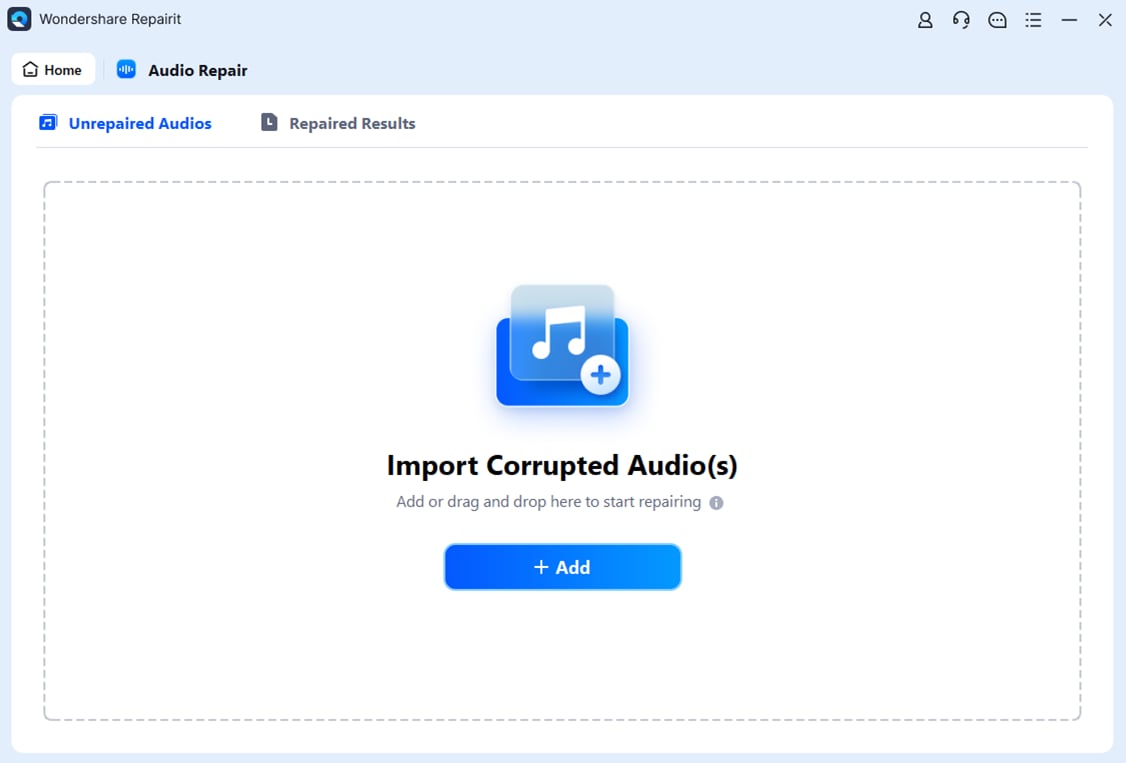
Step 1. Import the damaged audio files you want to fix into Repairit Audio Repair to begin the repair process smoothly.
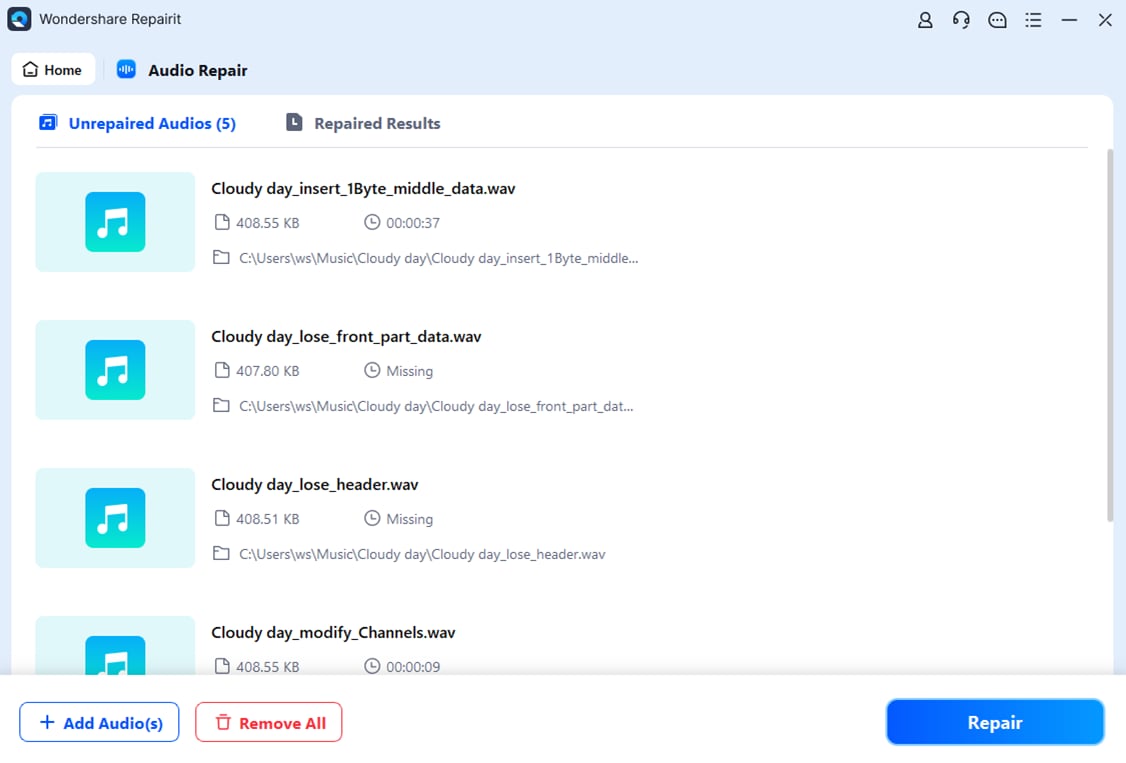
Step 2. Click the repair button to let Repairit Audio Repair automatically analyze and repair the corrupted audio files efficiently.
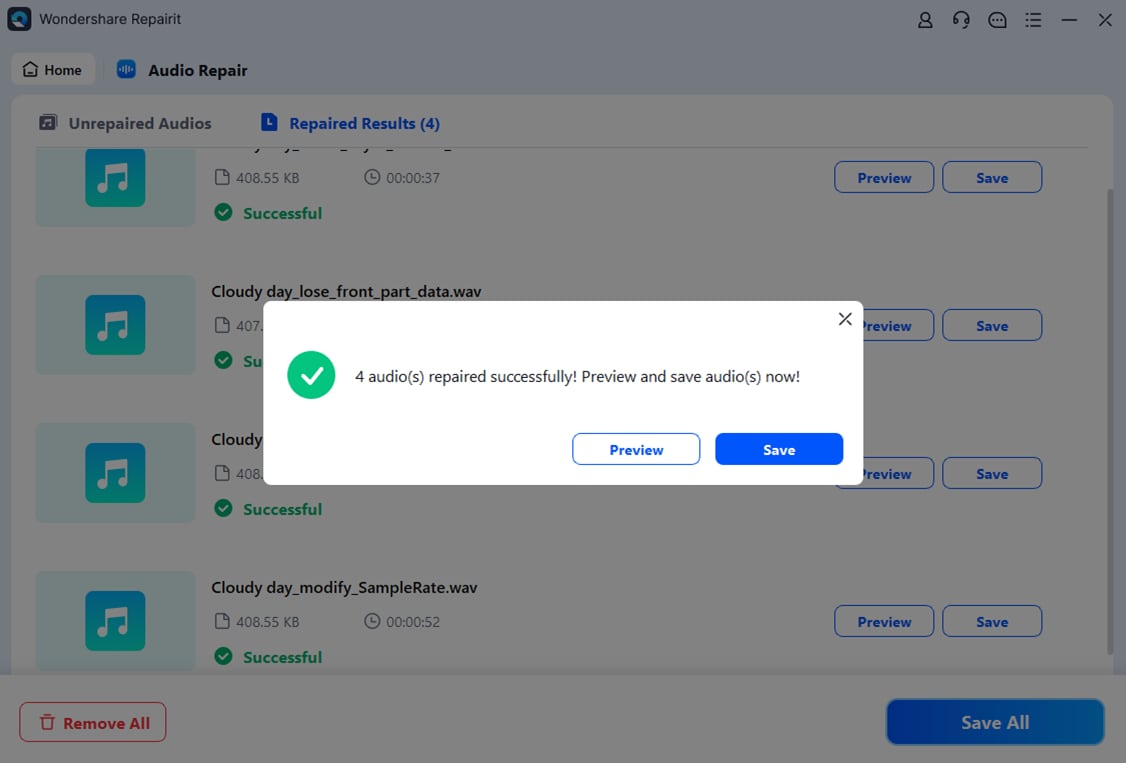
Step 3. Preview the repaired audio results, then save the successfully repaired files to your device.
Once your audio plays correctly, you can decide whether it is ready to deliver as-is or whether it should be passed into a more detailed restoration workflow in iZotope RX for additional noise reduction, de-clicking, or tonal shaping.
Final Verdict
The key difference between Repairit Audio Repair and iZotope RX is depth versus simplicity across your audio repair workflow.
Repairit Audio Repair is more suitable when you primarily need to repair corrupted or unplayable audio files and restore damaged audio playback quickly, without diving into spectral editing or complex module chains. It is well suited as a first step that focuses on file integrity and basic usability.
iZotope RX may be enough if you are working in a professional environment where deep spectral repair, detailed control, and technical, layered workflows are part of your daily routine. It shines once your audio already plays and you need to refine quality with precise, region-level tools.
In most real-world cases, many users benefit from combining both approaches: they stabilize problematic recordings with Repairit Audio Repair, then bring those repaired files into iZotope RX only when a project truly demands advanced restoration and precision.
Next: Repairit Audio Repair vs Adobe Audition
FAQ
-
1. Is Repairit Audio Repair a replacement for iZotope RX?
In most real-world cases, Repairit Audio Repair is not a full replacement for iZotope RX. It is better viewed as a simpler tool focused on file-level repair and restoring damaged audio playback, while iZotope RX remains stronger for deep spectral editing and complex restoration tasks in professional workflows. -
2. When should I use iZotope RX instead of Repairit Audio Repair?
Use iZotope RX when you need precise, module-based control over hum, clicks, plosives, ambience, and other detailed problems, especially in broadcast, film, or archival restoration. Its spectral editing and advanced tools matter if you regularly perform scene-by-scene or phrase-by-phrase repair and cleanup. -
3. What is the difference between audio repair and audio enhancement or cleanup?
Audio repair focuses on making damaged or corrupted recordings playable again and fixing issues that break normal playback or introduce severe artifacts. Audio enhancement or cleanup, such as denoise, de-click, or voice enhancement, assumes the file already plays and aims to improve clarity or reduce distractions. Repairit Audio Repair leans toward file-level repair, while iZotope RX is often used for both repair and advanced cleanup. -
4. Can I use both Repairit Audio Repair and iZotope RX in the same workflow?
Yes, many users first repair corrupted or unplayable audio files with Repairit Audio Repair to restore basic playback, then send the repaired file into iZotope RX for deeper spectral work or final cleanup. This staged approach can save time, since RX then deals with a stable, playable file instead of trying to interpret corrupted audio.