
Repairit Audio Repair and Adobe Audition approach problem audio from different directions, which matters when you are deciding how to repair corrupted or noisy recordings. Repairit Audio Repair focuses on repairing corrupted audio files and fixing unplayable or damaged recordings through a guided workflow, while Adobe Audition is a professional audio editor that blends editing, mixing, and integrated cleanup tools in one environment.
In most real-world cases, Repairit Audio Repair is more suitable when your priority is to restore damaged audio playback and get broken files working again. Adobe Audition may be enough if your audio already opens and plays but needs detailed editing, noise reduction, or multitrack post-production. Understanding these different goals helps you choose the right tool for each project instead of forcing one app to do every job.
Repair Corrupted Audio Files With Repairit Audio Repair
 Security Verified. Over 7,302,189 people have downloaded it.
In this article
- Repairit Audio Repair vs Adobe Audition: Quick Verdict
- Repairit Audio Repair vs Adobe Audition: Key Differences
- Repairit Audio Repair vs Adobe Audition: Comparison Table
- What Repairit Audio Repair and Adobe Audition Are Best For
- Repairit Audio Repair vs Adobe Audition: Audio Repair Capabilities
- Repairit Audio Repair vs Adobe Audition: Supported Audio Formats and Use Cases
- Repairit Audio Repair vs Adobe Audition: Workflow and Ease of Use
- Repairit Audio Repair vs Adobe Audition: AI Processing and Automation
- Repairit Audio Repair vs Adobe Audition: Pricing and Accessibility
- Who Should Choose Repairit Audio Repair
- Who Should Choose Adobe Audition
- Pros and Cons of Repairit Audio Repair and Adobe Audition
- How to Repair Corrupted Audio Files After Choosing the Right Tool
Repairit Audio Repair vs Adobe Audition: Quick Verdict
The main difference in most workflows is that Repairit Audio Repair is built to repair corrupted audio files and fix unplayable or glitchy recordings, while Adobe Audition is designed for editing and post-production where audio already opens correctly. If you are staring at a damaged file that will not play or is full of digital artifacts, Repairit Audio Repair is usually the more suitable starting point.
For users who need to cut, arrange, mix, and enhance multiple tracks in one session, Adobe Audition becomes more attractive. Many editors adopt a hybrid approach: they repair heavily damaged audio in Repairit Audio Repair first, then bring the repaired file into Adobe Audition for cleanup, EQ, dynamics, and integration with video or other audio elements.
Repairit Audio Repair vs Adobe Audition: Key Differences
The key difference between these tools is the focus on file-level repair versus editor-style cleanup and enhancement. Repairit Audio Repair concentrates on repairing corrupted audio structures, restoring damaged audio playback, and fixing unplayable recordings with a guided workflow. Adobe Audition focuses more on waveform and multitrack editing, with repair tools positioned as part of a broader production environment.
This matters if you regularly receive recordings from phones, cameras, or screen captures that arrive broken. In those situations, you often need specialized repair first, before any EQ or compression. When your audio already plays but sounds noisy or unbalanced, Adobe Audition offers more manual tools to refine sound quality inside a detailed mix.
Repairit Audio Repair vs Adobe Audition: Comparison Table
This side-by-side table highlights how Repairit Audio Repair and Adobe Audition differ in focus, workflow, and how they handle corrupted or noisy audio.
| Dimension | Repairit Audio Repair | Adobe Audition |
|---|---|---|
| Best for | Users who need to repair corrupted audio files and fix unplayable or damaged recordings quickly with a guided process. | Creators and editors needing both detailed audio editing and integrated cleanup in one professional tool. |
| Ease of use | Simpler, task-focused interface that guides users through repairing damaged or unplayable audio. | Moderate learning curve with many editing and mixing options that can feel complex for pure repair tasks. |
| Repair depth | Focused on file-level repair to restore damaged audio playback and fix corrupted audio issues. | Strong noise reduction and cleanup tools, but less specialized for fixing severely corrupted audio files. |
| AI capability | Guided, automated repair decisions aimed at restoring corrupted or distorted audio with minimal manual tweaking. | More manual, editor-style control with some assisted cleanup features rather than fully guided repair. |
| Workflow | Single-purpose, step based workflow centered on importing, repairing, and exporting repaired audio. | Editor-style workflow designed for editing, arranging, and mixing, with repair as part of a larger session. |
| Strengths | Straightforward way to repair damaged files and fix unplayable audio without deep editing knowledge. | Balanced feature set with strong editing, good noise reduction, and tight integration with the Adobe ecosystem. |
| Weaknesses | Less suitable when you need full multitrack editing, sound design, or complex mixing. | Less specialized than dedicated repair tools for restoring corrupted files or heavily damaged recordings. |
What Repairit Audio Repair and Adobe Audition Are Best For
Repairit Audio Repair is more suitable when your primary goal is to repair corrupted audio files that fail to play or contain severe glitches, while Adobe Audition is better aligned with editing sessions where you also need arrangement, mixing, and detailed processing. Thinking about where your audio breaks helps you pick the right entry point.
In most real-world cases, Repairit Audio Repair fits scenarios like damaged call recordings, glitched phone audio, or exported files that refuse to open properly. Adobe Audition fits workflows where you are producing podcasts, voiceovers, or video soundtracks and want to combine light repair with EQ, compression, fades, and multitrack layering in one timeline.
Repairit Audio Repair vs Adobe Audition: Audio Repair Capabilities
The main difference in audio repair capabilities is that Repairit Audio Repair is centered on file-level repair, while Adobe Audition emphasizes cleanup and enhancement of already playable audio. This distinction becomes important when your file is corrupted at the structural level rather than just noisy.
Repairit Audio Repair is designed to repair corrupted audio files, fix unplayable or partially broken recordings, and restore damaged audio playback so the file can be opened and heard again. It leans on a guided process that reduces the number of technical choices you have to make. Adobe Audition, by contrast, gives you tools such as spectral editing, denoise, de-click, and other restoration effects that work best when the file already plays but needs quality improvements.
In practice, users often notice that severe glitches or files that refuse to load respond better to a dedicated repair workflow. Once the file is playable, Adobe Audition can be used for further denoise, de-hum, or mixing steps as part of a broader production chain.
Repairit Audio Repair vs Adobe Audition: Supported Audio Formats and Use Cases
Both Repairit Audio Repair and Adobe Audition work with widely used formats such as MP3, WAV, M4A, AAC, or FLAC in most real-world cases, which makes them practical for typical recording setups. This matters if you receive audio from phones, cameras, handheld recorders, or conferencing platforms that all output slightly different formats.
Repairit Audio Repair focuses on getting damaged files in these formats playable again, tackling situations where the file may refuse to open, cut out unexpectedly, or output broken sound. Adobe Audition is more about what happens after the file is already usable, letting you trim, crossfade, batch process, and integrate audio into larger projects such as podcasts or video edits.
Repairit Audio Repair vs Adobe Audition: Workflow and Ease of Use
The key difference in workflow is that Repairit Audio Repair offers a focused, step based process, while Adobe Audition uses a full editor-style timeline that can feel heavier for quick fixes. Choosing between them depends on whether you value speed and guidance or detailed control.
Repairit Audio Repair typically follows a simple pattern: add corrupted audio, start the repair, then Preview and save. The interface is centered on this specific job, which helps non-engineers get results without learning a full DAW-style layout. Adobe Audition, on the other hand, presents waveform and multitrack views, routing, effects chains, and other production tools that require more familiarity.
Users often notice that quick repairs and problem-file triage feel faster in Repairit Audio Repair, especially when they only need to restore damaged playback. When they move into complex productions with multiple tracks, sound design layers, and mix revisions, Adobe Audition offers more flexibility at the cost of a steeper learning curve.
Repairit Audio Repair vs Adobe Audition: AI Processing and Automation
The main difference in automation is that Repairit Audio Repair leans more toward guided, semi-automated repair, while Adobe Audition leans toward manual editing with some assisted cleanup features. This determines how many technical decisions you need to make while fixing audio.
With its hybrid_edit_repair focus, Repairit Audio Repair aims to repair corrupted audio files and fix distorted or noisy audio with minimal tweaking, presenting an accessible path for users who are not audio engineers. The tool suggests and applies repair actions so you spend more time checking results and less time tuning parameters.
Adobe Audition typically expects you to choose effects, adjust denoise thresholds, and manage processing chains inside the editor. That can be useful if you are experienced and want detailed control, but it may slow down users who just want a damaged file to work again. In many workflows, a practical combination is to let Repairit Audio Repair handle the heavy lifting on corrupted files and then fine-tune with Adobe Audition only when needed.
Repairit Audio Repair vs Adobe Audition: Pricing and Accessibility
Repairit Audio Repair and Adobe Audition differ in how you typically access and pay for them, which influences which tool makes sense for occasional repair versus ongoing production work. Adobe Audition is usually tied to a subscription model, while Repairit Audio Repair is positioned as a focused product for audio repair tasks.
For users already invested in an Adobe workflow, having Adobe Audition available within a broader Creative Cloud plan may feel natural, especially when audio editing is part of daily work. For users who mainly need to repair corrupted audio files a few times per month or as part of client troubleshooting, a specialized tool like Repairit Audio Repair can be a more targeted investment.
In most real-world cases, editors compare overall cost against how often they need deep multitrack editing versus targeted file-level repair. Trying available trials from both tools before committing makes it easier to confirm which one fits your actual projects rather than just theoretical needs.
Who Should Choose Repairit Audio Repair
Repairit Audio Repair is more suitable when your main pain point is corrupted or unplayable audio rather than everyday editing and mixing. It is designed as a focused step for restoring damaged files so you can move on with your project in any editor you like.
- Users who need to repair corrupted audio files and restore damaged audio playback without learning a full editor.
- People facing unplayable, glitchy, or heavily distorted recordings from devices, calls, or live events.
- Creators who already edit elsewhere but need a dedicated tool to fix problematic or corrupted audio files before editing.
- Anyone prioritizing a guided, step based repair workflow over deep multitrack editing and mixing controls.
If that describes your situation, adding Repairit Audio Repair to your toolkit can streamline the early troubleshooting phase of your audio workflow.
Who Should Choose Adobe Audition
Adobe Audition may be enough if your audio already opens correctly and your primary tasks are editing, arranging, and enhancing rather than repairing corrupted files. It is oriented toward users who live in a multitrack environment and want repair tools embedded within that context.
- Editors who need detailed waveform and multitrack editing with integrated noise reduction and cleanup.
- Content creators producing podcasts, videos, or broadcasts inside the wider Adobe ecosystem.
- Users who want to combine repair-style cleanup, enhancement, and creative processing in one professional environment.
- Audio professionals comfortable with moderate workflow complexity and manual control over restoration effects.
For these scenarios, Adobe Audition can act as the central hub, with dedicated tools like Repairit Audio Repair brought in only when a file is too corrupted to open or play correctly inside the editor.
Pros and Cons of Repairit Audio Repair and Adobe Audition
Looking at pros and cons side by side helps clarify when Repairit Audio Repair or Adobe Audition is the stronger choice for your specific audio repair tasks.
Repairit Audio Repair Pros and Cons
Adobe Audition Pros and Cons
How to Repair Corrupted Audio Files After Choosing the Right Tool
After comparing Repairit Audio Repair and Adobe Audition, the next step is to actually repair the corrupted audio file that is holding up your project. In many workflows, users start with a dedicated repair pass to restore basic playback and then move into an editor for any extra cleanup or creative work.
When your file is distorted, unplayable, or fails to open in an editor, a guided repair tool such as Repairit Audio Repair can be a practical first stop. Once the file is usable again, you can decide whether you need further editing in Adobe Audition or are ready to publish immediately.
Key Features
The key strength of Repairit Audio Repair is its focus on corrupted or broken audio rather than general mixing or sound design. Its core capabilities are tailored to users who simply need their recordings to play reliably again.
- Targeted repair of corrupted audio files that fail to play correctly or contain glitches.
- Guided workflow that helps non-technical users fix distorted or noisy audio with minimal setup.
- Designed to output repaired audio that can be taken into editors like Adobe Audition for further work.
Step-by-step guide
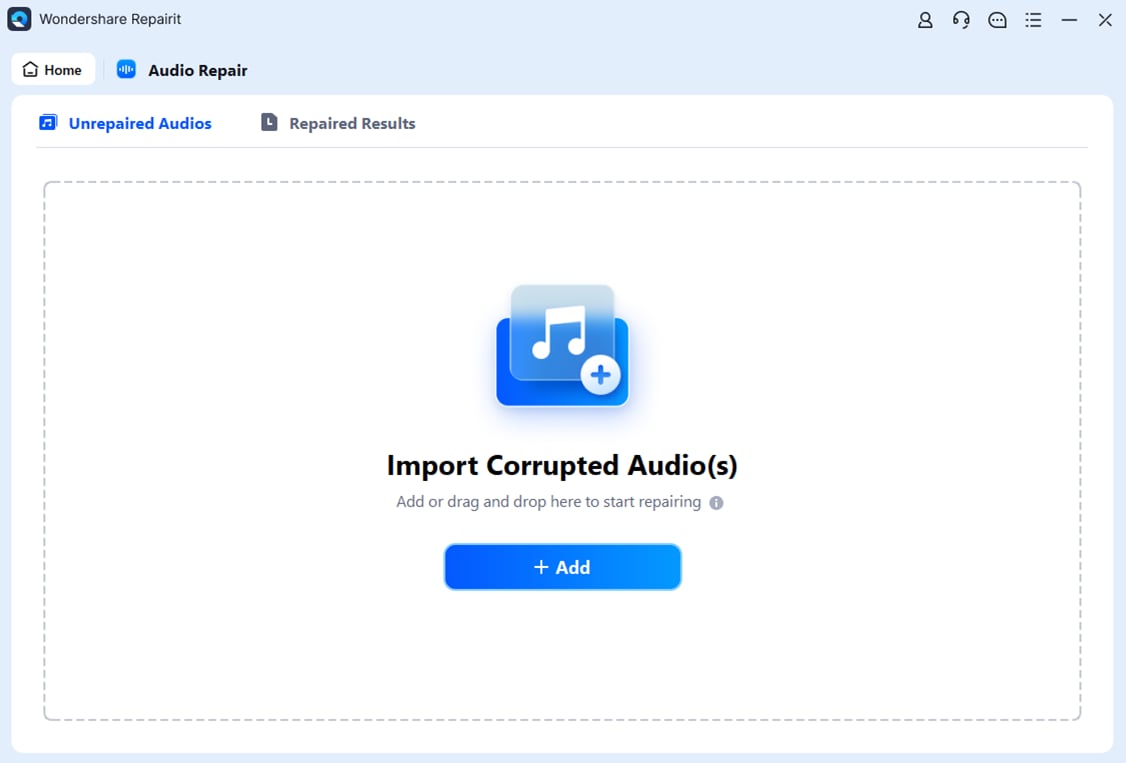
Step 1. Import the damaged audio files you want to fix into Repairit Audio Repair to begin the repair process smoothly.
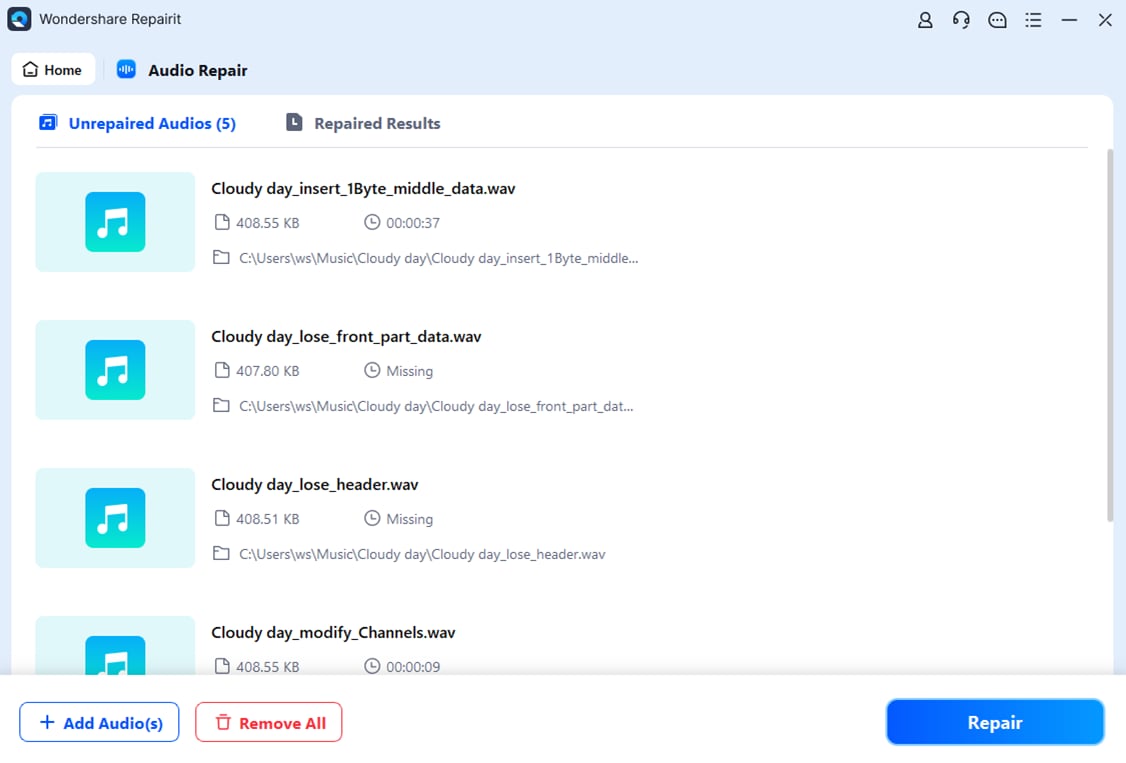
Step 2. Click the repair button to let Repairit Audio Repair automatically analyze and repair the corrupted audio files efficiently.
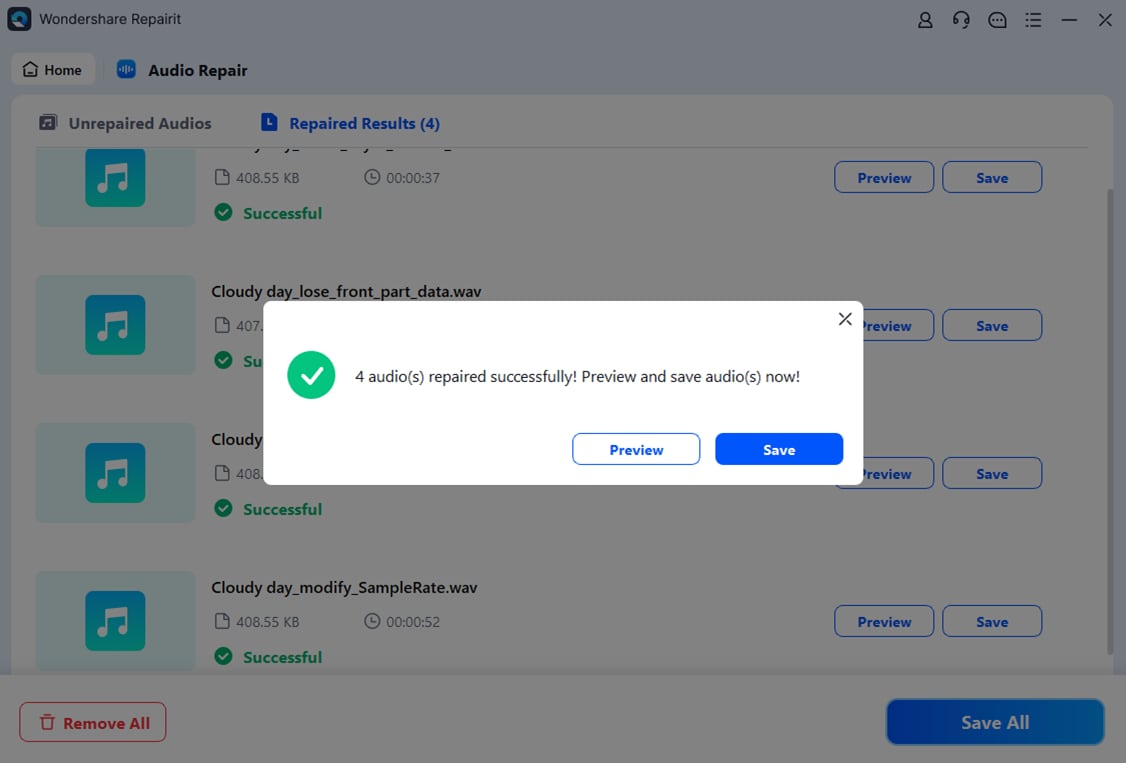
Step 3. Preview the repaired audio results, then save the successfully repaired files to your device.
Final Verdict
The core difference between Repairit Audio Repair and Adobe Audition is intent: Repairit Audio Repair is geared toward repairing corrupted audio files and fixing unplayable or glitchy recordings, while Adobe Audition is a production editor for projects where audio already loads and needs detailed editing, cleanup, and mixing. Neither tool replaces the other; they address different stages of the audio pipeline.
Repairit Audio Repair is a stronger choice for users who frequently receive damaged files from phones, meetings, or exports and need a straightforward way to restore playback. Adobe Audition may be enough if your workflow is centered on podcasting, video post, or music editing where noise reduction and enhancement happen after the file is already stable. In many real-world cases, the most reliable path is to repair severe damage with Repairit Audio Repair first, then perform any remaining cleanup or creative processing in Adobe Audition.
Next: Repairit Audio Repair vs Steinberg Spectralayers
FAQ
-
1. Is Repairit Audio Repair a replacement for Adobe Audition?
No. Repairit Audio Repair focuses on repairing corrupted audio files and fixing unplayable or damaged recordings, while Adobe Audition is a full audio editor with multitrack, effects, and detailed cleanup tools. In most workflows, users treat Repairit Audio Repair as a dedicated repair step before doing editing and mixing in Adobe Audition. -
2. When should I use Adobe Audition instead of Repairit Audio Repair?
You should use Adobe Audition when your files open and play correctly but need editing, arranging, mixing, or detailed noise reduction. It is better suited for podcasts, video post-production, and complex sessions where audio repair is only one part of a broader workflow. -
3. What is the difference between audio repair and audio enhancement or cleanup?
Audio repair focuses on fixing corrupted audio files, repairing damaged playback, and making unplayable or glitchy files usable again. Audio enhancement or cleanup focuses on improving quality in files that already play, using tools such as denoise, de-click, de-hum, and voice enhancement. Repairit Audio Repair emphasizes file-level repair, while Adobe Audition provides many enhancement and cleanup options within an editor. -
4. Can I use Repairit Audio Repair and Adobe Audition together in one workflow?
Yes. A common workflow is to first use Repairit Audio Repair to fix unplayable or damaged recordings and export a repaired file, then bring that file into Adobe Audition for further editing, detailed noise reduction, mixing, and integration with video or other tracks.