

An I-Frame is a term you will see in camera settings, NLE export dialogs, streaming encoders, and codec documentation for formats like H.264 and H.265. It describes how video is stored and transmitted, and it heavily influences editing accuracy, streaming stability, and how easily damaged footage can be repaired or recovered.
Repair Corrupted Files To Save Your Data
 Security Verified. Over 7,302,189 people have downloaded it.
In this article
What Is I-Frame?
An I-Frame, short for intra frame, is a type of video frame that is encoded as a complete, standalone image. It belongs to the "frame type" category inside modern codecs such as H.264 and H.265, alongside P-Frames and B-Frames. In a compressed sequence, the I-Frame works as a reference point: other frames can be reconstructed by describing only the changes from this self-contained picture. Because of this, I-Frames are crucial for accurate seeking, editing, and error recovery during recording, editing, exporting, streaming, and playback.
Why Is I-Frame Important in Video Compression?
I-Frames and compression efficiency
The main problem modern video compression solves is how to keep image quality acceptable while dramatically reducing file size and bitrate. A raw video stream stores every frame as a full image, which is huge. By using an I-Frame followed by more efficient predicted frames, the encoder avoids re-storing identical information over and over.
In simple terms, the encoder creates I-Frames as strong "anchor" images, then uses P-Frames and B-Frames to capture only motion and small differences between frames. This structure:
- Reduces file size and bandwidth compared to storing full images for every frame.
- Improves bitrate efficiency because detailed reference data is reused for many following frames.
- Helps handle motion smoothly when combined with motion estimation in P/B-Frames.
Benefits and limitations of I-Frames
I-Frames strongly influence image quality, editing friendliness, and playback behavior.
| Benefits of I-Frames | Limitations of I-Frames |
|---|---|
| Provide clean reference points that keep long scenes visually consistent. | Larger than P-Frames or B-Frames, increasing bitrate when used too often. |
| Enable accurate seeking and scrubbing; players jump to the nearest keyframe (I-Frame). | More frequent I-Frames can reduce overall compression efficiency and shorten recording times at fixed bitrates. |
| Make frame-accurate editing, trimming, and smart-render exports more reliable. | If an I-Frame is damaged, many dependent frames can also appear corrupted. |
From a creator's point of view, I-Frames help:
- Streaming platforms recover faster after network hiccups.
- NLEs like Premiere Pro or DaVinci Resolve perform smoother timeline scrubbing.
- Hardware recorders and cameras provide more robust footage for post-production.
However, overly long gaps between I-Frames can cause blurry playback after errors, slow seeking, and more visible glitches when corruption occurs. On the other hand, extremely short I-Frame intervals increase file size and may hurt visual quality at a fixed bitrate because bits are "wasted" on too many full frames.
How Does I-Frame Work in the Encoding Workflow?
I-Frames inside the GOP structure
Most modern codecs organize frames into a GOP structure (Group of Pictures). An I-Frame usually appears at the start of each GOP, followed by predicted frames (P and B):
I B B P B B P B B I ...
Within the encoding workflow, the role of the I-Frame is to:
- Provide a full reference picture without relying on any other frame in the GOP.
- Serve as the starting point for motion prediction in P-Frames and B-Frames.
- Act as a recovery point when decoders encounter errors or packet loss.
The encoder decides when to insert an I-Frame based on your settings and scene content. There are two common strategies:
- Fixed interval (keyframe every X frames or seconds): Ensures consistent seek points and predictable behavior for streaming.
- Scene-change detection: Forces a new I-Frame when the scene changes dramatically to avoid wasting bits predicting from an unrelated image.
Where you control I-Frames in real tools
You will see I-Frame controls in many encoding and streaming tools:
- FFmpeg: Options like
-g(GOP length),-keyint_min, or codec-specific settings define keyframe / I-Frame spacing. - x264/x265: Parameters such as
keyintandmin-keyintadjust how often I-Frames are inserted, and scene-cut detection can automatically add them at transitions. - OBS Studio: The "Keyframe Interval" field defines how often I-Frames are generated for live streams, which is critical for platforms like YouTube or Twitch.
- HandBrake: GOP length and scene-change options control the placement of I-Frames during exports for playback on TVs, mobile devices, or social media.
- Adobe Premiere Pro / Media Encoder: Under advanced H.264 or HEVC settings, the "Key Frame Distance" or "I-Frame interval" options determine how dense these reference frames are.
- Camera and hardware encoder menus: Some DSLRs, mirrorless cameras, and dedicated recorders expose "All-Intra" vs "Long-GOP" modes, directly changing how I-Frames are used.
All-Intra (all I-Frames) recording makes every frame independent, which is ideal for heavy editing and precise color grading but generates very large files. Long-GOP compresses more aggressively by spacing I-Frames farther apart and relying on prediction between them, which is better for streaming and long-form recording where storage and bandwidth are limited.
When Should You Care About I-Frame? Common Mistakes and Quick Tips
Understanding I-Frames is especially important for video editors, colorists, VFX artists, streaming creators, and anyone configuring delivery formats across different platforms.
When it really matters:
- When you need smooth scrubbing and frame-accurate editing in NLEs.
- When live-streaming to platforms that require specific keyframe intervals (for example, 2 seconds).
- When exporting masters for broadcast or heavy post-production workflows.
- When troubleshooting glitches, freezes, or macroblocking that repeat until the next I-Frame.
When it matters less:
- For quick social clips where minor seek delays are acceptable.
- For casual viewing where you are not doing frame-accurate edits later.
Common misunderstandings about I-Frames:
- "More I-Frames always mean better quality." In reality, quality depends on total bitrate and encoder settings; too many I-Frames can waste bits and reduce average quality.
- "Glitches on one frame are isolated." If an I-Frame is corrupted, it can affect many P/B-Frames that depend on it, causing long visual artifacts.
- "Keyframes equal every edit point." Your NLE can decode in-between frames, but edit and render efficiency are much better when cuts line up with I-Frames.
Quick practical tips:
- For streaming, follow the platform guidelines, often 2 seconds (e.g., 60 fps with keyframe interval of 120).
- For editing-heavy projects, use higher I-Frame density or All-Intra recording if storage allows.
- If you see glitches repeating in a pattern, suspect a damaged I-Frame and consider repairing or re-encoding the file.
- When exporting long-form content, test short segments with different keyframe intervals before committing to a full render.
The key takeaway: think of I-Frames as structural pillars. Placed wisely, they keep your videos easier to edit, more resilient to errors, and smoother to stream.
How to Use Repairit to Fix a Corrupted Video File
Repairit introduction
When a damaged I-Frame, broken header, or corrupted GOP structure makes your video unplayable, manual repair is rarely practical. Wondershare Repairit is a dedicated media repair solution that focuses exactly on these problems, rebuilding video structures so you can recover footage from cameras, phones, drones, action cams, and more. You can learn about all features and download it safely from the Repairit official website for both Windows and macOS.
Key features of Repairit
- Repairs multiple corrupted video formats from various devices in one go.
- Offers both quick and advanced repair modes to handle mild glitches and severe structural damage.
- Lets you preview repaired videos before saving, so you only keep results that actually play correctly.
Step-by-step guide to repair videos
- Add corrupted video files
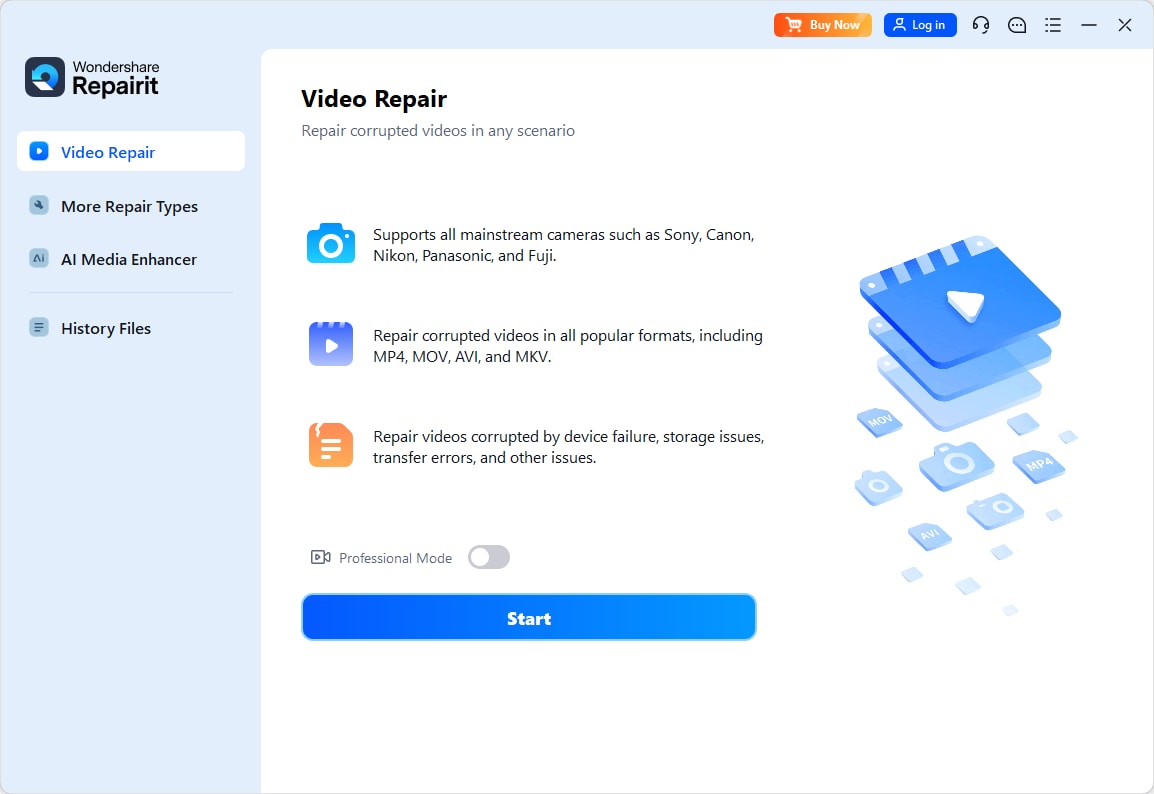
Install and open Wondershare Repairit on your computer, then go to the Video Repair module. Click the "Add" or "+" button to browse your folders and select the broken clips that show black screens, stuttering playback, or persistent glitches around I-Frames. Confirm to load them into the repair list so Repairit can analyze each file.
- Repair video files
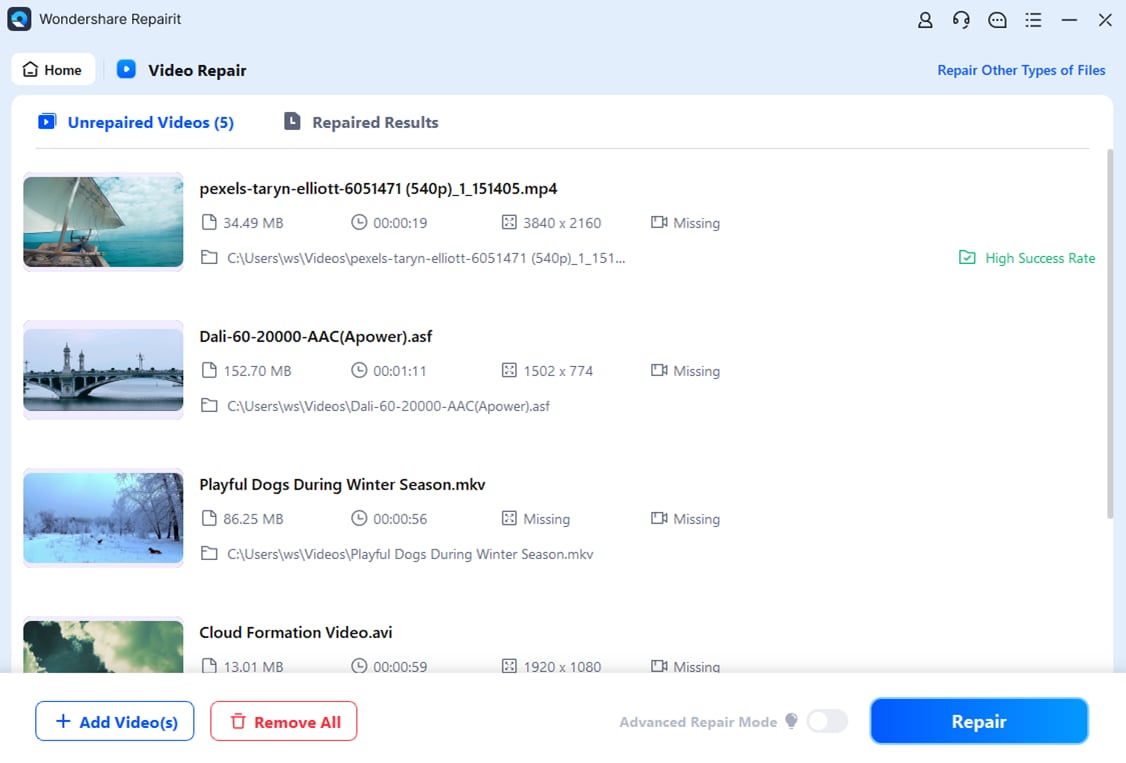
After your videos are listed, check the ones you want to fix and click the "Repair" button. Repairit will scan the internal structure, rebuild damaged headers, and attempt to fix broken GOP structure elements such as missing or corrupted I-Frames. If standard repair cannot fully restore a clip, switch to Advanced Repair and provide a working sample file from the same device or format so the engine can better reconstruct the encoding pattern.
- Save the repaired video files
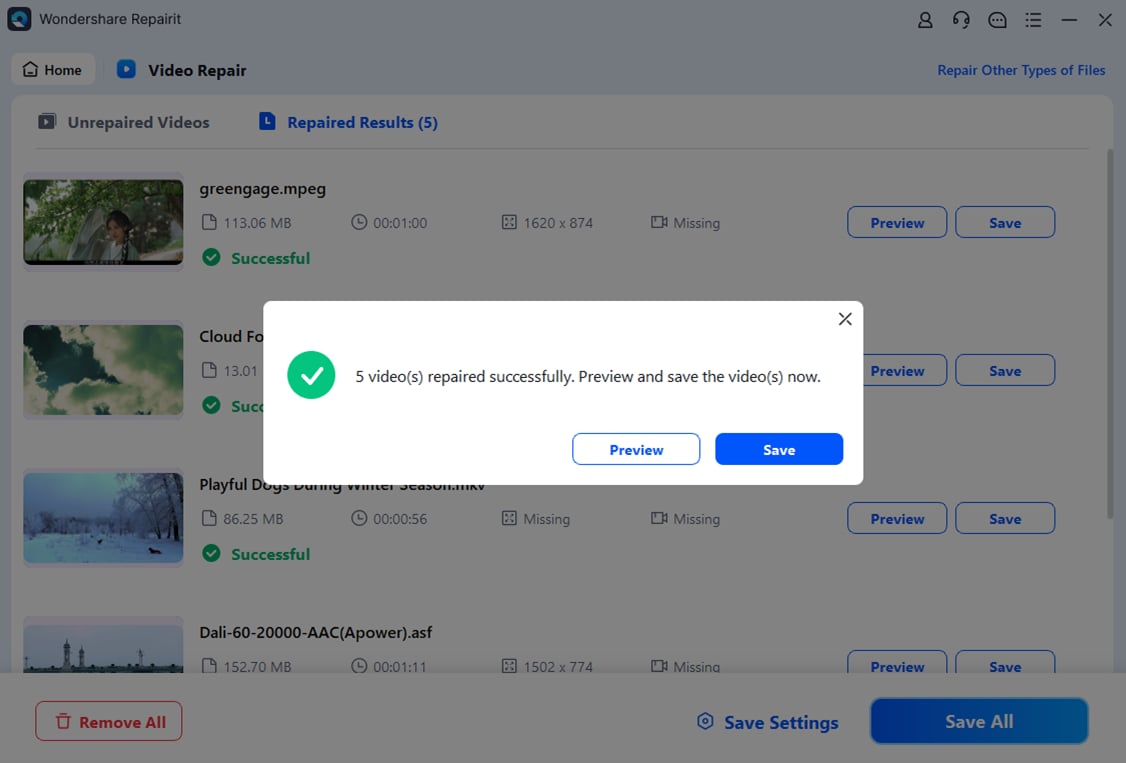
When the repair finishes, use the built-in player to preview each recovered video. Check that the image is stable, audio is in sync, and playback no longer breaks at keyframe positions. If you are satisfied, click "Save" and choose a secure destination folder or drive. Saving to a different disk than your source is a good habit to avoid overwriting original files, especially when you might want to attempt additional recovery later.
Conclusion
I-Frames are the anchor points of modern video compression, acting as complete images that other frames depend on. Their spacing and quality directly affect file size, visual clarity, seeking responsiveness, and how stable your videos feel across editing apps, streaming platforms, and playback devices.
By understanding how I-Frames fit into the GOP structure, how they differ from P-Frames and B-Frames, and how encoders let you control keyframe intervals, you can make smarter choices for recording, exporting, and live streaming. And when corruption or damaged I-Frames ruin your footage, a specialized repair tool like Wondershare Repairit can help you restore videos that would otherwise be lost.
Next: P-Frame
FAQ
-
1. What is an I-Frame in simple terms?
An I-Frame is a single video frame stored as a complete image, similar to a JPEG photo. It does not rely on any other frame to be decoded and often serves as a reference for surrounding frames in compressed video. -
2. How is an I-Frame different from a P-Frame or B-Frame?
An I-Frame contains full image data. P-Frames store only the changes from previous frames, and B-Frames store changes using both past and future frames. This makes P/B-Frames smaller but dependent on nearby frames, while I-Frames stand alone. -
3. Does increasing I-Frame frequency always improve quality?
No. More frequent I-Frames improve seeking and error recovery but consume more bitrate. At a fixed bitrate, adding too many keyframes can actually reduce average image quality because fewer bits remain for the rest of the frames. -
4. Why do glitches often repeat until the next I-Frame?
If the reference I-Frame is corrupted, all dependent P/B-Frames may inherit that damage. The visible distortion can persist until the decoder reaches a clean I-Frame that resets the reference image, clearing the artifacts. -
5. Can I repair corrupted I-Frames in a damaged video?
Manual repair of broken I-Frames is complex because it involves low-level codec structures. Tools like Wondershare Repairit are built to scan, rebuild headers, and reconstruct damaged GOPs, increasing the chance of recovering playable video from corrupted files.




