
You will often see the term cavlc in camera specs, streaming settings, and H.264 export options in NLEs or encoders. It is one of the building blocks that decides how efficiently your video is packed into bits, which affects file size, streaming smoothness, and quality. Understanding h.264 cavlc helps creators, editors, and streamers make smarter choices when recording, encoding, and troubleshooting playback or corruption issues in compressed video.
Repair Corrupted Files To Save Your Data
 Security Verified. Over 7,302,189 people have downloaded it.
In this article
What Is CAVLC?
cavlc stands for Context Adaptive Variable Length Coding. It is an entropy coding method used inside the H.264/AVC video compression standard to represent transformed coefficients (the numbers that describe image details) as compactly as possible. In simple terms, it is a way of turning those numbers into short bit patterns so the encoder can store or transmit them efficiently.
In the larger family of video concepts, video compression uses entropy coders like cavlc to shrink data after prediction and transform stages. CAVLC belongs to the category of entropy coding methods, alongside CABAC. Its basic role is to encode the remaining detail information of each block so that H.264 files stay small enough for recording, editing, exporting, streaming, and playback across many platforms and devices.
Why Is CAVLC Important in Video Compression?
CAVLC exists to solve one main problem: how to represent video data in fewer bits without losing extra quality. After prediction and transform, many of the coefficients in a block are zero, and some values appear much more often than others. CAVLC exploits this pattern by assigning shorter bit codes to frequent values and longer codes to rare ones, and by adapting to the local context in the block.
This has several practical effects on your compressed video:
- Bitrate efficiency and file size: By using shorter codes for common patterns, CAVLC reduces the average number of bits per block. That means smaller H.264 files at a given quality, which is crucial for cameras with limited storage, cloud uploads, and long recordings.
- Streaming performance: Smaller bitrate makes it easier to stream at lower bandwidths and helps avoid buffering, especially for mobile viewers or unstable connections.
- Decoding complexity and device support: CAVLC is simpler to implement and decode than CABAC. That is why many low-power chips, action cameras, older phones, and entry-level encoders support CAVLC-based profiles more widely.
- Editing friendliness: A bitstream using CAVLC can be easier for some basic tools to parse, which helps when quickly scrubbing, previewing, or generating proxies, especially on less powerful systems.
Key benefits of CAVLC
- Lower computational cost: Compared with CABAC, CAVLC requires fewer operations, which reduces CPU load and power consumption during both encoding and decoding.
- Good trade-off between compression and complexity: It offers decent compression without needing the heavy processing that more advanced coders demand.
- Broad compatibility: Many cameras, capture cards, hardware encoders, and playback chips are designed with CAVLC in mind, ensuring that compressed video plays smoothly on a wide range of devices.
Main limitations of CAVLC
- Less efficient than CABAC: For the same visual quality, CAVLC generally needs a slightly higher bitrate than CABAC. Over long projects or large libraries, that adds up to more storage and bandwidth usage.
- Limited room for optimization: Because it is simpler and less flexible, there is less tuning potential for squeezing out maximal efficiency in very constrained workflows like high-quality streaming at very low bitrates.
- Still sensitive to corruption: While its structure is simpler, video compression streams that use CAVLC can still break if bits are damaged during transfer or recording, leading to playback glitches or unopenable files.
How Does CAVLC Work in the Encoding Workflow?
In a typical H.264 pipeline, CAVLC appears near the end of the encoding chain. It does not decide how the picture looks; instead, it decides how the final numbers are written into the bitstream.
Where CAVLC fits in H.264 encoding
Here is a simplified view of how CAVLC fits in with the other stages:
- 1. Capture and color processing: The camera or software captures raw frames and may convert color formats (like RGB to YUV) and subsample chroma.
- 2. Motion estimation and prediction: The encoder predicts each block from previous or future frames (inter-prediction) or from nearby pixels in the same frame (intra-prediction) to avoid sending full pictures every time.
- 3. Transform and quantization: The difference between the actual block and its prediction is transformed (similar to a DCT) into frequency coefficients and then quantized, which throws away some detail to save bits.
- 4. Coefficient scanning and run-length representation: These quantized coefficients are reordered so zeros tend to cluster, making runs of zeros easier to encode efficiently.
- 5. CAVLC entropy coding: Now cavlc takes over. It:
- Counts non-zero coefficients and encodes that count.
- Encodes the position of trailing 1s and their signs.
- Uses predefined variable length code tables that adapt based on recently encoded blocks (context), so frequent patterns get shorter codes.
- Writes all this into the bitstream in a compact, lossless way.
- 6. Bitstream assembly and muxing: The CAVLC-coded coefficients are combined with motion vectors, headers, timing info, and audio to form the final H.264 container or transport stream.
On playback, the decoder reverses this process: it reads CAVLC-coded bits, restores the coefficients, inverts the transform, adds prediction, and reconstructs frames for display. If the CAVLC data is damaged, artifacts, stuttering, or decoder errors may appear.
CAVLC in common tools and workflows
You may not always see the word CAVLC directly in your tools, but it is often implied by profile or encoder choices:
- FFmpeg and x264: When you choose Baseline or some Main-profile presets for H.264, FFmpeg/x264 may use h.264 cavlc entropy coding rather than CABAC, depending on flags and profile constraints. Hardware-compatibility presets often favor CAVLC.
- OBS and live streaming encoders: Some hardware encoders used by OBS, capture cards, or dedicated streaming devices may rely on CAVLC for lower latency and simpler decoding on older set-top boxes or mobile devices.
- Editing and export in NLEs: In Adobe Premiere Pro, Media Encoder, or similar tools, profile settings like "H.264 Baseline" or device-targeted presets (e.g., older mobile or legacy web formats) often correspond to CAVLC usage under the hood.
- Cameras and recorders: Budget cameras, webcams, drones, and action cams sometimes use CAVLC-based profiles so the on-board processor can encode in real time without overheating or draining the battery too quickly.
Knowing that your workflow relies on CAVLC helps explain why files might be slightly larger than CABAC encodes, but more widely compatible and easier to decode in low-power environments.
When Should You Care About CAVLC? Common Mistakes and Quick Tips
Not everyone needs to tweak cavlc vs cabac settings, but certain users benefit from understanding the trade-offs.
Who should care the most?
- Live streamers balancing latency, CPU load, and viewer compatibility.
- Editors and colorists working with long-form content on constrained drives or older workstations.
- Technical directors who manage broadcast pipelines, OTT platforms, or multi-device delivery.
- Camera operators or drone pilots who often record long flights or events and need reliable, efficient storage.
When it matters:
- When you target older phones, legacy set-top boxes, or embedded players that only support Baseline/Main H.264 profiles using CAVLC.
- When CPU or power is limited (laptops on battery, small streaming PCs, hardware encoders) and you need a lighter entropy coder.
- When troubleshooting playback or corruption issues in video encoding pipelines that rely on H.264 Baseline streams.
When it does not matter much:
- If you are exporting for modern platforms (YouTube, Vimeo, social apps) that re-encode uploads anyway.
- If your primary targets are recent phones, PCs, and TVs that support both CAVLC and CABAC.
- If storage and bandwidth are plentiful and you are not chasing tight bitrate targets.
Common misunderstandings:
- "CAVLC automatically gives better quality." – It does not. Quality mainly depends on bitrate, resolution, and encoder settings. CAVLC just affects how efficiently those bits are organized.
- "CABAC is always better, so CAVLC is outdated." – CABAC is more efficient but heavier on CPU and not always supported in low-end or legacy devices; CAVLC still has a place where simplicity and compatibility matter.
- "Entropy coding type explains all artifacts." – Blockiness, banding, and smearing usually come from low bitrate or aggressive quantization, not from CAVLC itself.
Quick practical tips:
- If maximum compatibility is your goal (old devices, browsers, or low-power decoders), favor presets that imply CAVLC-based H.264 Baseline or Main profile.
- If you control both encoding and playback and want smaller files at the same quality, consider CABAC-capable profiles instead, assuming your hardware can handle it.
- Always keep backup copies of important recordings, because both CAVLC and CABAC streams can get corrupted by bad cards, interrupted transfers, or disk errors.
- When a CAVLC-based file becomes unplayable, avoid re-encoding it immediately; try dedicated repair tools first to salvage as much original data as possible.
Takeaway: CAVLC is mostly a behind-the-scenes setting, but knowing what it does helps you choose the right H.264 profile for your camera, exports, and streaming targets, and it guides you when diagnosing playback or corruption problems.
How to Use Repairit to Fix a Corrupted Video File
Why use Repairit for corrupted H.264 CAVLC video
When compressed video that uses CAVLC gets corrupted, media players may fail to open it, show green frames, lose audio, or freeze mid-playback. Wondershare Repairit is designed specifically to deal with such structural problems in media files. It analyzes headers, container metadata, and stream data from cameras, phones, drones, and recorders, then reconstructs playable video whenever possible. You can get the latest desktop and online versions from the Repairit official website.
Key features of Wondershare Repairit
- Repairs multiple corrupted videos from various formats and devices in one go.
- Supports advanced repair using a sample file from the same device or codec.
- Offers an intuitive, step-by-step interface suitable for both beginners and experts.
Step-by-step: repair damaged CAVLC-encoded videos
- Add corrupted video files
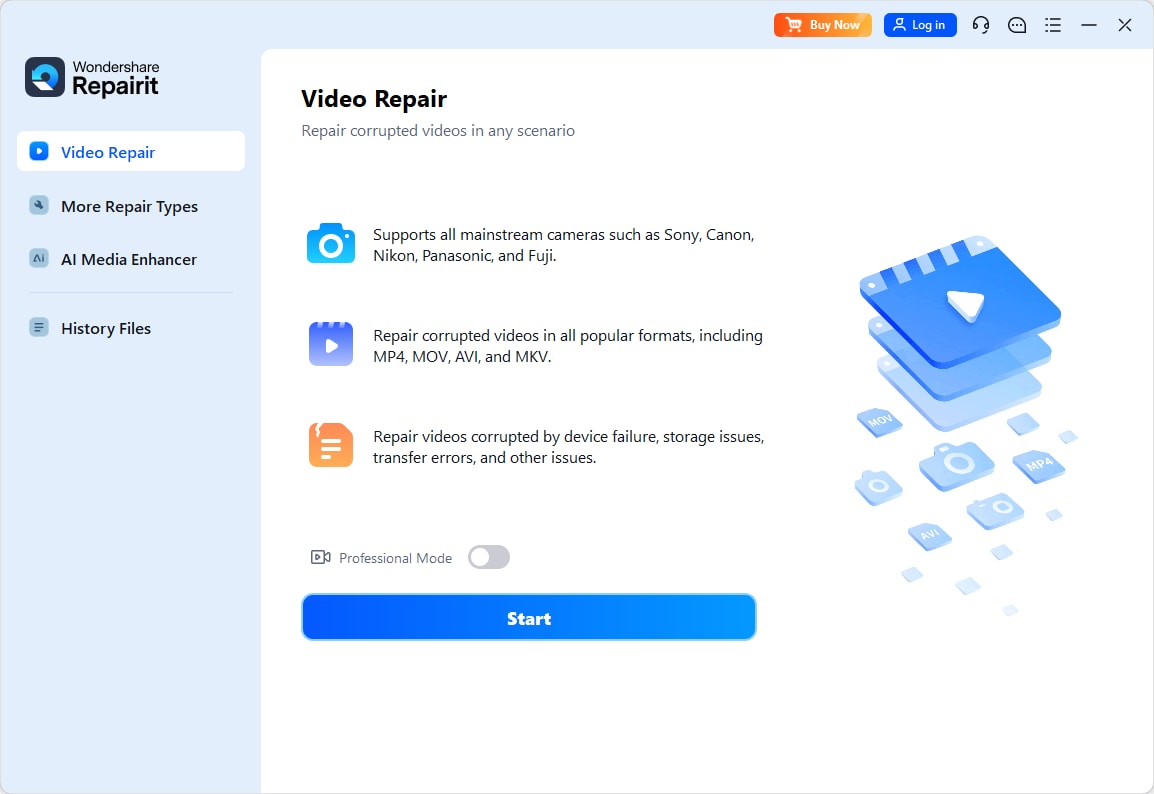
Install and launch Wondershare Repairit on your computer, then switch to the Video Repair module. Click the option to add files and browse to the location where your damaged H.264 CAVLC clips are stored, such as an SD card backup, external drive, or local folder. Select one or several problematic videos and confirm to load them into the repair list so Repairit can scan them.
- Repair video files
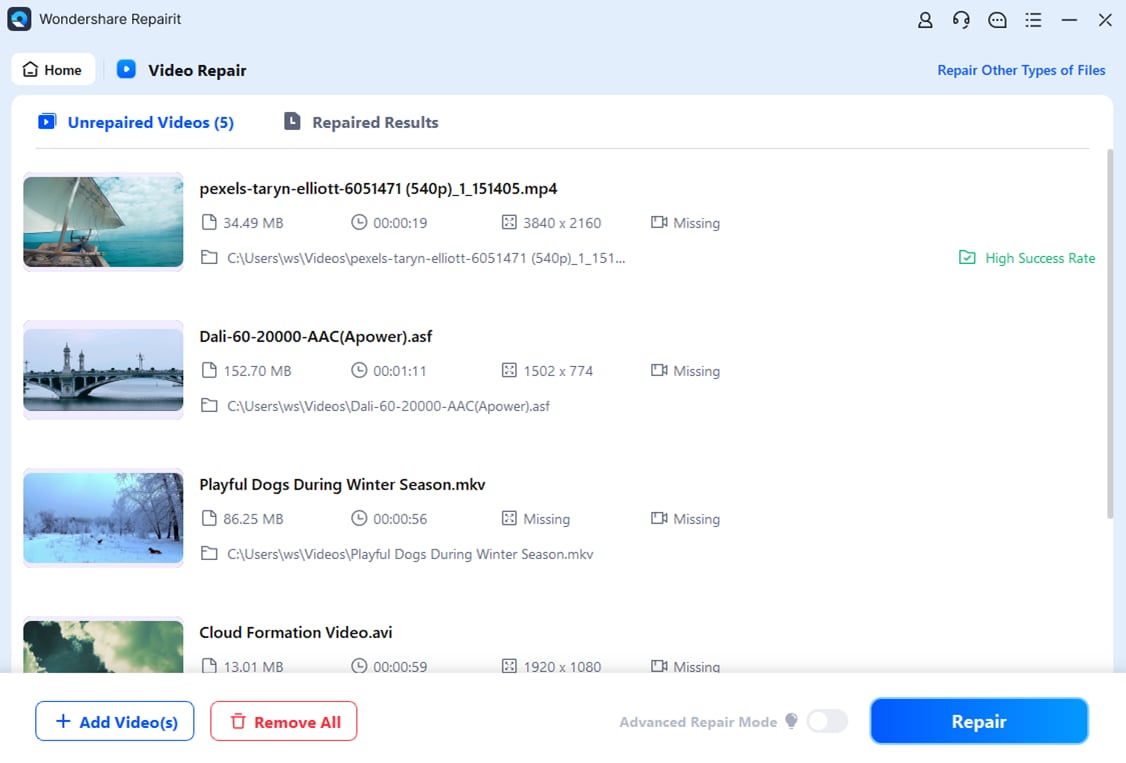
After the clips appear in the list with their basic information, check that all the videos you want to fix are selected. Click the Repair button to start the automatic process. Repairit will examine the containers, headers, and video compression streams, then attempt to reconstruct a correct structure around the CAVLC-encoded data. When the repair finishes, use the built-in preview to quickly play the results and verify image, motion, and audio.
- Save the repaired video files
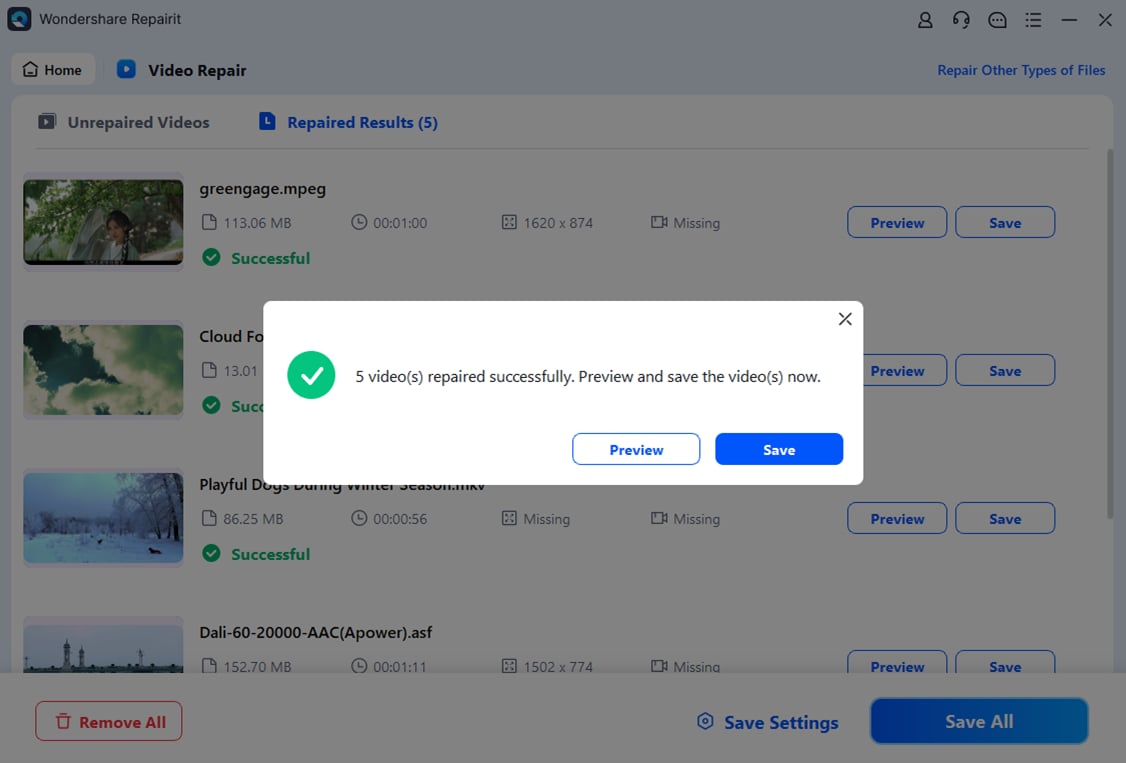
If the preview looks good, select the clips you want to keep and click Save. Choose a safe output folder different from the original source path (for example, a folder on another drive) to avoid overwriting partially damaged data. Repairit will export new, playable copies of your repaired videos that you can edit, re-encode, stream, or archive without the corruption issues that affected the original files.
Conclusion
CAVLC is a context-adaptive variable length entropy coder used inside H.264. It compresses block coefficients efficiently, helping you record, edit, export, stream, and play video with reasonable file sizes and good compatibility, especially on low-power or older hardware. While it is less efficient than CABAC, its simplicity and broad support keep it relevant in many real-world workflows.
However, even well-encoded CAVLC streams can become corrupted through bad media, interrupted transfers, or storage failures. Instead of giving up on damaged footage or re-encoding broken files, you can use Wondershare Repairit to repair corrupted headers and streams and restore playback. That way, you preserve your original encoding and protect valuable content with minimal extra effort.
Next: Transform Block
FAQ
-
1. Is CAVLC the same as H.264?
No. H.264 (also called AVC) is a complete video compression standard that defines many tools, including prediction, transform, and entropy coding. cavlc is only one of its entropy coding options used to compress transform coefficients inside certain H.264 profiles. -
2. How is CAVLC different from CABAC?
CAVLC uses variable length codes with relatively simple context adaptation, which makes it easier and lighter to implement in hardware and software. CABAC is more complex and computationally intensive but usually achieves better compression, meaning smaller files at the same quality level. The choice affects bitrate efficiency and CPU load, not the basic look of the picture. -
3. Does CAVLC directly affect video quality?
Not directly. Quality mostly depends on bitrate, resolution, frame rate, and encoder settings. CAVLC determines how efficiently the remaining data is written into bits. At a fixed bitrate, CABAC might keep slightly more detail than CAVLC, but both are lossless coding stages working on already-quantized data. -
4. Why do some devices still use CAVLC instead of CABAC?
Many low-power or cost-sensitive devices prefer CAVLC because it is cheaper to implement and easier to decode without overheating or draining the battery. This includes some cameras, IoT devices, embedded players, and older mobile hardware, where simplicity and reliability outweigh small gains in compression efficiency. -
5. Can CAVLC-encoded videos be repaired if they are corrupted?
Yes. If the damage is not too severe, tools like Wondershare Repairit can often reconstruct broken headers and stream structures so CAVLC-based H.264 videos become playable again. This is especially helpful when footage from cameras, drones, or recorders turns unplayable after card errors, crashes, or interrupted transfers.