
Low-latency HLS (LL-HLS) is a modern twist on Apple’s HTTP Live Streaming that brings live video much closer to real time. You will see it mentioned in camera apps, live production switchers, encoding software, streaming CDNs, OTT platforms, and even in player settings on the web or smart TVs. Understanding LL-HLS helps you capture, encode, and deliver fast, responsive live streams for sports, gaming, auctions, or any show where delays frustrate viewers.
Repair Corrupted Files To Save Your Data
 Security Verified. Over 7,302,189 people have downloaded it.
In this article
What Is Low-Latency HLS (LL-HLS)?
Low-latency HLS (often written as LL-HLS) is an extension of Apple HLS designed to cut the delay between what a camera records and what appears on a viewer’s screen. Traditional Apple HLS typically uses segment durations of 4–10 seconds and waits for full segments to be available before they are listed in the playlist, which leads to 20–45 seconds of delay.
LL-HLS keeps the same fundamental HLS structure (playlists, segments, HTTP delivery) but introduces several changes:
- Shorter media segments (often 2 seconds or less).
- Partial segments (also called chunks), which are fractions of a segment that can be delivered as soon as they are encoded.
- More frequent playlist updates so players can request newer content quickly.
- Optional HTTP/2 or HTTP/3 features like server push and blocking reloads for even faster refresh.
From a recording and editing perspective, LL-HLS does not change how you shoot or edit the master content. The impact is mostly in the encoding, packaging, and playback stages where the video is split into smaller pieces and delivered in a more granular way. For exporting and streaming, your encoder or packager adds LL-HLS tags (such as EXT-X-PART) to playlists so compatible players can fetch these partial segments and play them almost in real time.
How Does Low-Latency HLS (LL-HLS) Work in the Real Workflow?
In practice, LL-HLS shows up as a set of options or presets in your encoder, packager, and player configuration. It sits between your camera or screen capture on one side and viewers’ devices on the other, handling how your encoded video is chopped up, stored on a CDN, and requested by apps and browsers.
Capture, contribution, and encoding
The first part of the workflow looks similar to any live or near-real-time production:
- Capture and recording: Cameras, mobile phones, webcams, or screen-capture tools record the video. For live shows, this feed is sent directly to an encoder; for VOD previews or highlights, the footage may be edited first in tools like Adobe Premiere Pro or Final Cut Pro.
- Contribution to the encoder: The signal is sent to an on-prem or cloud encoder using RTMP, SRT, or another ingest protocol. At this point, the stream is still a continuous video signal, not yet HLS.
- Encoding settings tuned for low latency: The encoder creates ABR (adaptive bitrate) renditions and compresses the video using H.264 or HEVC. To support live streaming latency goals of a few seconds, operators typically configure:
- Short GOPs (e.g., 1–2 seconds).
- Low buffer sizes and low-latency tuning in the encoder.
- Segment durations of 2 seconds or less.
- LL-HLS packaging: The packager (built into the encoder or a separate service) creates:
- Standard HLS playlists (master and media playlists).
- Media segments (.ts or .m4s) aligned to short durations.
- Partial segments (chunks) with LL-HLS tags so players can request sub-second pieces as soon as they are ready.
From a file perspective, this means you end up with many more, smaller files on storage or origin servers. If something goes wrong during this process (encoder crash, network drop, disk error), partial or complete segments can be corrupted, which later causes playback errors or broken recordings that may need video repair.
Packaging, delivery, and playback
Once the content is encoded and packaged for LL-HLS, it moves into the distribution and playback layers:
- CDN delivery: The segments and playlists are pushed or pulled to a content delivery network. Modern CDNs that support low-latency HLS can cache partial segments and make sure edge nodes respond quickly to playlist reloads, maintaining just a few seconds of total delay.
- Player behavior: Web players, mobile SDKs, and smart TV apps that understand LL-HLS extensions can:
- Reload playlists more frequently, sometimes using blocking reloads to wait for fresh content.
- Request partial segments instead of waiting for a whole segment.
- Maintain very small playback buffers while still avoiding stalls.
- Real-time user experience: Viewers on OTT apps, betting platforms, or live shopping sites see the action within 2–8 seconds of real time, dramatically better than traditional Apple HLS.
In recording workflows, many platforms archive what is being sent as LL-HLS into MP4 or TS files for on-demand playback later. If playlist or segment files are corrupted during capture or archive (for example, due to interrupted downloads of HLS recordings, sudden power loss on a recorder, or file system issues), the resulting VOD asset may not open. These are typical situations where a dedicated repair tool is needed to reconstruct the video container and make the file playable again.
Where Is Low-Latency HLS (LL-HLS) Commonly Used?
Low-latency HLS shows up anywhere timing is critical and audiences are spread across browsers, mobile apps, and connected TVs. Because it stays inside the Apple HLS ecosystem and uses standard HTTP, it fits naturally into many existing streaming protocol pipelines without replacing CDNs or players entirely.
Common usage scenarios include:
- Sports streaming and watch parties: Broadcasters and OTT platforms use LL-HLS so that viewers see goals, scores, or key plays just seconds after they happen, reducing spoilers from social media or stadium noise.
- Live auctions and betting: Platforms offering real-time bidding or in-play betting rely on low delay so users can place actions fairly and synchronously with what they see on screen.
- Interactive live shows and shopping: Q&A sessions, live sales, and talent shows benefit from reducing the feedback loop between hosts and audience chat or reactions.
- Cloud gaming and e-sports: While ultra-low-latency protocols handle gameplay, LL-HLS is often used for spectators, restreams, and highlight channels that need fast but scalable video delivery.
- Enterprise and education: Town halls, webinars, and virtual classrooms adopt live streaming latency targets of under 10 seconds to improve engagement without adding too much complexity.
From a user’s point of view, you may encounter LL-HLS as a preset in streaming encoders, as a "low latency" toggle in a video platform’s settings, or in logs from your player or CDN. Even if you mainly work in recording, editing, or exporting, understanding how low-latency HLS behaves helps you troubleshoot when downloaded streams or archived event recordings refuse to play and need to be repaired.
How to Use Repairit to Fix a Corrupted Video File
Why choose Repairit for streaming-related video repair
When OTT streaming or Apple HLS workflows misbehave, you can be left with partially downloaded or damaged recordings. Instead of reshooting or re-streaming, you can try to fix those files with a specialized repair utility. Wondershare Repairit is designed precisely for this: it analyzes broken containers and video data and reconstructs playable files so you can salvage crucial footage from real time streaming, live events, or post-production exports.
You can download the latest version directly from the Repairit official website for Windows and Mac. Its interface is simple enough for beginners but powerful enough to handle complex corruption scenarios that occur in LL-HLS capture pipelines, camera recordings, or screen-grab tools used alongside live streaming.
Key features of Repairit for corrupted streaming videos
- Fix corrupted video clips from many formats (MP4, MOV, MTS, and more), and repair several broken files at the same time to streamline your workflow.
- Use advanced repair mode for severely damaged recordings, improving the success rate when standard tools cannot open the video at all.
- Preview the repaired videos inside Repairit before saving them, so you only export files that actually play as expected.
Step-by-step: Fix corrupted LL-HLS video files
The following steps walk you through repairing corrupted LL-HLS recordings or downloaded HLS-based videos using Wondershare Repairit. The process is the same whether your file came from a live encoder archive, a desktop capture of a video delivery session, or a downloaded streaming protocol test asset.
-
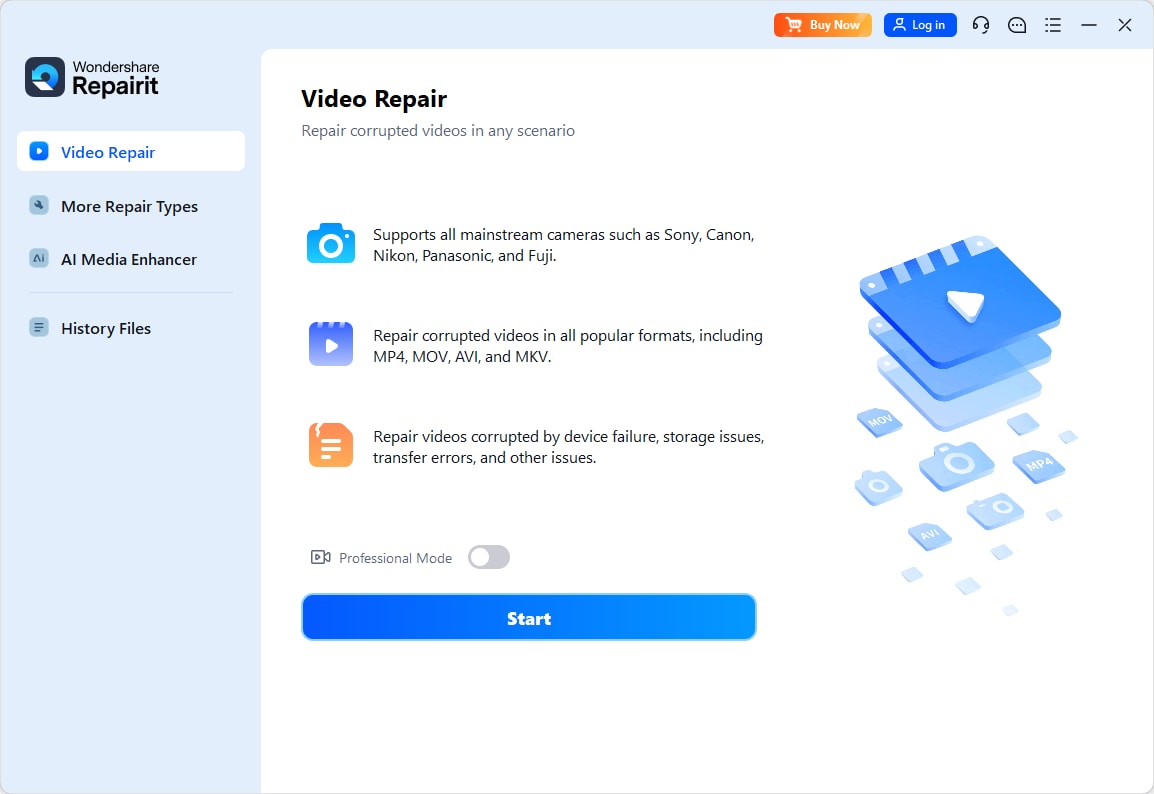
Add corrupted video files
Open Wondershare Repairit and choose the Video Repair feature from the main interface. Click the "Add" button and browse to the corrupted clips you captured or exported from your low-latency HLS workflow. You can select multiple files at once, which is useful if an entire event archive is affected by the same network or disk issue.
-
Repair video files
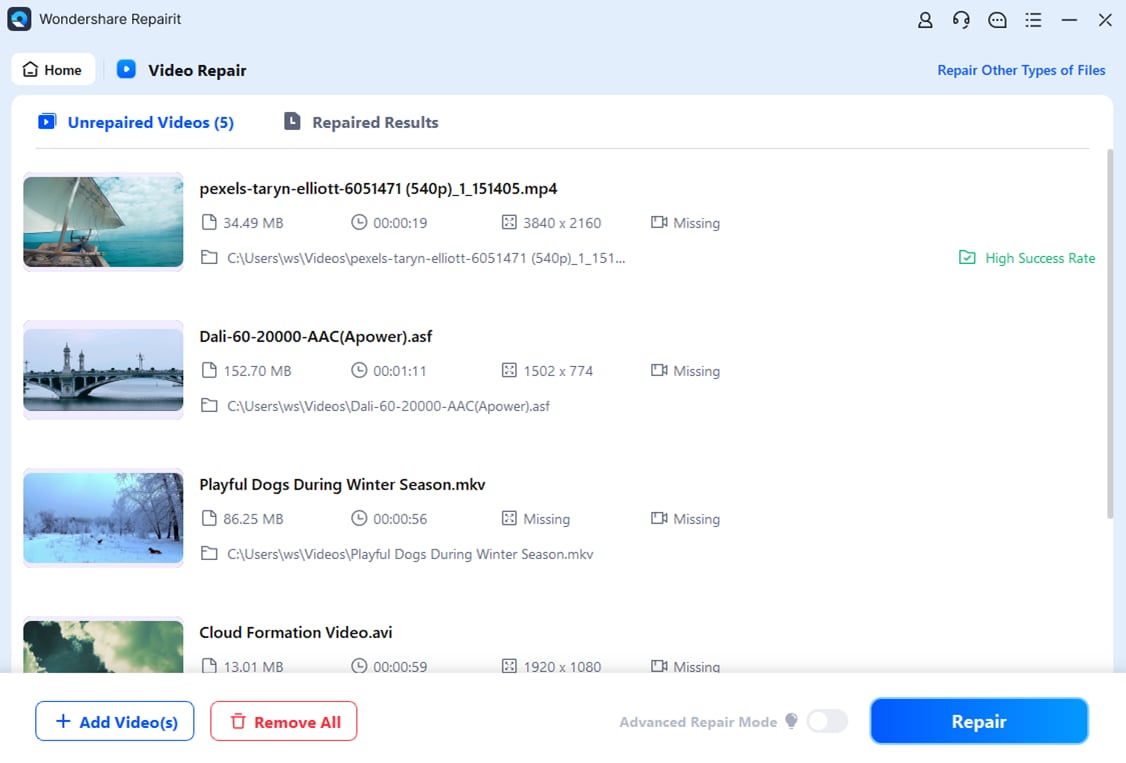
After importing, you will see a list showing each file’s name, size, and format. Confirm that all the damaged items are included, then click the "Repair" button to start. Repairit scans each video, rebuilds headers and indexes, and attempts to restore frames and audio streams that were affected by download interruptions or encoding glitches during LL-HLS capture.
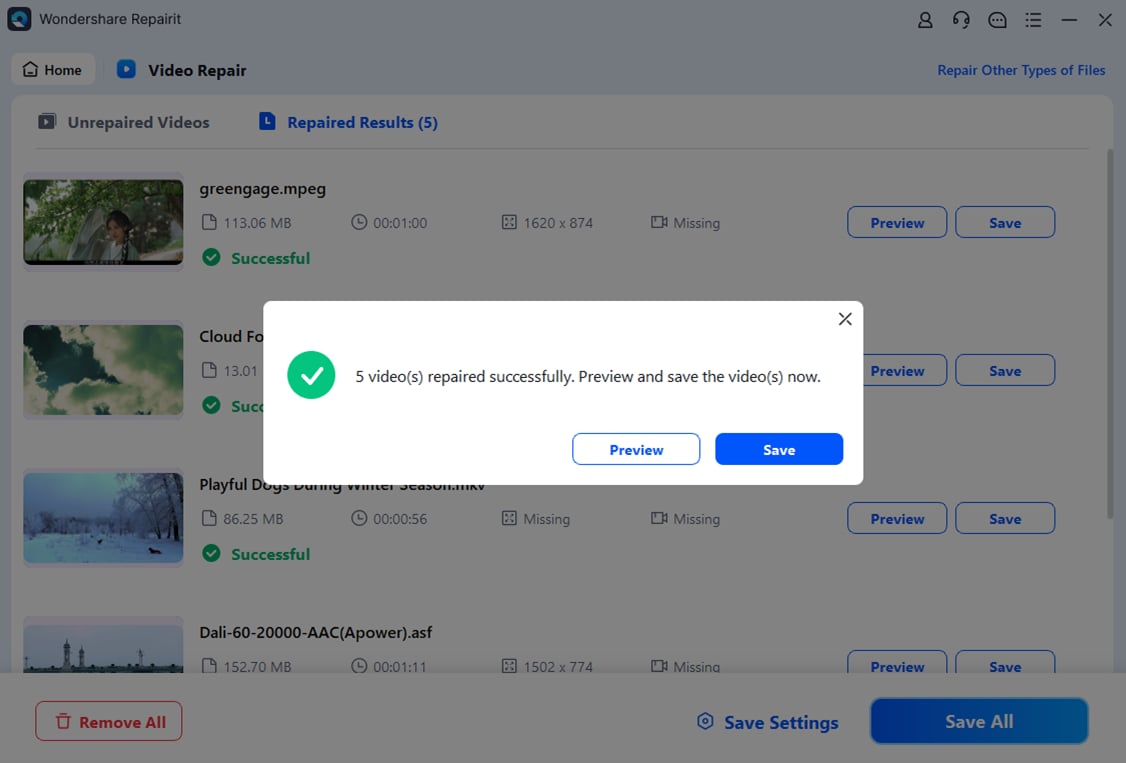
When the quick repair is done, use the Preview option to play back the recovered result directly in Repairit. This helps you confirm that timeline navigation works correctly and that both video and audio are synchronized before saving.
-
Save the repaired video files
If you are satisfied with the preview, click "Save" (or "Save All" if you repaired multiple items) and choose a secure destination folder that is different from where the corrupted files currently reside. Repairit will export clean, playable versions of your videos that you can open in standard players, bring back into your editing software, or upload again to your OTT streaming or Apple HLS distribution platform.
Conclusion
Low-latency HLS (LL-HLS) narrows the gap between live events and playback by using shorter segments, partial segments, and more agile playlist updates. Because it remains compatible with existing Apple HLS and CDN infrastructures, it is a practical way to achieve near-real-time video delivery for sports, auctions, interactive shows, and enterprise events without rebuilding your entire stack.
However, complex streaming protocol chains and aggressive live streaming latency settings can still lead to recording failures, incomplete files, or corrupted downloads. Wondershare Repairit gives you a straightforward path to fix corrupted video assets from LL-HLS and other workflows so your content stays recoverable for editing, archiving, and redistribution.
Next: Mpeg-Dash Streaming
FAQ
-
1. What latency can I expect with Low-Latency HLS (LL-HLS)?
With a well-tuned encoder, CDN, and compatible player, LL-HLS usually achieves end-to-end latency in the range of 2–8 seconds. The exact number depends on segment length, partial segment size, buffer settings, and network conditions. -
2. Do I need new infrastructure to use LL-HLS?
In many cases you can reuse your existing HLS pipeline and CDN. You mainly need an encoder/packager that supports the LL-HLS extensions and a player capable of handling partial segments and faster playlist reloads. Some CDN configuration changes may be required to cache and serve low-latency content efficiently. -
3. Can LL-HLS be used alongside other streaming protocols?
Yes. Many platforms run LL-HLS in parallel with protocols like WebRTC, RTMP, or MPEG-DASH. For example, WebRTC might power interactive video calls while LL-HLS is used to reach large audiences across browsers, mobile devices, and smart TVs. -
4. Why do my downloaded LL-HLS recordings sometimes not play?
HLS and LL-HLS downloads are made up of many small segments. If the download is interrupted, if some chunks are missing, or if the container headers are corrupted during recording, the combined file may not open in standard players. A video repair tool like Wondershare Repairit can often reconstruct the damaged structure and restore playback. -
5. What file formats can I repair if my LL-HLS workflow fails?
Most LL-HLS pipelines archive to MP4, MOV, TS, or similar containers. Wondershare Repairit supports a wide range of formats used in cameras, editors, and streaming recorders, allowing you to fix corrupted video files even when they originate from complex real time streaming setups.