
Intra-frame compression pops up whenever you record, edit, or export video, especially with cameras and codecs designed for high-quality post-production. You may see it mentioned in camera menus, NLE export settings, or codec descriptions like ProRes and DNxHR. Understanding how this type of compression works helps you pick the right formats, keep editing snappy, and avoid surprise quality loss or playback issues across devices and platforms.
Repair Corrupted Files To Save Your Data
 Security Verified. Over 7,302,189 people have downloaded it.
In this article
What Is Intra-frame Compression?
Intra-frame compression (also written as intraframe compression or simply intra frame) is a compression method used in digital video. It compresses each frame independently, almost like saving a rapid sequence of still photos (I-frames) inside a video file.
In modern video compression standards such as H.264/AVC, H.265/HEVC, and professional codecs like ProRes or DNxHR, intra-frame compression is the technique responsible for encoding those self-contained I-frames. Its basic role in video encoding is to shrink file size while keeping every frame complete and decodable on its own, which is crucial for smooth editing, scrubbing, and reliable playback.
Why Is Intra-frame Compression Important in Video Compression?
The main problem intra-frame compression solves is how to reduce video data while keeping frames independent and easy to access. Instead of sharing information between frames (like inter-frame codecs do with P- and B-frames), it focuses on squeezing as much redundant detail as possible out of a single frame.
This directly affects several aspects of your footage:
- File size and bitrate efficiency: Intra-frame codecs usually produce larger files than inter-frame codecs at the same quality, because more data is stored in each frame instead of being shared across time.
- Image quality and motion handling: Because each frame is self-contained, they often preserve detail better for fast motion, complex textures, and frequent cuts, which can be critical for action, sports, or handheld footage.
- Editing friendliness: NLEs like Premiere Pro, DaVinci Resolve, and Final Cut can jump instantly to any frame, making scrubbing and frame-accurate trimming smoother compared with heavily inter-frame compressed formats like long-GOP H.264.
- Decoding complexity: Playback or editing software does not need to reconstruct a chain of neighboring frames, which can reduce CPU load and improve responsiveness on typical editing machines.
However, intra-frame compression has trade-offs:
- Larger storage requirements: More data per frame means higher bitrates, which consume more disk space and can stress slower drives.
- Less bandwidth-efficient streaming: Platforms like YouTube, Netflix, or live-streaming services typically prefer inter-frame compression because it uses bandwidth more efficiently.
- Not always needed for delivery: For final delivery to viewers, a well-tuned inter-frame encode can look just as good at a lower bitrate.
In short, intra-frame formats optimize editability and robustness, while inter-frame formats typically optimize compression efficiency for streaming and distribution.
How Does Intra-frame Compression Work in the Encoding Workflow?
Where Intra-frame Compression Fits in the Pipeline
Inside a typical video encoding pipeline, intra-frame compression affects what happens to each frame after it is captured or rendered, but before it is packaged into the final file container.
A simplified workflow looks like this:
- 1. Capture or render: The camera sensor or editing software produces full-resolution frames with lots of raw data.
- 2. Color space and subsampling: Video may be converted to YUV and chroma-subsampled (4:2:2, 4:2:0, etc.), which already reduces data.
- 3. Intra prediction within the frame: The encoder analyzes blocks of pixels in a frame and predicts each block based on neighboring blocks. Only the difference (residual) is encoded, which cuts redundancy.
- 4. Transform and quantization: The residual data is transformed (e.g., DCT-like transforms) and quantized to discard visually less important detail. This is where much of the compression happens.
- 5. Entropy coding: The quantized data is further compressed using methods like CABAC or CAVLC to pack it efficiently.
- 6. Multiplexing into a stream: Each compressed frame is wrapped into a container (MP4, MOV, MXF, MKV, etc.) with timestamps, audio, and metadata.
Unlike inter-frame modes, there is no temporal prediction step that references other frames. The encoder only looks inside the current frame. This makes intra-frame compression resilient when you jump randomly through the timeline, because decoding a frame does not depend on any others.
How Intra-frame Compression Appears in Real Tools
Across recording, editing, exporting, and streaming tools, you will see intra-frame options presented in different ways.
- Cameras and recorders: Many cinema and mirrorless cameras offer codecs like ProRes, DNxHR, or All-I H.264/H.265, which are intra frame or "I-frame only" modes aimed at high-quality post-production.
- FFmpeg: You can force intra-only encoding using flags such as "-g 1" (GOP size of 1) with codecs like libx264 or libx265, or by choosing intra-only codecs like ProRes (e.g., "-c:v prores_ks").
- x264/x265: Intra-only mode is often mentioned as "keyint=1" or "intra refresh" settings. Many presets also influence how strong intra prediction and quantization behave.
- OBS and live streaming: OBS typically focuses on inter-frame H.264/H.265 for bandwidth efficiency, but you may see settings that adjust I-frame intervals, which influences the density of intra frames in the stream.
- HandBrake: Intra-only presets are less common, but GOP size, profile, and preset selections control how often I-frames appear and how much intra prediction is used.
- Premiere Pro, Media Encoder, Final Cut, Resolve: When exporting, choosing formats like Apple ProRes, Avid DNxHR, or an H.264 "All-I" preset means your video is using intra-frame compression, ideal for further editing, color grading, or VFX.
- Hardware encoders: Some broadcast or SDI recorders offer I-frame-only modes to keep latency low and ensure robust frame-by-frame editing for broadcast workflows.
In practical terms, if a codec or preset mentions "All-I", "I-frame only", "intra-only", ProRes, or DNxHR, it is typically using intra-frame compression that favors editing and quality over minimal file size.
When Should You Care About Intra-frame Compression? Common Mistakes and Quick Tips
Editors, colorists, filmmakers, YouTubers, broadcast technicians, and even some streamers should understand when intra-frame compression is worth the extra storage and bandwidth.
When it matters most
- Professional editing and grading: For heavy color correction, VFX, and compositing, intra-frame formats like ProRes or DNxHR hold up better under repeated re-encoding than long-GOP delivery codecs.
- Fast-paced timelines: If you scrub a lot, do multicam edits, or need frame-accurate cuts in tight deadlines, intra-frame codecs reduce choppiness and lag.
- High-motion or noisy footage: Intra-only modes can preserve detail more consistently when every frame is complex and hard to predict from neighbors.
- Archiving master files: Storing masters in a robust intra-frame format gives you more flexibility for future recuts and re-grades.
When it matters less
- Final delivery to viewers: For platforms like YouTube, Vimeo, TikTok, or streaming services, efficient inter-frame compression is usually preferred. You often upload a high-quality master and let the platform re-encode.
- Low-complexity content: Screen captures, static slides, or talking heads with little motion may not benefit much from intra-only encoding.
- Bandwidth-constrained streaming: For live streaming over limited connections, inter-frame modes are more practical.
Common misunderstandings
- "Intra-frame always looks better": At the same bitrate, it often does, but if you give inter-frame more bitrate or a better preset, the visible difference can become minimal.
- "All-I is always the best choice": It is best for editing and post, but not always for delivery or long-term cloud storage because of larger file sizes.
- "Intra-frame is only for professionals": Even creators on modest setups can benefit by transcoding difficult camera formats into an intra-frame editing codec for smoother timelines.
Quick tips and takeaway
- Use an intra-frame compression codec (ProRes, DNxHR, All-I H.264/H.265) as an intermediate or editing format when your timeline feels sluggish.
- Keep your final delivery files in efficient inter-frame codecs optimized for streaming or downloads.
- If your high-bitrate intra-frame masters ever become unplayable or corrupted, have a recovery plan using a tool like Wondershare Repairit.
The core takeaway: intra-frame formats trade storage for editing speed, reliability, and quality headroom. Choose them when working, not necessarily when delivering.
How to Use Repairit to Fix a Corrupted Video File
Wondershare Repairit Introduction
When clips encoded with intra-frame compression refuse to open, freeze, or show playback errors, a dedicated repair tool is far more effective than repeatedly re-downloading or reinstalling players. Wondershare Repairit is designed specifically for repairing broken media files, including videos from cameras, phones, drones, and professional workflows. It supports many video compression formats, from consumer MP4s to pro-level intra-frame codecs, and provides a guided process so you can restore your footage without deep technical knowledge. You can learn more and download it from the Repairit official website.
Key Features of Repairit for Video Repair
- Repairs multiple corrupted or unplayable video encoding formats in a single batch session.
- Lets you preview repaired videos before export to confirm that image quality and video quality are acceptable.
- Uses an intuitive, step-based interface that works well for beginners and experienced editors handling complex camera codecs.
Step-by-step Guide to Fix a Corrupted Intra-frame Compressed Video
- Add corrupted video files
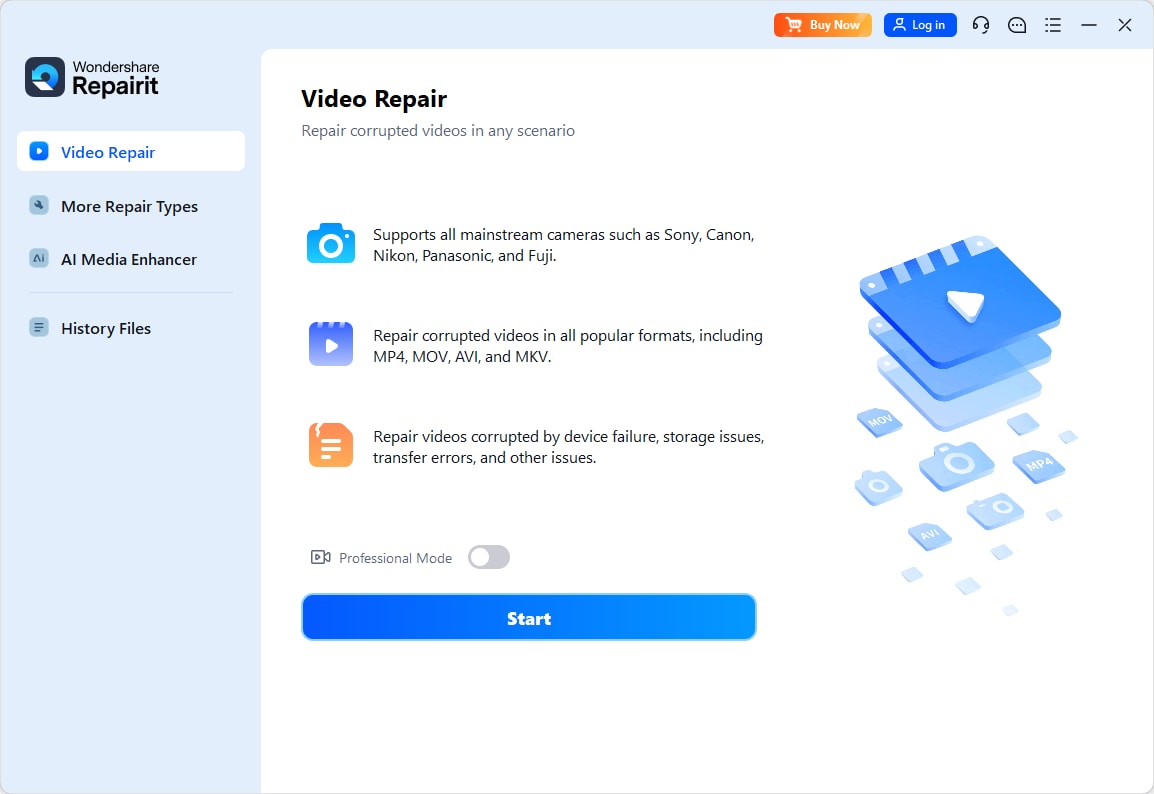
Install and launch Wondershare Repairit, then switch to the Video Repair module. Click the option to add files and locate your broken intra-frame videos, such as ProRes, DNxHR, or All-I H.264 clips from your camera or NLE export. You can load several damaged files at once so they are queued for repair in a single pass.
- Repair video files
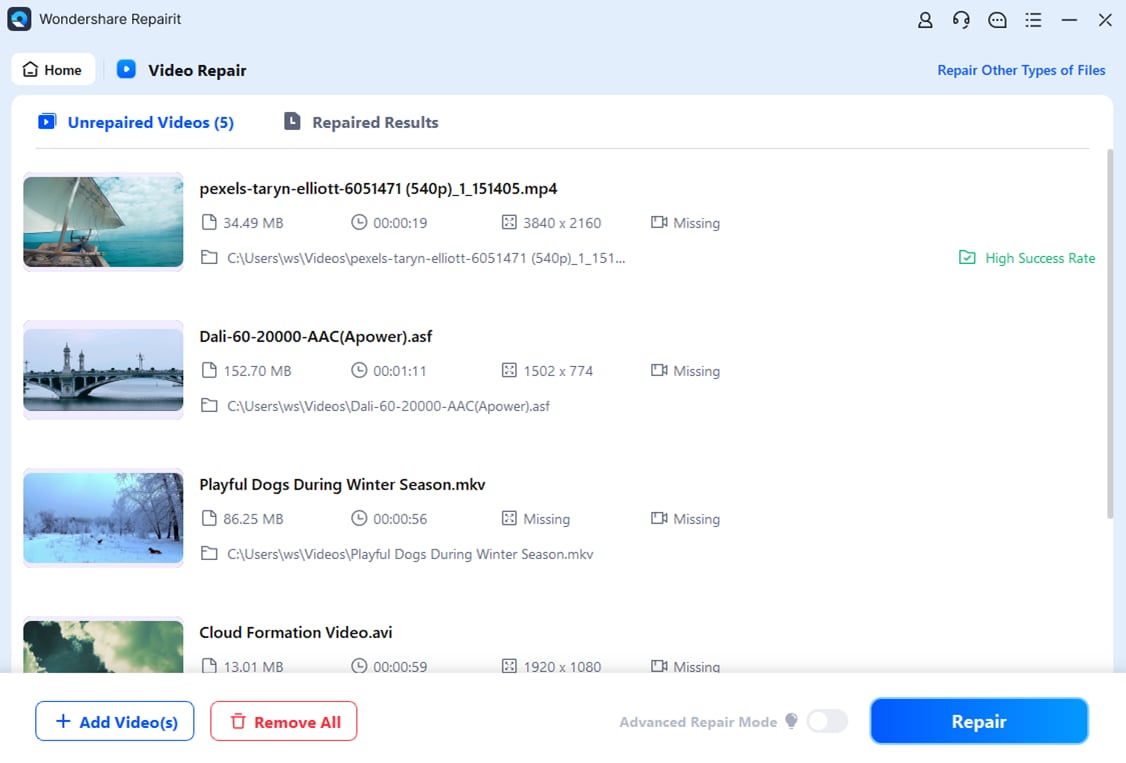
After importing your problem clips, start the repair process. Repairit will scan each file, analyze its structure, and attempt to fix issues with headers, metadata, and corrupted frame data that prevent proper decoding. When the quick repair finishes, use the built-in preview to play the recovered video so you can check motion, video quality, and audio sync. If a file is badly damaged, Repairit may prompt you to run an advanced repair for deeper recovery.
- Save the repaired video files
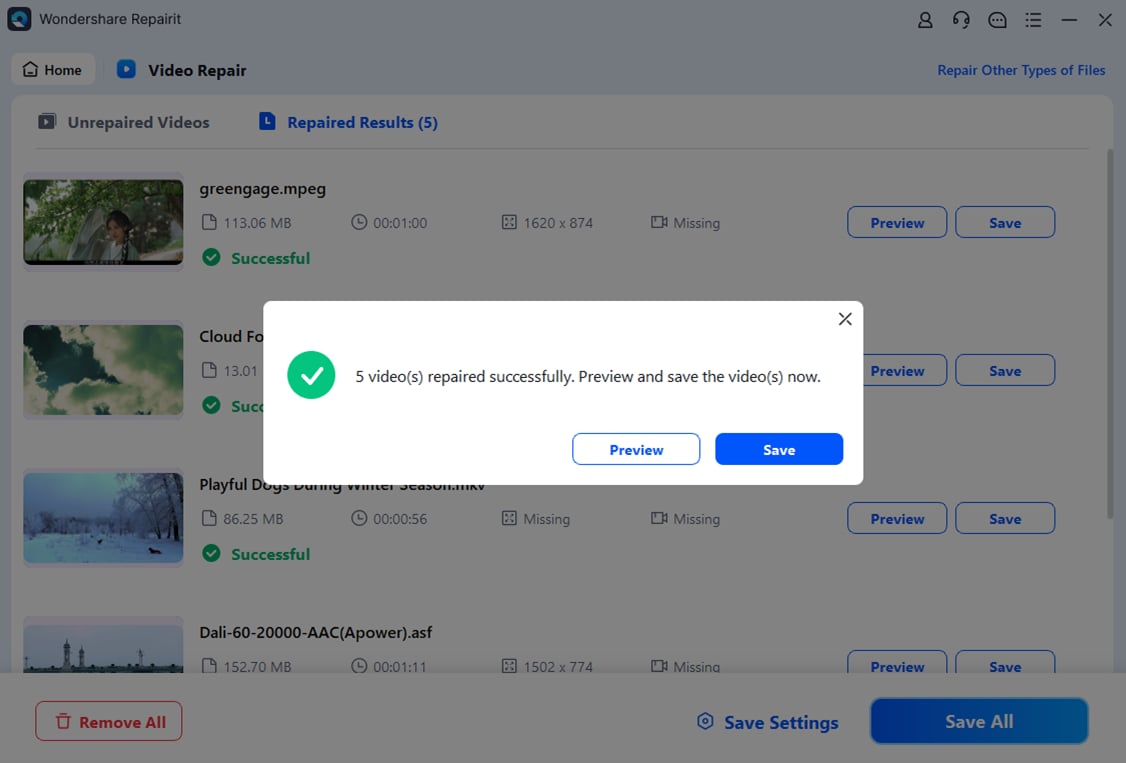
Once you are satisfied with the previewed results, choose an output folder on a healthy drive and save the repaired versions. It is best practice to store fixed copies separately from the original corrupted files so you always have a clean backup for future editing, encoding, or sharing. You can then bring these repaired intra-frame videos back into Premiere, Resolve, Final Cut, or your preferred player for normal use.
Conclusion
Intra-frame compression treats every video frame as a self-contained image. This approach increases file size but delivers smoother editing, consistent video quality, and less decoding stress, which is why it is favored for recording, post-production, and archiving masters.
By recognizing when an intra-frame format is the right tool and when a leaner inter-frame encode is enough, you can balance quality, storage, and performance across your cameras, editing systems, exports, and streaming workflows. If those crucial master files ever become corrupted, Wondershare Repairit gives you a practical way to bring broken footage back to life and keep projects on track.
Next: Inter-Frame Compression
FAQ
-
1. What is intra-frame compression in simple terms?
Intra-frame compression is a method of encoding video where each frame is compressed independently, similar to compressing a sequence of still photos. Every frame contains all the data needed for display, so the decoder does not have to reference other frames to show a clean picture. -
2. How is intra-frame compression different from inter-frame compression?
Intra-frame compression only analyzes one frame at a time, while inter-frame compression compares multiple frames and stores just the differences between them. Intra-frame formats are easier to edit and scrub, whereas inter-frame formats are more efficient for minimizing bitrate and file size, which is ideal for streaming and delivery. -
3. Why do professional editors often choose intra-frame codecs?
Professional editors prefer intra-frame codecs like ProRes or DNxHR because they allow smooth timeline scrubbing, quick seeking, and precise frame-level cuts. These codecs also tolerate multiple rounds of re-encoding with less visible degradation, which is important in complex post-production pipelines with heavy color grading and VFX. -
4. Do intra-frame formats always give better quality than inter-frame formats?
Not automatically. At the same bitrate, intra-frame codecs often preserve detail better because more data is devoted to each frame. However, a higher-bitrate or well-tuned inter-frame encode can look just as good while using less storage. The main advantage of intra-frame is editing performance and robustness, not just raw visual quality. -
5. How can I repair a corrupted intra-frame compressed video file?
First, try simple fixes like copying the file again, testing it on another device, or updating your media player and codecs. If the video still will not play or keeps freezing, use a dedicated repair tool such as Wondershare Repairit to scan the file, fix structural and header issues, and export a playable version of your intra-frame encoded footage.