

When you shoot, edit, export, or stream video, you may see ugly square patterns or harsh edges, especially at low bitrates. This blocky look often appears on YouTube, streaming platforms, CCTV footage, or heavily compressed screen recordings. The tool that helps smooth those artifacts inside many codecs is the deblocking filter—and understanding it can help you get cleaner, more professional-looking footage.
Repair Corrupted Files To Save Your Data
 Security Verified. Over 7,302,189 people have downloaded it.
In this article
What Is Deblocking Filter?
A deblocking filter is a video postprocessing tool built into many modern codecs, such as H.264/AVC, H.265/HEVC, AV1, and others. It belongs to the category of in-loop filtering or in-loop postprocessing, and its job is to smooth the boundaries between compressed blocks (macroblocks or coding tree units) so they do not look like visible squares.
During video recording, editing, encoding, exporting, and streaming, the image is divided into small blocks to compress it efficiently. At low bitrates, these blocks can leave sharp, stair-stepped edges. The h.264 deblocking and hevc deblocking filters automatically soften those edges during encoding and decoding, improving the perceived video quality without changing the underlying content.
In practical terms, the deblocking filter is part of the video encoding workflow setting. It influences how your footage will look after compression, whether it is camera-original footage, a screen capture, a game stream, or an exported master for platforms like YouTube, Vimeo, or social media.
Why Is Deblocking Filter Important in Video Compression?
Block-based compression is efficient, but it can introduce artifacts. When bitrates are tight, each block may be simplified too aggressively, causing discontinuities between neighboring blocks. This produces the classic "blocky video" look, especially in dark areas, gradients, and fast motion.
The deblocking filter helps solve this by smoothing the transition at block edges so they blend together more naturally. This has several important effects on your footage across recording, playback, and streaming scenarios.
| Aspect | Effect of deblocking filter |
|---|---|
| Image quality | Reduces blockiness and harsh edges, giving a smoother, more natural image. |
| Bitrate efficiency | Improves perceived quality at a given bitrate, letting you compress more without the picture falling apart. |
| Motion and gradients | Makes moving objects and smooth gradients (like skies or walls) look less blocky and distracting. |
| Decoding complexity | Adds some computational cost during playback, especially on weak devices or high resolutions. |
| Editing friendliness | Can slightly soften details, which is acceptable for delivery files but less ideal for heavy post-processing. |
Main benefits
- Visibly cleaner video at the same file size or bitrate.
- Better experience for streaming viewers on platforms that recompress your uploads.
- More film-like, less "digital" or blocky image, especially in low-light or heavily graded scenes.
Key limitations
- It cannot fully rescue extremely low-bitrate or poorly encoded footage.
- It may soften fine texture and sharp edges if used too aggressively.
- It increases CPU/GPU work during both encoding and decoding, which matters for real-time streaming or playback on older devices.
How Does Deblocking Filter Work in the Encoding Workflow?
Where deblocking sits in the codec pipeline
To understand video encoding and where deblocking filter fits, it helps to think in stages rather than math.
In typical block-based codecs like H.264 or HEVC, the workflow for each frame looks roughly like this:
- 1. The frame is split into blocks (macroblocks or coding units).
- 2. Prediction and transform steps estimate each block from neighbors or previous frames.
- 3. The encoder quantizes and compresses that data to reduce bitrate.
- 4. The encoded blocks are reconstructed internally to see what the decoder will get.
- 5. The deblocking filter is applied to the reconstructed frame, along block edges.
- 6. The filtered frame is stored for use as a reference for future frames.
This is called an "in-loop" filter because it sits inside the compression loop. The filtered frame, not the raw blocky frame, becomes the reference that later frames use. That way, both the encoder and decoder work with smoother reference pictures, reducing the chance that block artifacts propagate over time.
The filter itself makes decisions per edge: it analyzes how strong the discontinuity is between neighboring blocks and how much detail is present. Then it applies a gentle smoothing or leaves the edge mostly untouched if it contains genuine detail, like a sharp text edge or fine texture.
Deblocking in popular tools and workflows
As a creator or technician, you usually meet deblocking filter options as codec settings rather than raw algorithms.
- FFmpeg and x264/x265: You might see flags that control deblocking strength, such as custom parameters for H.264 or HEVC profiles. Many presets implicitly choose balanced deblocking values.
- OBS Studio: For live streaming using x264 or hardware encoders, deblocking is often enabled by default as part of the chosen profile/level. It helps keep gameplay and webcam feeds clean at Twitch- or YouTube-friendly bitrates.
- HandBrake: When exporting compressed MP4 or MKV files, deblocking settings are wrapped inside encoder presets. Quality-focused presets typically use conservative but effective deblocking.
- Premiere Pro / Media Encoder: Export settings like "Profile," "Level," and "Bitrate Encoding" for H.264/HEVC include default h.264 deblocking behavior. You rarely need to toggle it manually unless you are following a strict broadcast spec.
- Camera and hardware encoders: Action cams, drones, mirrorless cameras, capture cards, and phones often implement deblocking directly in hardware, linked to their chosen codec profile. Users do not usually see a deblocking switch, but they see its effect when reviewing highly compressed footage.
On the playback side, software players, set‑top boxes, TVs, and mobile chipsets also apply corresponding deblocking logic during decoding. This is why the same file may appear slightly different depending on the player and device capabilities.
When Should You Care About Deblocking Filter? Common Mistakes and Quick Tips
The importance of the deblocking filter changes depending on your role and workflow.
Who should care most?
- Streamers and live broadcasters: Running tight bitrates (e.g., 3–8 Mbps 1080p on Twitch or YouTube Live) makes content vulnerable to blockiness, especially in fast games or sports. Sensible deblocking is crucial.
- Online creators: If you upload to platforms that re-encode your footage, well-tuned deblocking in your export can give them a cleaner source, helping preserve quality after their compression pass.
- Video editors and colorists: For final delivery files, deblocking is your friend. For intermediate editing masters, however, you may prefer higher bitrates and lighter filtering to retain detail for grading.
- Archivists and post houses: For archival masters, you usually prioritize higher bitrates and intra-only codecs where deblocking is less critical or even unnecessary.
When it really matters
- Exporting low-bitrate files for streaming or mobile playback.
- Encoding security camera or screen recording footage where bandwidth is limited.
- Delivering VOD content where viewers will watch on large displays that exaggerate blockiness.
When it matters less
- High-bitrate mezzanine files for editing or grading.
- Lossless or visually lossless intermediates (e.g., ProRes, DNxHR, CineForm) where block artifacts are already minimal.
- Simple, low-motion content like slideshows or talking-head shots at generous bitrates.
Common misunderstandings
- "Deblocking will fix any bad video." – It only mitigates compression artifacts; it does not repair corruption or missing data.
- "More deblocking is always better." – Over-filtering can blur details, especially on text, UI elements, and fine textures.
- "Disabling deblocking saves quality." – Turning it off may increase apparent sharpness, but blockiness and ringing can become far more distracting at realistic bitrates.
Quick practical tips
- For general exports (YouTube, social, client previews), leave deblocking at default values in your encoder or preset.
- If your video still looks blocky video at reasonable settings, consider raising bitrate, lowering resolution, or using a slower preset rather than just cranking deblocking.
- For live streaming, test on a private channel and compare VOD recordings across presets; pick the one with the least distracting block edges at your target bitrate.
- For archive-quality masters, prioritize higher bitrates and mild filtering to keep more detail for future reuse.
The takeaway: treat the deblocking filter as a smart smoothing tool that helps your compression look cleaner, but do not expect it to work miracles if bitrate or source quality is too low.
How to Use Repairit to Fix a Corrupted Video File
Repairit introduction
While the deblocking filter improves how compressed video looks, it does not solve structural damage such as files that will not open, freeze mid‑playback, or show severe glitches. For those problems, you need a dedicated repair tool like Wondershare Repairit. It is a specialized application designed to fix damaged or unplayable videos from cameras, phones, drones, action cams, screen recorders, and more. You can learn more and download it from the Repairit official website.
Key features of Wondershare Repairit
- Fixes a wide range of video corruption issues across popular formats such as MP4, MOV, M2TS, MKV, and more.
- Offers both quick repair and advanced repair modes to handle simple glitches and severe damage in the same interface.
- Provides a straightforward, guided workflow suitable for beginners, editors, and IT teams who need reliable results.
Step-by-step guide
Follow these steps to repair corrupted video files with Wondershare Repairit.
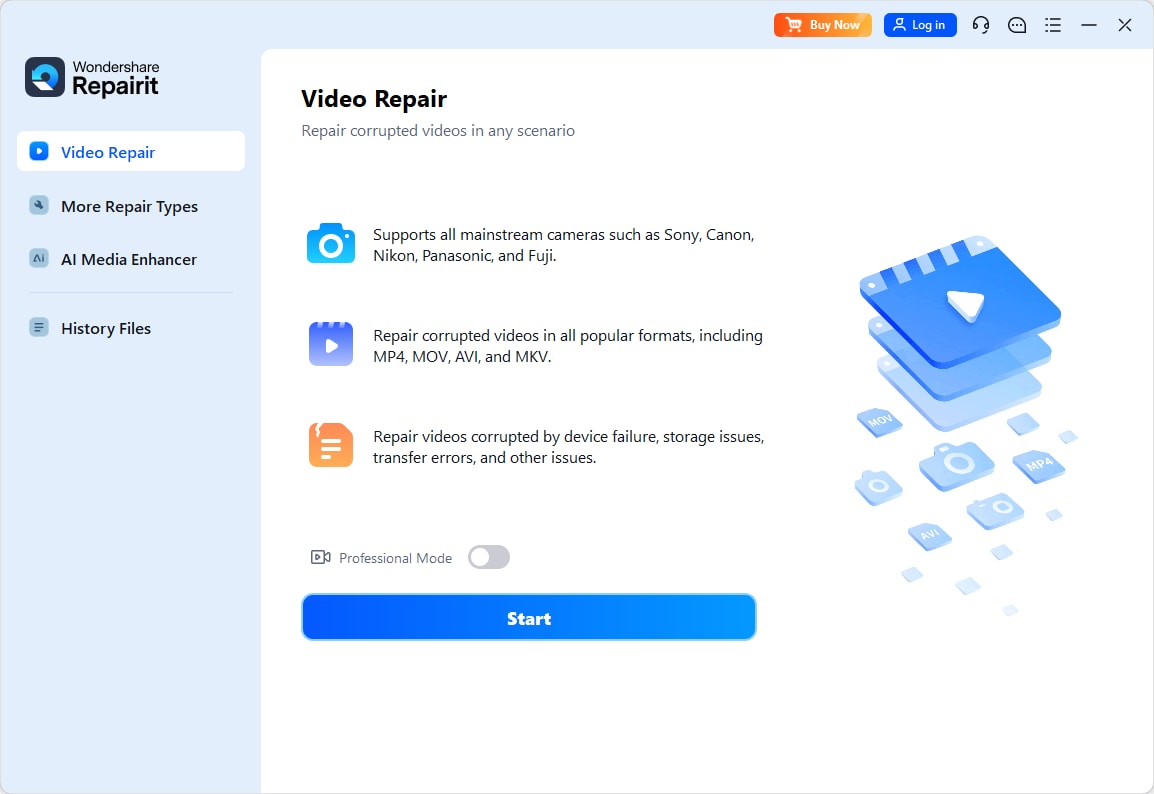
- Add corrupted video files
Install and launch Wondershare Repairit on your computer, then switch to the Video Repair tab. Click the "Add" button in the center of the window and browse to the damaged clips on your local drive, memory card, or external storage. You can import multiple problem files at once so they are processed together.
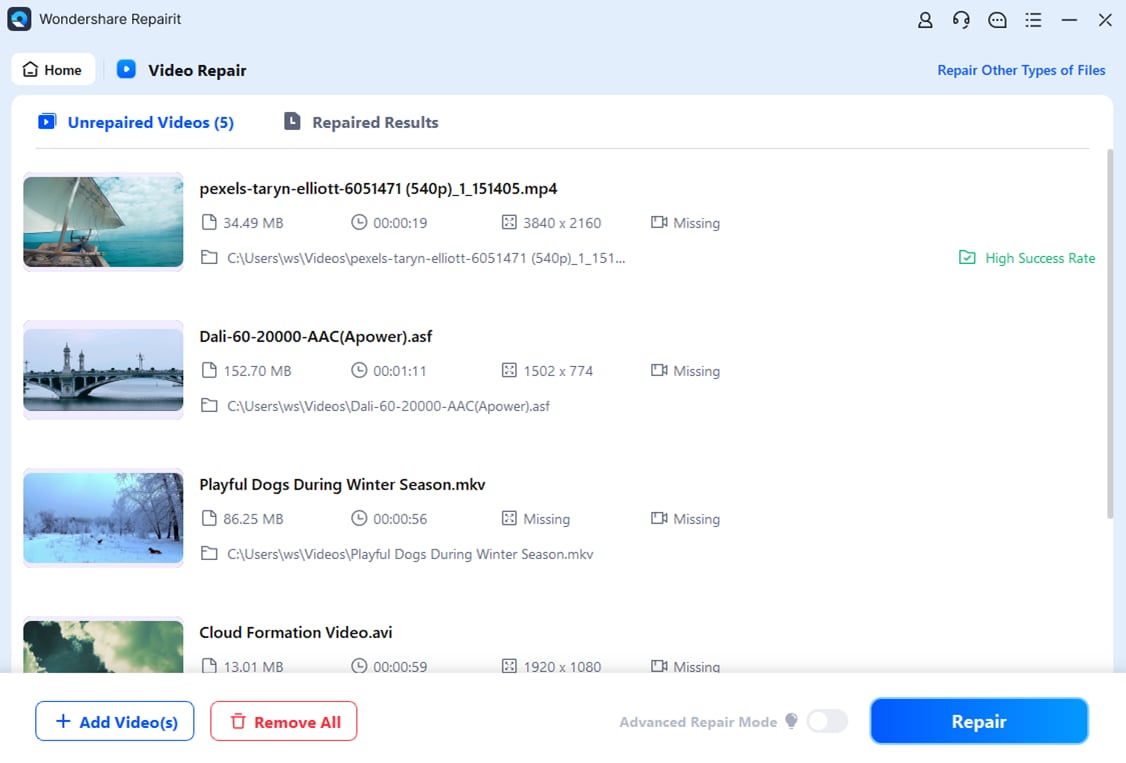
- Repair video files
Once your clips appear in the list, verify their details such as format, resolution, and duration. Click the "Repair" button to start the automatic analysis. Repairit scans each file for structural errors, header issues, and decoding problems, then rebuilds the stream so it can play smoothly. When the process finishes, use the Preview option to watch the repaired version and confirm that playback looks correct.
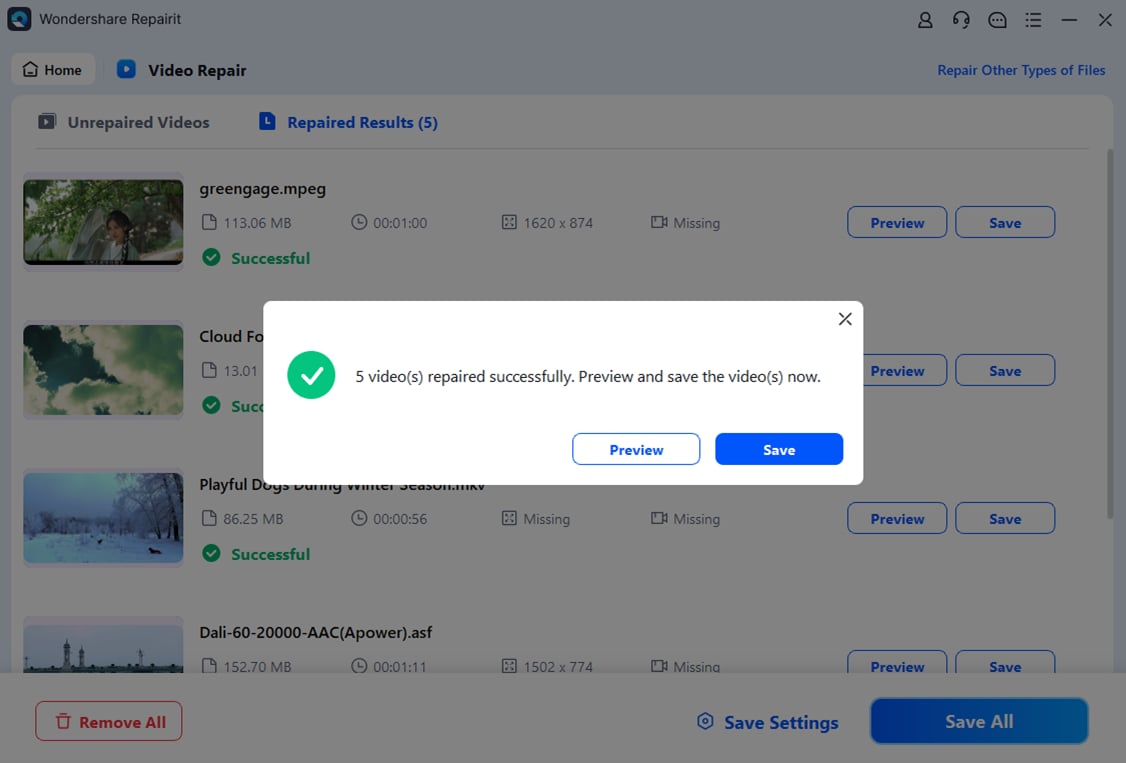
- Save the repaired video files
If you are satisfied with the preview result, click "Save" and choose a secure output folder that is different from your source location. Repairit exports the fixed videos there while keeping your original files untouched. You can then import the repaired clips into your NLE (Premiere Pro, Final Cut, DaVinci Resolve) or play them in your favorite media player without errors.
Conclusion
The deblocking filter is a core part of modern video compression. By smoothing the harsh edges between blocks, it reduces visible video artifacts and helps your footage look more natural at practical bitrates across recording, editing, exporting, and streaming workflows. Well-tuned h.264 deblocking and hevc deblocking can make a big difference in how your videos appear on phones, TVs, and web players.
However, deblocking is not a cure-all. It cannot fix corrupted files, missing data, or severe glitches. For those issues, combining good codec settings with a dedicated repair solution like Wondershare Repairit ensures you maintain high-quality, playable media from capture to final delivery.
Next: Rate Control
FAQ
-
1. What is a deblocking filter in video compression?
A deblocking filter is an in-loop postprocessing step in codecs like H.264 and HEVC that smooths block boundaries created during compression. It reduces visible square patterns and harsh edges so the picture looks cleaner, especially at low or medium bitrates. -
2. Why does my compressed video look blocky even with deblocking enabled?
Your video may still look blocky if the bitrate is too low for the chosen resolution, the content has a lot of motion or noise, or the encoder preset is very fast (trading quality for speed). The filter can hide some artifacts, but it cannot fully compensate for overly aggressive compression or poor source quality. -
3. Does the deblocking filter reduce video sharpness?
Yes, deblocking can slightly soften fine details because it smooths edges between blocks. When tuned correctly, however, it removes distracting blockiness more than useful detail, so overall perceived quality usually improves. If your content relies on crisp UI or text, use balanced settings and adequate bitrate. -
4. Can I turn off deblocking in my encoder settings?
Many encoders let you weaken or disable the deblocking filter, but this is usually recommended only at high bitrates, for visually simple content, or in specific professional workflows. For streaming and typical web delivery, leaving deblocking on (with default strength) generally yields better results. -
5. Can a deblocking filter fix a corrupted video file?
No. The filter only targets compression artifacts on a valid stream; it cannot repair missing data, damaged headers, or files that refuse to open. For corruption issues, use a dedicated repair solution like Wondershare Repairit to scan, fix, and restore your video files.