Choosing between Repairit Audio Repair vs WaveLab Pro depends on whether you mainly need to repair corrupted audio files or manage full-scale editing and mastering projects with some restoration on the side. Repairit Audio Repair is centered on fixing unplayable or damaged recordings through a guided, file-level repair workflow, while WaveLab Pro is a mastering and audio editing suite that also offers restoration tools for users who live in a more technical studio environment.
In most real-world cases, the key decision is whether you want a focused tool that gets broken audio playing again with minimal setup, or a deep editing platform where repair is only one part of a broader production workflow. Understanding how each approach affects repair depth, workflow complexity, and learning curve will help you pick the tool that actually fits your day-to-day audio repair tasks.
Repair Corrupted Audio Files With Repairit Audio Repair
 Security Verified. Over 7,302,189 people have downloaded it.
In this article
- Repairit Audio Repair vs WaveLab Pro: Quick Verdict
- Repairit Audio Repair vs WaveLab Pro: Key Differences
- Repairit Audio Repair vs WaveLab Pro: Comparison Table
- What Repairit Audio Repair and WaveLab Pro Are Best For
- Repairit Audio Repair vs WaveLab Pro: Audio Repair Capabilities
- Repairit Audio Repair vs WaveLab Pro: Supported Audio Formats and Use Cases
- Repairit Audio Repair vs WaveLab Pro: Workflow and Ease of Use
- Repairit Audio Repair vs WaveLab Pro: AI Processing and Automation
- Repairit Audio Repair vs WaveLab Pro: Pricing and Accessibility
- Who Should Choose Repairit Audio Repair
- Who Should Choose WaveLab Pro
- Pros and Cons of Repairit Audio Repair and WaveLab Pro
- How to Repair Corrupted Audio Files After Choosing the Right Tool
Repairit Audio Repair vs WaveLab Pro: Quick Verdict
The key difference between Repairit Audio Repair vs WaveLab Pro is that Repairit Audio Repair focuses on guided, file-level repair for corrupted or unplayable audio, while WaveLab Pro centers on editing, mastering, and restoration in a more technical studio workflow. Repairit Audio Repair is more suitable when your main problem is broken playback and you want to fix it quickly without learning a full production suite.
WaveLab Pro may be enough if you already work in mastering or detailed editing and occasionally need to clean up problematic recordings within the same environment. For support calls, interviews, everyday recordings, and other situations where files simply refuse to play or sound obviously damaged, a focused repair workflow usually gets you to usable audio more directly.
Repairit Audio Repair vs WaveLab Pro: Key Differences
The main difference between these tools is how they treat damaged audio: Repairit Audio Repair is built around diagnosing and repairing corrupted files, while WaveLab Pro integrates restoration into a much broader editing and mastering toolkit. This matters if your typical issue is that a file will not play at all versus needing detailed sound shaping on audio that already plays.
Another important distinction is workflow complexity. Repairit Audio Repair uses a streamlined path where you import, repair, preview, and export. WaveLab Pro uses a studio-style layout with multiple windows, meters, and processes, which is powerful for experienced engineers but can feel like overkill when you only need to restore damaged audio playback for a handful of clips.
Repairit Audio Repair vs WaveLab Pro: Comparison Table
This comparison table summarizes how Repairit Audio Repair vs WaveLab Pro differ in typical repair workflows, helping you quickly match each tool to your real-world needs.
| Dimension | Repairit Audio Repair | WaveLab Pro |
|---|---|---|
| Best for | Users who need guided file-level repair to fix corrupted or unplayable audio quickly. | Advanced users combining mastering, editing, and moderate restoration in one suite. |
| Ease of use | Straightforward, task-focused interface with minimal setup. | More complex, studio-style layout suited to technical workflows. |
| Repair depth | Focused on repairing damaged playback and corrupted files with guided steps. | Good restoration modules but less centered on deep file-level repair workflows. |
| AI capability | AI-driven diagnosis and guided repair for common corruption scenarios. | More manual, processing-focused tools with less guided automation for corruption. |
| Workflow | Repair-first workflow: import, repair, preview, export. | Technical, production-oriented workflow spanning editing, mastering, and restoration. |
| Strengths | Clear focus on fixing corrupted audio and restoring damaged playback. | Comprehensive editing tools and integrated mastering with useful restoration modules. |
| Weaknesses | Not a full DAW or mastering suite; limited advanced editing. | Less focused on dedicated repair depth for severely corrupted or unplayable files. |
What Repairit Audio Repair and WaveLab Pro Are Best For
The key difference is that Repairit Audio Repair is best for restoring broken playback on individual files, while WaveLab Pro is best for users who combine mastering, editing, and repair in longer projects. Understanding this split helps you avoid using a full production suite for jobs that mainly require file-level audio repair.
In most real-world cases, Repairit Audio Repair is a stronger choice when you receive corrupted voice notes, meeting recordings, or exported audio that will not open or play correctly. WaveLab Pro fits better if you already run a mastering or post-production workflow and want to integrate restoration with tasks like loudness control, sequencing, and spectral editing.
Repairit Audio Repair vs WaveLab Pro: Audio Repair Capabilities
The main difference in audio repair capabilities is that Repairit Audio Repair targets corrupted or unplayable files directly, while WaveLab Pro focuses more on cleaning and enhancing audio that already plays. This distinction is crucial when deciding whether you need file-level repair or primarily noise and artifact reduction.
Repairit Audio Repair is designed to handle situations where audio structures are damaged enough to cause playback issues, using guided steps to repair those files and restore usable output. WaveLab Pro brings strong processing tools for clicks, noise, and tonal problems, but these are usually applied once the file is already open and functioning inside a mastering or editing session, so severely corrupted files may still require a dedicated repair stage first.
Repairit Audio Repair vs WaveLab Pro: Supported Audio Formats and Use Cases
For most users, both tools support common formats such as MP3, WAV, M4A, AAC, and FLAC, but they serve different use cases. The key difference is that Repairit Audio Repair treats these formats as inputs for corrupted audio repair, while WaveLab Pro treats them as sources for editing, mastering, and restoration within larger projects.
Repairit Audio Repair is more suitable when you are dealing with files from phones, conferencing apps, or consumer recorders that suddenly become unplayable or distorted. WaveLab Pro may be enough if your audio already plays and you mainly want to refine albums, podcasts, or broadcast material, but you should not expect it to function as a dedicated tool for heavily corrupted audio formats in every scenario.
Repairit Audio Repair vs WaveLab Pro: Workflow and Ease of Use
The key workflow difference is that Repairit Audio Repair offers a simple, guided path, while WaveLab Pro requires a more technical, multi-window setup. This matters if you want to fix audio quickly without adopting a full studio mindset.
Repairit Audio Repair generally follows a clear path: add damaged files, run repair, preview, then export. Users often notice that this feels similar to using a utility app rather than a full DAW. WaveLab Pro, by contrast, assumes you are comfortable with timelines, meters, effect chains, and detailed routing. That complexity pays off in mastering scenarios but can slow down users who only need to repair damaged recordings from time to time.
Repairit Audio Repair vs WaveLab Pro: AI Processing and Automation
The main difference in automation is that Repairit Audio Repair leans on AI-guided diagnosis for corrupted audio, while WaveLab Pro focuses more on processing chains and batch workflows for editing and mastering. This is important if you prefer the tool to decide how to fix typical corruption issues.
In a hybrid edit-and-repair context, Repairit Audio Repair uses AI-driven analysis to recognize common corruption patterns and suggest or apply appropriate repairs with minimal tweaking. WaveLab Pro instead offers automation around rendering, processing setups, and effect chains, which is useful for consistent mastering but less about automatically fixing severely unplayable audio from scratch.
Repairit Audio Repair vs WaveLab Pro: Pricing and Accessibility
The key difference in accessibility is that Repairit Audio Repair is positioned as a focused repair utility, while WaveLab Pro is a high-end mastering and editing suite aimed at studios and experienced engineers. This usually affects both cost and how much time you invest in learning the tool.
Repairit Audio Repair is typically more approachable for individuals, support teams, or small content creators who only need to fix corrupted audio files. WaveLab Pro, with its broader feature set, tends to make more sense when you are committed to a professional workflow and will regularly use its advanced editing and analysis tools beyond occasional repair tasks.
Who Should Choose Repairit Audio Repair
Repairit Audio Repair is more suitable when your priority is to get corrupted or unplayable audio working again, rather than building complex mastering sessions. It fits users who want a focused repair process that does not require deep audio engineering experience.
- You primarily need to repair corrupted audio files or fix unplayable recordings from phones, meetings, or voice notes.
- You prefer a guided, low-friction workflow where the software handles most technical decisions.
- You do not need multitrack production, album sequencing, or elaborate mastering chains.
- You handle support calls, podcast interviews, training sessions, or internal recordings where damaged playback is the main issue.
Who Should Choose WaveLab Pro
WaveLab Pro may be enough if your main work revolves around detailed editing, mastering, and analysis, and you only occasionally encounter audio that needs restoration rather than full file-level repair. It caters to users comfortable with technical controls and studio-style layouts.
- You already work in mastering, sound design, or broadcast-oriented editing and want restoration tools within the same environment.
- You want comprehensive editing, metering, and processing with restoration as part of a larger production chain.
- You prefer a technical workflow where you can fine-tune many parameters and route audio in flexible ways.
- You need to handle mastering, editing, and moderate repair tasks without switching between multiple applications.
Pros and Cons of Repairit Audio Repair and WaveLab Pro
The main trade-off between these tools is focus versus breadth: Repairit Audio Repair concentrates on file-level audio repair, while WaveLab Pro offers a wide editing and mastering toolkit with restoration included. Considering their pros and cons side by side helps clarify which approach fits your typical audio problems.
Repairit Audio Repair Pros and Cons
WaveLab Pro Pros and Cons
How to Repair Corrupted Audio Files After Choosing the Right Tool
After comparing Repairit Audio Repair vs WaveLab Pro, the next step is actually fixing the corrupted or unplayable audio that started the search in the first place. For many users, it makes sense to rely on a guided repair utility to restore playback, then optionally move into a mastering suite for additional editing or enhancement.
In most real-world workflows, this means using a dedicated repair stage to get the file playing cleanly, and only then applying noise reduction, EQ, or mastering chains. A practical way to do this is to repair the damaged recording with Repairit Audio Repair, export the fixed version, and import that file into WaveLab Pro if you need more advanced editing.
Key Features
The main difference between this kind of guided tool and an editing suite is that the features are organized around repair rather than general production. For users who mainly need to restore damaged playback, this can significantly shorten the path from broken file to usable audio.
- Guided file-level repair so you can fix corrupted or unplayable audio without deep technical configuration.
- AI-assisted detection of common corruption patterns that often lead to playback errors or severe artifacts.
- Preview-based workflow, letting you compare repaired output with the original before committing to export.
Step-by-step guide
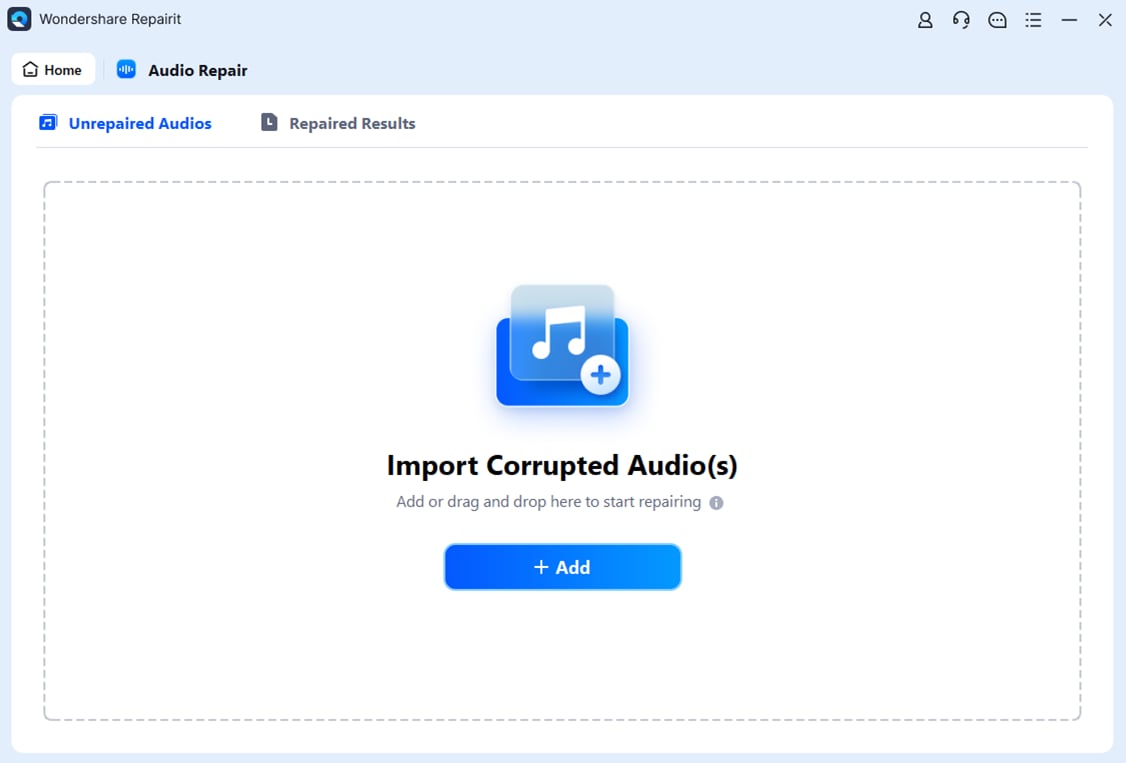
Step 1. Import the damaged audio files you want to fix into Repairit Audio Repair to begin the repair process smoothly.
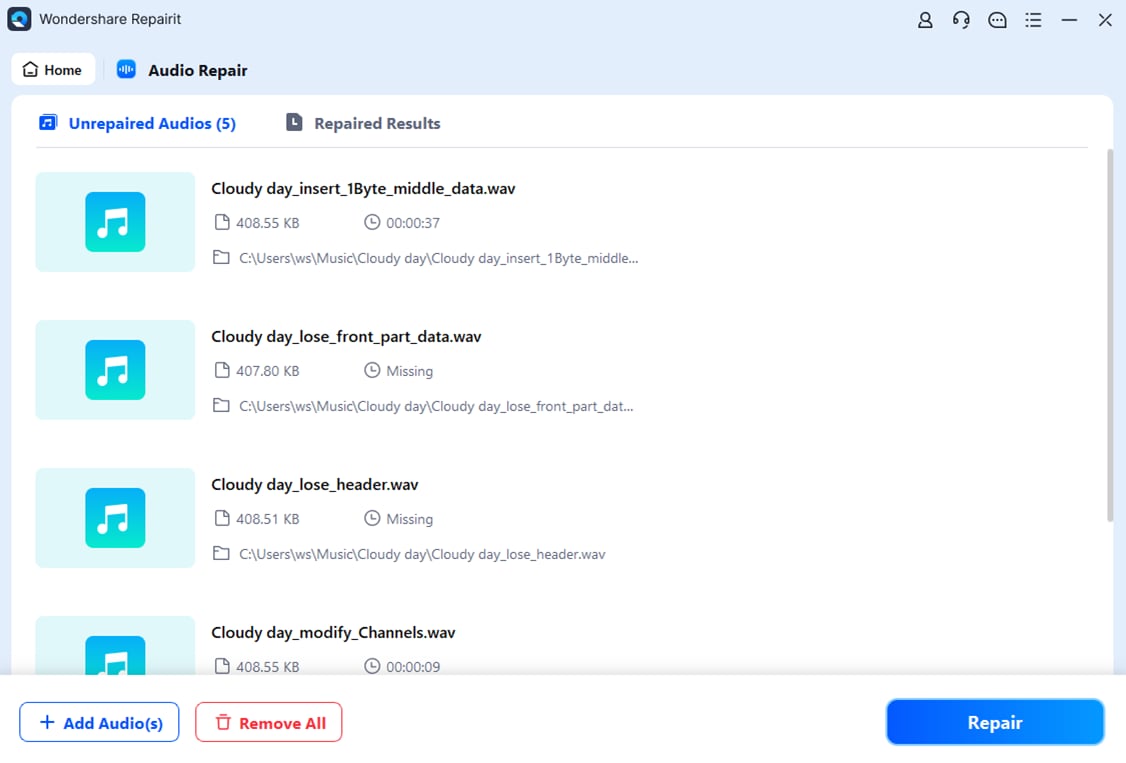
Step 2. Click the repair button to let Repairit Audio Repair automatically analyze and repair the corrupted audio files efficiently.
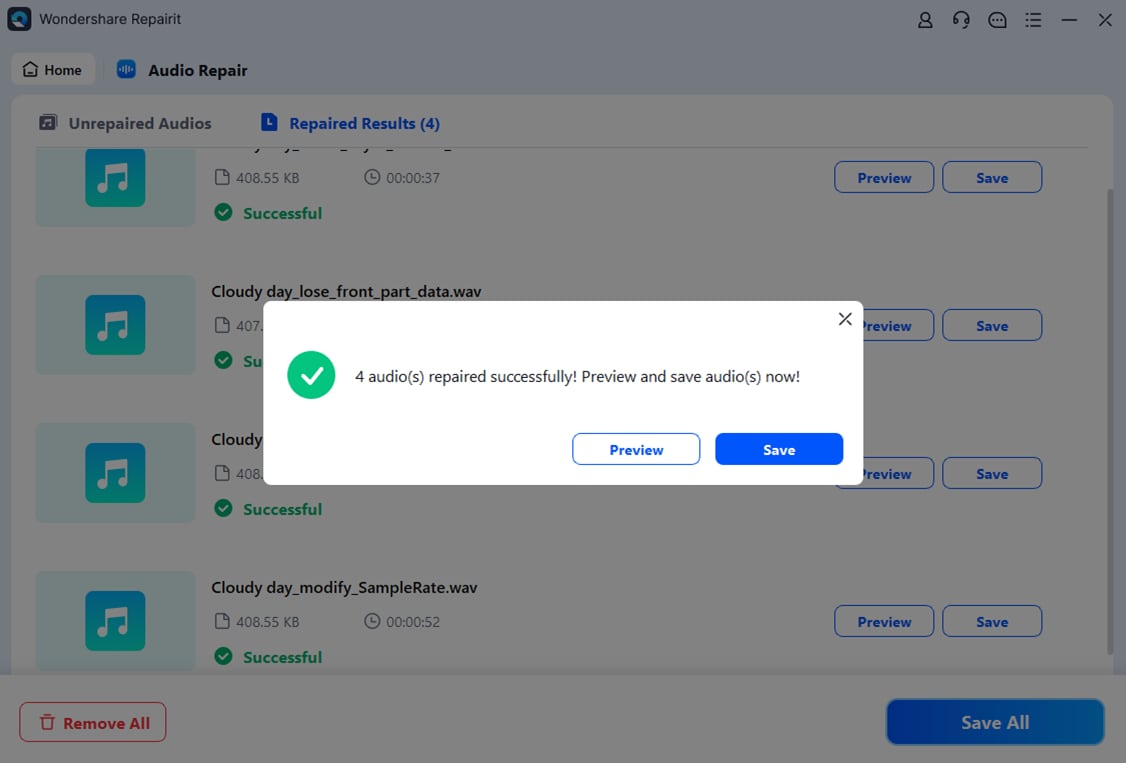
Step 3. Preview the repaired audio results, then save the successfully repaired files to your device.
Once you have a repaired version, you can usually stop there if your goal was just to restore damaged playback. If you need further editing or mastering, you can bring the fixed audio into WaveLab Pro to handle equalization, loudness, sequencing, or other production tasks.
Final Verdict
The key difference between Repairit Audio Repair vs WaveLab Pro is whether your priority is file-level repair or a full editing and mastering environment that includes restoration. Repairit Audio Repair is more suitable when you regularly encounter corrupted, unplayable, or obviously damaged recordings and want a guided workflow to restore them with minimal setup.
WaveLab Pro may be enough if you already work in a production-oriented environment and need restoration to sit alongside editing, mastering, and analysis. In many real-world setups, users combine both approaches: using Repairit Audio Repair to get troubled files playing cleanly, then relying on WaveLab Pro for detailed polishing and final delivery.
Next: Repairit Audio Repair vs Sound Forge Audio Cleaning Lab
FAQ
-
1. Is Repairit Audio Repair better than WaveLab Pro for fixing corrupted audio files?
Repairit Audio Repair is generally more suitable when the main goal is to repair corrupted audio files, fix unplayable tracks, or restore damaged playback through a guided workflow. WaveLab Pro can address noise, clicks, and other issues inside a mastering context, but it is less focused on dedicated file-level repair for severe corruption. -
2. When does WaveLab Pro make more sense than Repairit Audio Repair?
WaveLab Pro makes more sense if you already work in mastering, sound design, or detailed editing and want comprehensive tools for production, analysis, and restoration in one suite. If your everyday tasks include album mastering, podcast finishing, and nuanced processing, its technical workflow can be more efficient than jumping between multiple specialized applications. -
3. What is the difference between audio repair and audio enhancement or cleanup?
Audio repair focuses on fixing structural or severe problems, such as corrupted audio files, unplayable tracks, or damaged audio playback that fails or glitches. Audio enhancement or cleanup focuses on improving sound quality of already playable files, for example reducing noise, removing hum, or improving voice clarity. In many projects, you first need repair to make audio playable, then use cleanup tools for refinement.