Repairit Audio Repair and Sound Forge Audio Cleaning Lab both help you clean up imperfect recordings, but they focus on different problems. Sound Forge Audio Cleaning Lab targets home users who want guided noise reduction and simple enhancement. Repairit Audio Repair concentrates on repairing corrupted or unplayable audio so the files will actually play back. Understanding where cleanup ends and real repair begins is crucial when you are deciding which tool to rely on for your recordings.
Repair Corrupted Audio Files With Repairit Audio Repair
 Security Verified. Over 7,302,189 people have downloaded it.
In this article
- Repairit Audio Repair vs Sound Forge Audio Cleaning Lab: Quick Verdict
- Repairit Audio Repair vs Sound Forge Audio Cleaning Lab: Key Differences
- Repairit Audio Repair vs Sound Forge Audio Cleaning Lab: Comparison Table
- What Repairit Audio Repair and Sound Forge Audio Cleaning Lab Are Best For
- Repairit Audio Repair vs Sound Forge Audio Cleaning Lab: Audio Repair Capabilities
- Repairit Audio Repair vs Sound Forge Audio Cleaning Lab: Supported Audio Formats and Use Cases
- Repairit Audio Repair vs Sound Forge Audio Cleaning Lab: Workflow and Ease of Use
- Repairit Audio Repair vs Sound Forge Audio Cleaning Lab: AI Processing and Automation
- Repairit Audio Repair vs Sound Forge Audio Cleaning Lab: Pricing and Accessibility
- Who Should Choose Repairit Audio Repair
- Who Should Choose Sound Forge Audio Cleaning Lab
- Pros and Cons of Repairit Audio Repair and Sound Forge Audio Cleaning Lab
- How to Repair Corrupted Audio Files After Choosing the Right Tool
Repairit Audio Repair vs Sound Forge Audio Cleaning Lab: Quick Verdict
The main difference is that Repairit Audio Repair focuses on repairing corrupted or unplayable audio files, while Sound Forge Audio Cleaning Lab is mainly about cleaning up already playable recordings. In most real-world cases, this means you choose between file-level repair and day-to-day noise reduction.
If your recording opens and plays but has hiss, hum, or clicks, Sound Forge Audio Cleaning Lab can be enough for straightforward cleanup. If the audio stutters, refuses to play, or behaves like the file itself is damaged, Repairit Audio Repair is more suitable because it targets playback problems rather than just surface noise.
Repairit Audio Repair vs Sound Forge Audio Cleaning Lab: Key Differences
The key difference is the type of audio problem they are built to solve: Repairit Audio Repair aims at file-level issues, whereas Sound Forge Audio Cleaning Lab focuses on sound quality once the file is already usable.
In practice, users often notice that Sound Forge Audio Cleaning Lab feels like a guided editor with denoise and de-click modules, while Repairit Audio Repair feels like a dedicated repair step you run before any editing. This matters if you often deal with recordings from phones, cameras, or recorders that become partially corrupted or will not play smoothly.
Another important difference is workflow. Sound Forge Audio Cleaning Lab uses a project-style layout where you chain cleanup and enhancement, which is helpful for polishing. Repairit Audio Repair uses a simplified, task-focused process: import the problem file, Start the audio repair, and export a playable result.
Repairit Audio Repair vs Sound Forge Audio Cleaning Lab: Comparison Table
This comparison table summarizes how Repairit Audio Repair and Sound Forge Audio Cleaning Lab differ across typical decision factors like best use case, ease of use, and repair depth.
| Dimension | Repairit Audio Repair | Sound Forge Audio Cleaning Lab |
|---|---|---|
| Best for | Users who need to repair corrupted audio files and fix unplayable or severely damaged recordings | Home users and beginners cleaning everyday recordings with noise, hum, or clicks |
| Ease of use | Guided, focused repair process with minimal technical setup | Very beginner-friendly with intuitive, step-by-step cleaning workflows |
| Repair depth | Designed for file-level repair to restore damaged audio playback in many real-world cases | Good for surface-level cleanup but limited when files are corrupted or will not play |
| AI capability | Uses automated analysis to rebuild and repair problematic audio files | Primarily relies on guided presets and manual controls rather than deep AI repair |
| Workflow | Import, repair, then export fixed audio with a streamlined, task-focused flow | Project-style workflow with multiple cleanup modules and enhancement tools |
| Strengths | Helps fix unplayable, glitchy, or damaged audio that basic cleanup cannot open or stabilize | Easy noise reduction, de-hum, and de-click for casual recordings and simple tasks |
| Weaknesses | Less aimed at creative editing or detailed manual cleanup across many tracks | Struggles when audio files are corrupted, heavily glitched, or fail to play back correctly |
What Repairit Audio Repair and Sound Forge Audio Cleaning Lab Are Best For
Sound Forge Audio Cleaning Lab is a consumer-oriented audio cleaning and restoration tool, best for home users and beginners cleaning recordings with noise, hum, or clicks, while Repairit Audio Repair is aimed at corrupted or unstable audio that needs repair to become playable again.
In most real-world cases, Sound Forge Audio Cleaning Lab fits when you want to make spoken-word recordings clearer, tame vinyl crackle, or polish cassette transfers. Its guided modules help you reduce noise and add gentle enhancement without needing deep technical knowledge.
Repairit Audio Repair, by contrast, becomes important when the problem is more severe: recordings from events, interviews, or screen captures that will not open cleanly or keep glitching mid-playback. Instead of just reducing hiss, it focuses on restoring damaged audio playback so the file can be used in editing or shared with others.
Repairit Audio Repair vs Sound Forge Audio Cleaning Lab: Audio Repair Capabilities
The key difference in audio capabilities is that Repairit Audio Repair targets corrupted audio files and playback errors, while Sound Forge Audio Cleaning Lab focuses on noise reduction and cosmetic cleanup.
For audio that already plays from start to finish, Sound Forge Audio Cleaning Lab offers tools like denoise, de-hum, and de-click that you can apply with visual feedback. This works well for improving domestic recordings, podcasts, or music transfers that suffer from background noise but do not have structural damage.
When files are partially unreadable, cut off unexpectedly, or produce constant glitches, users often find that regular cleanup tools do not even start the job because playback is unstable. In those situations, Repairit Audio Repair is a stronger choice because it is designed to analyze and repair damaged recordings at the file level so they can be heard reliably again.
Repairit Audio Repair vs Sound Forge Audio Cleaning Lab: Supported Audio Formats and Use Cases
Both tools support common audio formats, but they differ in how they handle those formats when something goes wrong with the file.
In most real-world cases, both Repairit Audio Repair and Sound Forge Audio Cleaning Lab can work with typical formats like MP3, WAV, M4A, AAC, or FLAC captured on phones, cameras, or handheld recorders. The key difference is what happens when the file is damaged or incomplete.
Sound Forge Audio Cleaning Lab is ideal when the file opens normally in a player and you can scrub through the waveform, yet the sound is noisy or dull. Repairit Audio Repair is more suitable when that same MP3 or WAV refuses to play, stutters continuously, or shows signs of corruption after a copy, export, or device failure. This distinction matters if you often receive recordings from clients or devices that misbehave.
Repairit Audio Repair vs Sound Forge Audio Cleaning Lab: Workflow and Ease of Use
The main workflow difference is that Repairit Audio Repair offers a focused repair pipeline, while Sound Forge Audio Cleaning Lab provides a more traditional, module-based editing environment.
Sound Forge Audio Cleaning Lab uses a linear, guided approach where you load the file, then step through noise reduction, de-click, and enhancement stages. For beginners, the wizards and presets make it clear which button to press next, and you can listen as you tweak settings.
Repairit Audio Repair simplifies this even further for repair-focused work. You add the problematic audio file, start the repair, and then preview the result before exporting. Because the workflow does not rely on real-time playback during processing, it is often more comfortable when the file is already unstable and hard to audition in a standard editor.
Repairit Audio Repair vs Sound Forge Audio Cleaning Lab: AI Processing and Automation
The key difference in automation is that Repairit Audio Repair leans on automated analysis for corrupted files, while Sound Forge Audio Cleaning Lab uses presets and wizards to simplify manual cleanup.
Sound Forge Audio Cleaning Lab focuses on making standard denoise and restoration tools easier to apply by bundling them into guided workflows. You still make decisions about how aggressively to reduce noise or clicks, but the software helps you choose sensible starting points.
Repairit Audio Repair instead uses automated processing to inspect the problematic file and attempt to rebuild or stabilize audio that would otherwise fail. For users who do not have audio-engineering expertise, this can significantly reduce trial-and-error because the tool does more of the heavy lifting in the background for you.
Repairit Audio Repair vs Sound Forge Audio Cleaning Lab: Pricing and Accessibility
Pricing and access differ mainly by how each product is packaged and updated, so it is important to check each vendor for current offers.
Sound Forge Audio Cleaning Lab is typically presented as a consumer software product that you obtain from the official site, with options that may vary over time. It is aimed at users who want an accessible entry point into audio cleaning without assembling multiple tools.
Repairit Audio Repair is available from Wondershare with its own plans and download options. Because both tools may offer trials or demos, many users choose to install each one on a test file set: Sound Forge Audio Cleaning Lab for everyday cleaning, and Repairit Audio Repair for corrupted or unplayable audio, then decide which licensing setup best matches their ongoing workload.
Who Should Choose Repairit Audio Repair
Repairit Audio Repair is more suitable when the main obstacle is getting damaged or unplayable audio to run from start to finish without glitches.
- You have audio files that are corrupted, glitchy, or will not play correctly.
- You care more about restoring damaged audio playback than detailed editing.
- You want an automated workflow that repairs files with minimal manual tweaking.
- You already use another tool for editing and just need a focused repair step.
In these scenarios, running the file through Repairit Audio Repair before taking it into an editor can save time and reduce frustration compared with trying to clean an unstable file directly.
Who Should Choose Sound Forge Audio Cleaning Lab
Sound Forge Audio Cleaning Lab may be enough if your audio plays normally but needs straightforward cleanup to sound more polished.
- You are a home user or beginner cleaning noisy voice recordings or music.
- Your audio files open and play, but you hear hiss, hum, or clicks.
- You want guided wizards and presets for simple, visual cleanup steps.
- You prefer a manual, project-style workflow for polishing recordings.
In these cases, Sound Forge Audio Cleaning Lab acts like an approachable restoration studio where you can reduce noise, remove hum, and gently enhance audio without focusing on file corruption.
Pros and Cons of Repairit Audio Repair and Sound Forge Audio Cleaning Lab
This section outlines the main pros and cons of Repairit Audio Repair and Sound Forge Audio Cleaning Lab so you can quickly see which tradeoffs matter most for your situation.
Repairit Audio Repair Pros and Cons
Sound Forge Audio Cleaning Lab Pros and Cons
How to Repair Corrupted Audio Files After Choosing the Right Tool
Once you understand where Repairit Audio Repair and Sound Forge Audio Cleaning Lab differ, the next step is actually repairing the corrupted audio files that refuse to play or keep glitching.
In most workflows, users first decide whether their main issue is file corruption or simple noise. When playback itself is unreliable, a dedicated repair step with Repairit Audio Repair is often the most practical way to get a usable file that you can then clean further in any editor, including Sound Forge Audio Cleaning Lab if you want more polishing.
Repairit Audio Repair Introduction
Repairit Audio Repair, available at https://repairit.wondershare.com/audio-repair.html, is designed to repair corrupted audio files, fix unplayable recordings, and restore damaged audio playback when basic cleanup is not enough. Instead of just reducing noise, it focuses on making unstable or glitchy files playable again so you can actually hear the content and continue editing or sharing it.
Key Features
Both tools help improve problem audio, but Sound Forge Audio Cleaning Lab leans toward manual cleanup and enhancement, while Repairit Audio Repair focuses on repairing corrupted audio files and stabilizing damaged playback.
- File-level audio repair that targets corruption and playback issues.
- Automated analysis to repair damaged recordings with minimal setup.
- Support for common formats used by phones, cameras, and recorders.
Step-by-step guide
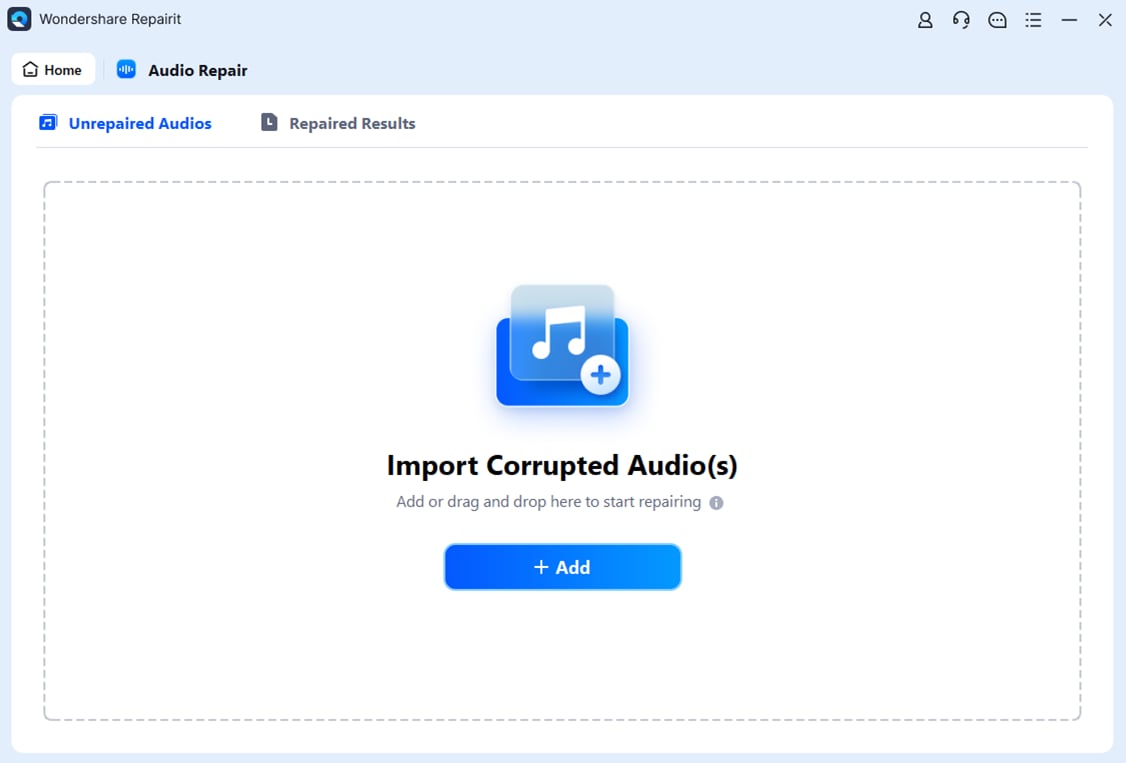
Step 1. Import the damaged audio files you want to fix into Repairit Audio Repair to begin the repair process smoothly.
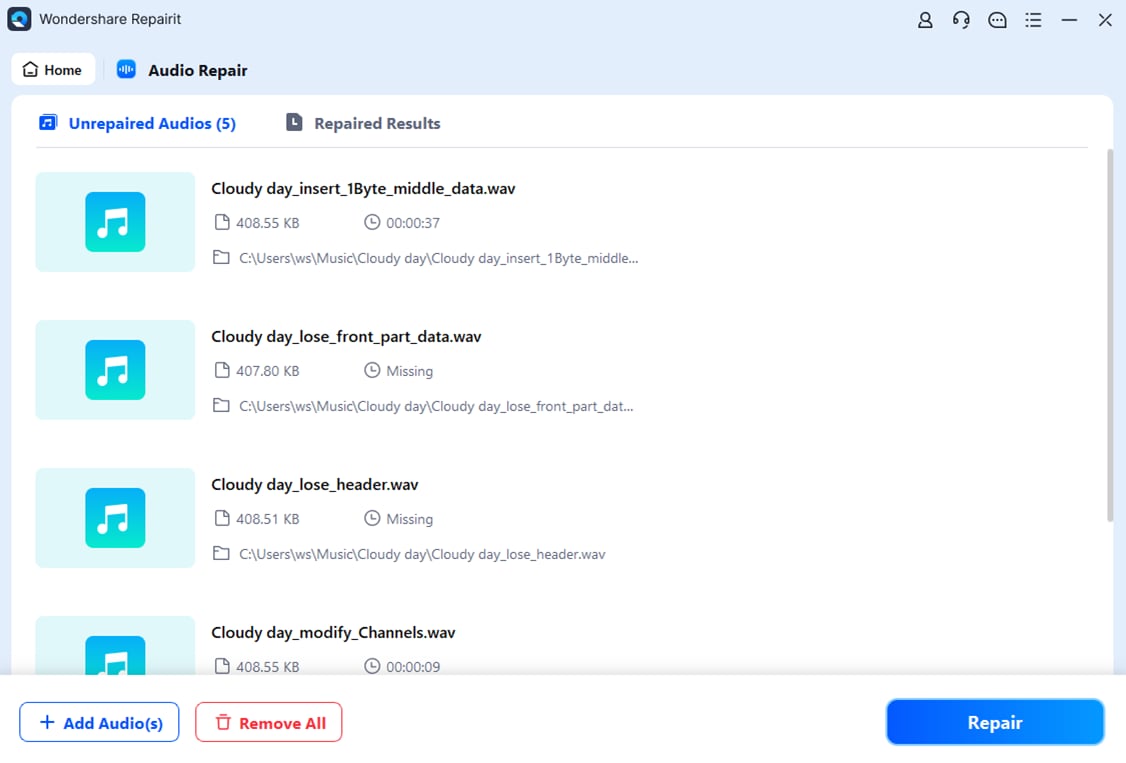
Step 2. Click the repair button to let Repairit Audio Repair automatically analyze and repair the corrupted audio files efficiently.
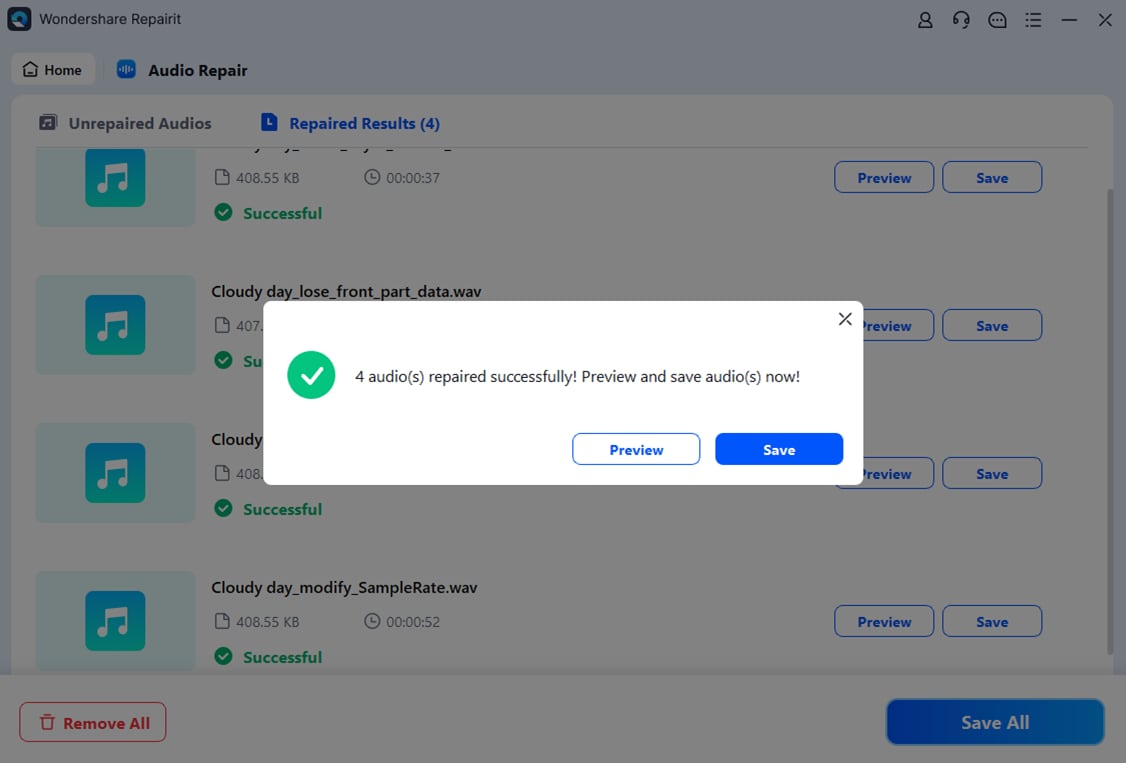
Step 3. Preview the repaired audio results, then save the successfully repaired files to your device.
Final Verdict
The main difference between Repairit Audio Repair and Sound Forge Audio Cleaning Lab is the type of problem they are built to solve, and your choice should follow the condition of your audio files.
Sound Forge Audio Cleaning Lab may be enough if your files are playable and you mainly need to reduce hiss, hum, or clicks with a simple, guided workflow. It suits users who focus on everyday cleanup and light enhancement rather than deep repair.
Repairit Audio Repair is more suitable when the issue is deeper: corrupted audio files, unplayable recordings, or playback that constantly glitches. In many real-world cases, the most efficient approach is to use Repairit Audio Repair first to get a damaged file playing again, then, if needed, run that repaired file through Sound Forge Audio Cleaning Lab or another editor for cosmetic noise reduction and final polish.
Next: Repairit Audio Repair vs Zynaptiq Repair Bundle
FAQ
-
1. Is Sound Forge Audio Cleaning Lab an audio repair tool or mainly a cleanup tool?
Sound Forge Audio Cleaning Lab is mainly a cleanup and enhancement tool for already playable audio. It focuses on reducing noise, hum, and clicks but is limited when dealing with corrupted audio files or recordings that will not play back correctly. -
2. When should I use Repairit Audio Repair instead of Sound Forge Audio Cleaning Lab?
You should use Repairit Audio Repair when your audio file is corrupted, unplayable, or full of glitches that prevent stable playback. Sound Forge Audio Cleaning Lab is better suited when the file plays fine but needs noise reduction and basic cleanup. -
3. Can I use both Repairit Audio Repair and Sound Forge Audio Cleaning Lab in the same workflow?
Yes, many users first run corrupted audio through Repairit Audio Repair to restore playback, then open the repaired file in Sound Forge Audio Cleaning Lab or another editor to manually reduce hiss, hum, or clicks and improve clarity.