
Choosing between Repairit Audio Repair and Zynaptiq Repair Bundle comes down to whether you need guided file level audio repair or deep, DAW based spectral tools. Repairit Audio Repair focuses on repairing corrupted or unplayable audio files through a straightforward workflow, while Zynaptiq Repair Bundle offers AI driven plugins that live inside professional sessions.
In most real world cases, the main decision factor is whether your problem is a file that will not play correctly or a mix that needs detailed cleanup. Repairit Audio Repair is more suitable when you must restore damaged audio playback quickly, whereas Zynaptiq Repair Bundle is better when you are already working inside a DAW and want spectral style control over noise, artifacts, and problem frequencies.
This comparison explains how each approach handles typical repair tasks such as fixing corrupted audio files, stabilizing glitched recordings, and cleaning up artifacts, so you can match the right tool to your workflow, skill level, and project type.
Repair Corrupted Audio Files With Repairit Audio Repair
 Security Verified. Over 7,302,189 people have downloaded it.
In this article
- Repairit Audio Repair vs Zynaptiq Repair Bundle: Quick Verdict
- Repairit Audio Repair vs Zynaptiq Repair Bundle: Key Differences
- Repairit Audio Repair vs Zynaptiq Repair Bundle: Comparison Table
- What Repairit Audio Repair and Zynaptiq Repair Bundle Are Best For
- Repairit Audio Repair vs Zynaptiq Repair Bundle: Audio Repair Capabilities
- Repairit Audio Repair vs Zynaptiq Repair Bundle: Supported Audio Formats and Use Cases
- Repairit Audio Repair vs Zynaptiq Repair Bundle: Workflow and Ease of Use
- Repairit Audio Repair vs Zynaptiq Repair Bundle: AI Processing and Automation
- Repairit Audio Repair vs Zynaptiq Repair Bundle: Pricing and Accessibility
- Who Should Choose Repairit Audio Repair
- Who Should Choose Zynaptiq Repair Bundle
- Pros and Cons of Repairit Audio Repair and Zynaptiq Repair Bundle
- How to Repair Corrupted Audio Files After Choosing the Right Tool
Repairit Audio Repair vs Zynaptiq Repair Bundle: Quick Verdict
The key difference is that Repairit Audio Repair focuses on guided file level repair for corrupted or unplayable audio, while Zynaptiq Repair Bundle is aimed at deep spectral style work inside DAWs. This distinction matters because it affects who can use each tool comfortably and how quickly you can stabilize a damaged file.
Repairit Audio Repair is more suitable when you need to:
- Repair corrupted audio files that will not open, will not play, or glitch heavily.
- Fix unplayable audio without configuring plugin chains or DAW routing.
- Use a simple, step based interface that guides you from import to export.
Zynaptiq Repair Bundle may be enough if you:
- Already work in a DAW and want plugins for spectral repair and detailed cleanup.
- Need AI assisted processing across multiple tracks or buses in real time.
- Are comfortable balancing many parameters to fine tune the result.
In most real world cases, creators dealing with broken or unplayable files lean toward Repairit Audio Repair, while mix engineers and post facilities lean toward Zynaptiq Repair Bundle for integrated, session based repair work.
Repairit Audio Repair vs Zynaptiq Repair Bundle: Key Differences
The main difference is that Repairit Audio Repair repairs audio at the file level, whereas Zynaptiq Repair Bundle focuses on track based processing within a DAW. Understanding this helps you decide whether you need a standalone repair step or in session problem solving.
From a workflow perspective, Repairit Audio Repair behaves like a dedicated repair station: import a damaged recording, let AI assisted analysis detect corruption and artifacts, then export a newly repaired file. Zynaptiq Repair Bundle is better suited to scenarios where the audio already plays but needs spectral repair, noise control, or artifact reduction on specific clips or buses.
In terms of repair depth, Repairit Audio Repair emphasizes restoring audio continuity and fixing severe playback issues, while Zynaptiq Repair Bundle offers more granular control over tone, noise, and spectral content. This becomes important when you decide whether technical flexibility or guided clarity is more valuable for your projects.
Repairit Audio Repair vs Zynaptiq Repair Bundle: Comparison Table
This comparison table summarizes how Repairit Audio Repair and Zynaptiq Repair Bundle differ across workflow, repair depth, and ease of use so you can quickly see which aligns with your needs.
| Dimension | Repairit Audio Repair | Zynaptiq Repair Bundle |
|---|---|---|
| Best for | Users who need to repair corrupted or unplayable audio files with a guided, file level workflow. | Professionals needing AI assisted, deep repair and spectral control inside DAWs. |
| Ease of use | Simpler, step based interface focused on fixing damaged audio playback. | More complex, requires DAW knowledge and plugin routing. |
| Repair depth | Strong for repairing file integrity and common corruption issues. | Suited to deep spectral repair, surgical artifact removal, and detailed tweaking. |
| AI capability | AI guided analysis focused on repairing file level damage and audible defects. | AI driven processing aimed at intelligent, real time repair inside mixes. |
| Workflow | Standalone style workflow for importing, repairing, and exporting audio files. | Plugin based workflow integrated into DAW sessions and buses. |
| Strengths | Straightforward repair path for corrupted, unplayable, or heavily glitched files. | Deep control, spectral tools, and real time processing for complex sessions. |
| Weaknesses | Less suited to complex, multi track, mix in place repair tasks. | Requires a DAW, steeper learning curve, and can be expensive for some users. |
What Repairit Audio Repair and Zynaptiq Repair Bundle Are Best For
Repairit Audio Repair is more suitable when your priority is repairing corrupted audio files that are not playing correctly, while Zynaptiq Repair Bundle is better when you need deep in session repair and spectral tweaks in a DAW.
Repairit Audio Repair is best for:
- Stabilizing exported audio that skips, cuts out, or refuses to open.
- Fixing interview, podcast, or field recordings that became corrupted.
- Creators who do not want to manage DAW routing but still need reliable audio repair.
Zynaptiq Repair Bundle is best for:
- Post production sessions where multiple tracks have hum, clicks, or bursts of noise.
- Sound design and mixing where you need spectral control over specific frequencies.
- Engineers comfortable automating plugin parameters for evolving repair moves.
In many workflows, users first repair corrupted files with Repairit Audio Repair and then use Zynaptiq Repair Bundle within a DAW for nuanced cleanup and enhancement.
Repairit Audio Repair vs Zynaptiq Repair Bundle: Audio Repair Capabilities
The key difference is that Repairit Audio Repair targets file level issues like corruption and unplayable sections, while Zynaptiq Repair Bundle mainly focuses on spectral and tonal problems in already playable audio.
According to the provided overview, Zynaptiq Repair Bundle is an AI driven set of plugins for intelligent repair inside DAWs, with strong AI processing and real time capability. It tends to shine when you are surgically tackling crackles, noise, or artifacts on specific regions of a track rather than fixing whether the file can play at all.
By contrast, Repairit Audio Repair concentrates on making file level audio repair straightforward while still using intelligent analysis to fix corrupted or unplayable audio and restore damaged playback. Its core feature set includes:
- Guided workflow to import, repair, and export damaged or unplayable audio files.
- Automatic detection of common audio defects that prevent smooth playback.
- Simple controls so non engineers can fix distorted or noisy audio quickly.
- AI assisted analysis that targets corruption, glitches, and severe playback issues at the file level.
- Repair options that focus on restoring audio continuity when sections are broken or heavily artifacted.
- Adjustable output settings to balance repaired quality with compatibility for different delivery formats.
In most real world cases, if the file itself is broken, Repairit Audio Repair is the more direct tool, while Zynaptiq Repair Bundle becomes more relevant once the file is stable and you want detailed cleanup.
Repairit Audio Repair vs Zynaptiq Repair Bundle: Supported Audio Formats and Use Cases
The main difference is that Repairit Audio Repair works directly with common audio files, while Zynaptiq Repair Bundle depends on what your DAW can host and import.
Repairit Audio Repair is designed to handle everyday formats like MP3, WAV, M4A, AAC, and FLAC when you need to repair corrupted audio files or fix unplayable audio coming from recorders, cameras, downloads, or exported projects. Users often notice that this flexibility makes it easy to repair problematic audio without returning to the original session.
Zynaptiq Repair Bundle operates as plugins inside a DAW, so supported formats are determined by the host application. If your DAW can load the audio, you can typically route it through Zynaptiq modules for spectral repair, denoising, or artifact reduction. This matters most when you are mixing or editing larger projects with many tracks and stems.
For one off damaged recordings that arrive as standalone files, Repairit Audio Repair is generally a more direct fit. For ongoing shows or films where everything lives in a DAW session, Zynaptiq Repair Bundle integrates more naturally.
Repairit Audio Repair vs Zynaptiq Repair Bundle: Workflow and Ease of Use
The main difference is workflow: Repairit Audio Repair offers a guided, standalone style process, while Zynaptiq Repair Bundle requires DAW integration and plugin management.
With Repairit Audio Repair, you typically:
- Open the application and load your problematic file.
- Let the tool analyze corruption, glitches, and other defects.
- Apply repair and export a clean, playable version.
This is easier for users who do not want to manage buses, inserts, or automation lanes.
With Zynaptiq Repair Bundle, you would:
- Insert specific modules as plugins on tracks or clips.
- Adjust multiple parameters, often while monitoring in real time.
- Automate controls if the issue changes over time in the audio.
This approach offers more detailed control but assumes comfort with DAW workflows. A common limitation for less technical users is simply the amount of setup required before any repair happens. Repairit Audio Repair minimizes that setup by focusing on a single, clear repair path.
Repairit Audio Repair vs Zynaptiq Repair Bundle: AI Processing and Automation
The key difference is that Repairit Audio Repair uses AI to guide file level repair decisions, while Zynaptiq Repair Bundle uses AI for deep, often real time processing inside mixes.
In Repairit Audio Repair, AI is primarily focused on:
- Detecting glitches, dropouts, and serious playback issues.
- Choosing appropriate repair strategies with minimal manual tuning.
- Helping non specialists improve damaged audio quickly.
This makes it practical for editors and creators who want results without learning a complex parameter set.
Zynaptiq Repair Bundle emphasizes AI driven processing that can:
- Respond dynamically to changing signal content during playback.
- Be automated via DAW lanes for evolving repair moves.
- Offer spectral and time based adjustments within a mix context.
This matters if you need to ride settings through a long scene or across multiple tracks. For pure corrupted file repair, however, users often find Repairit Audio Repair more focused and faster to deploy.
Repairit Audio Repair vs Zynaptiq Repair Bundle: Pricing and Accessibility
The main difference is that Zynaptiq Repair Bundle is positioned as a professional plugin suite, while Repairit Audio Repair aims to be more accessible for users who only need file level audio repair.
Zynaptiq Repair Bundle typically sits in a higher price range and assumes you already own and understand a DAW. This can be justifiable for studios and professionals who bill for complex post production, but may feel excessive for someone simply trying to fix a few corrupted audio files.
Repairit Audio Repair is generally easier to adopt because it does not require extra host software and is focused on a single task: repairing problematic audio files. In most real world cases, it makes sense to explore available trials or demos and see whether your day to day work really needs DAW integrated spectral repair or a dedicated, guided repair step is enough.
Who Should Choose Repairit Audio Repair
Repairit Audio Repair is more suitable when your main struggle is corrupted or unplayable audio files rather than complex DAW sessions.
You should consider Repairit Audio Repair if you are:
- A user with corrupted or unplayable audio files who wants a guided repair process rather than manual tweaking.
- A creator who does not work in DAWs but still needs to fix damaged recordings from cameras, recorders, or exports.
- An editor who prefers a standalone style workflow over managing multiple repair plugins.
- Part of a team that wants a simpler repair step before detailed mixing or mastering in other tools.
In practice, many users appreciate that Repairit Audio Repair focuses on getting a broken file back into a playable, editable state with minimal setup, which can save time whenever clients deliver problematic audio.
Who Should Choose Zynaptiq Repair Bundle
Zynaptiq Repair Bundle may be enough if you already live in a DAW and need deep, spectral style repair inside ongoing sessions.
This suite is better suited to:
- Mix engineers who need detailed spectral repair on dialog, music, or effects within a DAW session.
- Post production studios handling complex noise and artifact problems across many tracks.
- Sound designers who want AI assisted, real time repair on multiple buses or stems.
- Professionals comfortable with plugin chains, automation, and detailed parameter control.
If your day to day work involves scene based editing, ADR, or dense mixes, Zynaptiq Repair Bundle can fit more naturally into your workflow than a standalone repair tool. However, it is less focused on the initial challenge of making a corrupted or unplayable file stable in the first place.
Pros and Cons of Repairit Audio Repair and Zynaptiq Repair Bundle
The key difference in pros and cons is that Repairit Audio Repair trades extreme flexibility for simplicity and file level focus, while Zynaptiq Repair Bundle offers deeper control at the cost of complexity and host requirements.
Repairit Audio Repair Pros and Cons
Zynaptiq Repair Bundle Pros and Cons
How to Repair Corrupted Audio Files After Choosing the Right Tool
After comparing Repairit Audio Repair and Zynaptiq Repair Bundle, the next step is actually repairing your corrupted or unplayable audio file in a controlled, repeatable way. For many users, it makes sense to start with a guided file level repair to stabilize the audio before considering any in session cleanup.
In this action focused section, we will look at how Repairit Audio Repair can serve as that practical starting point, especially when you just need a damaged recording to play smoothly again so you can continue editing, mixing, or delivering your project.
Key Features
The main strength of Repairit Audio Repair is that it keeps file level audio repair focused and approachable while still using intelligent analysis to fix corrupted or unplayable audio.
- Designed to repair corrupted or unplayable audio so files open and play correctly again.
- AI assisted processing that targets glitches, dropouts, and severe playback issues.
- Simple, step based interface that fits naturally into editing or content creation pipelines.
Taken together, these features mean you can treat Repairit Audio Repair as a consistent first step whenever you encounter damaged recordings or exported files with obvious playback problems.
Step-by-step guide
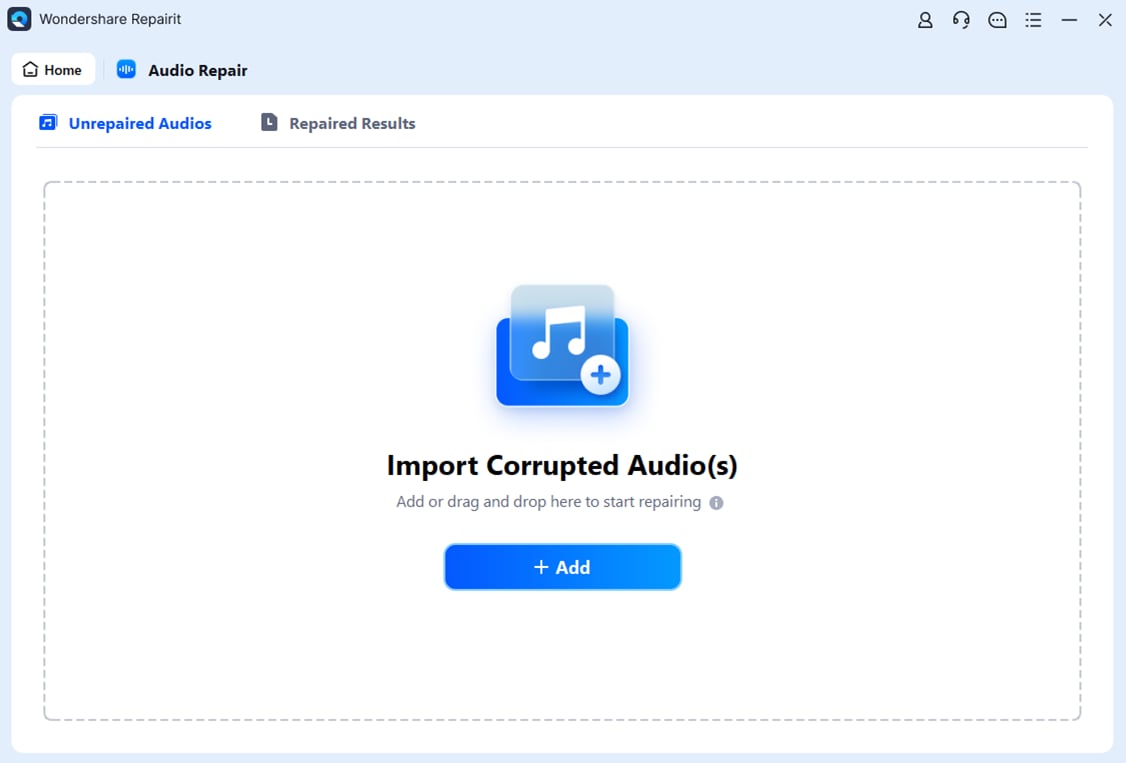
Step 1. Import the damaged audio files you want to fix into Repairit Audio Repair to begin the repair process smoothly.
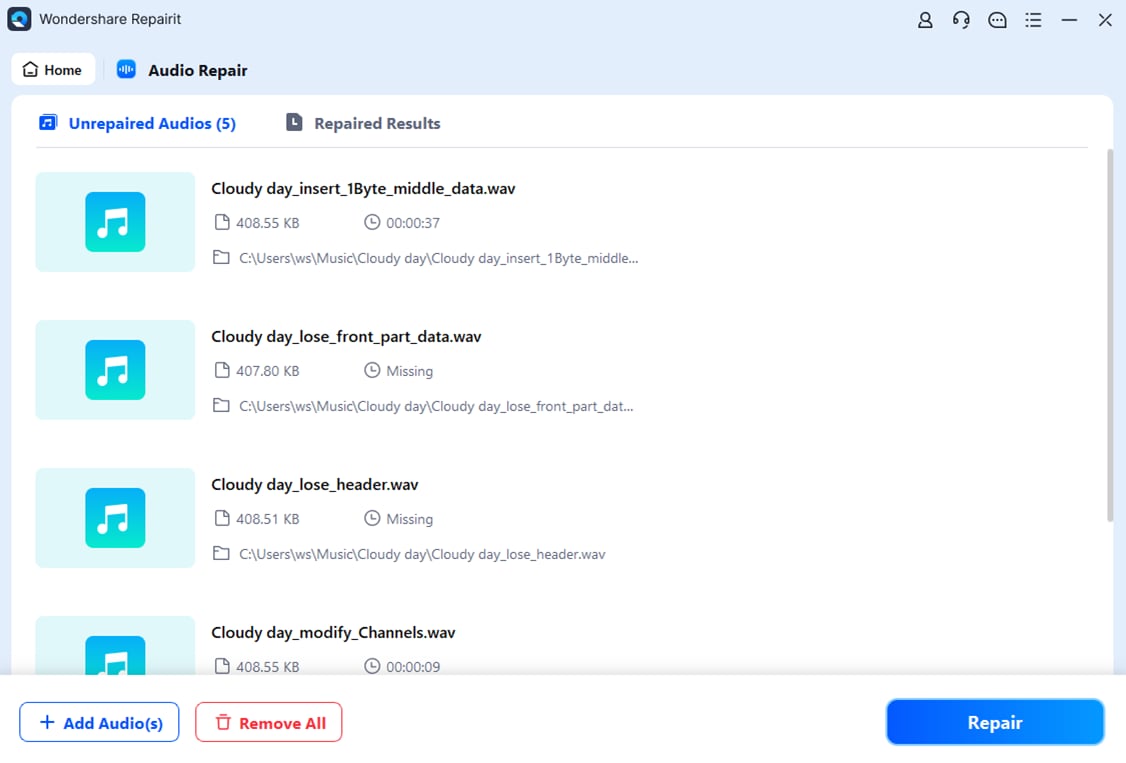
Step 2. Click the repair button to let Repairit Audio Repair automatically analyze and repair the corrupted audio files efficiently.
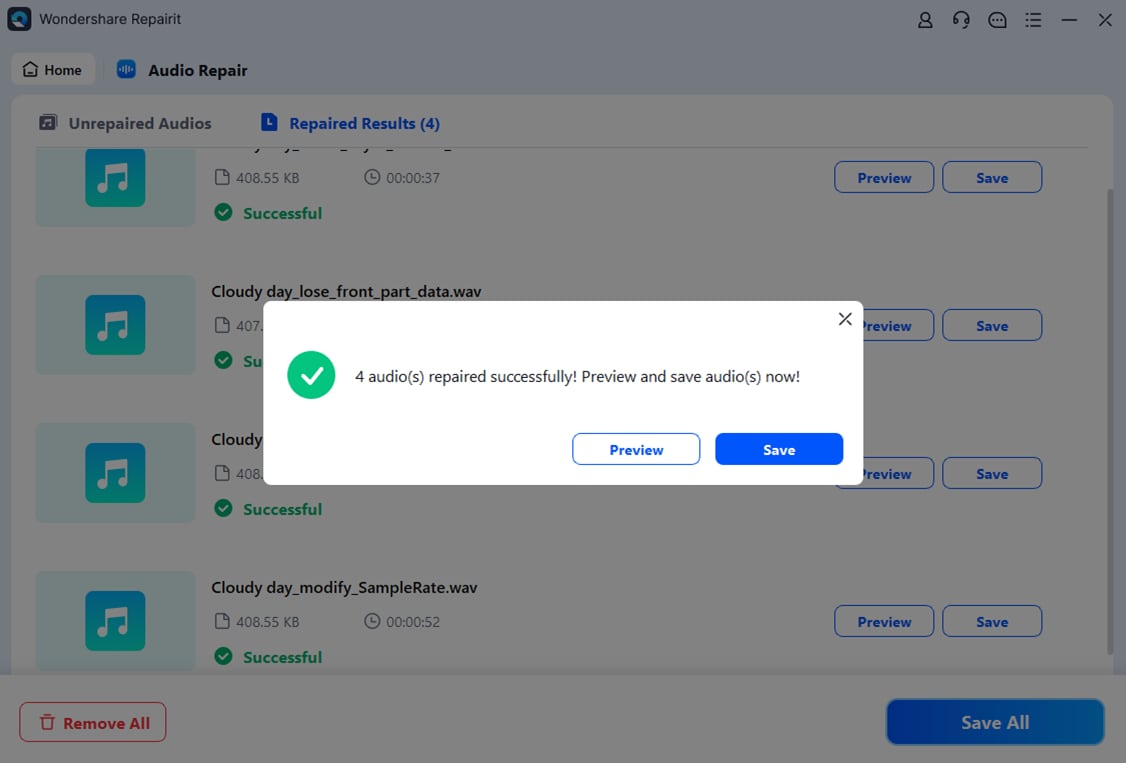
Step 3. Preview the repaired audio results, then save the successfully repaired files to your device.
Once the file is stable and plays correctly, you can move it into a DAW for any additional processing, including optional use of tools like Zynaptiq Repair Bundle for deeper spectral refinement if required.
Final Verdict
The key difference between Repairit Audio Repair and Zynaptiq Repair Bundle is where and how you carry out repairs: one centers on standalone, file level repair, while the other embeds into DAW sessions for detailed spectral work.
Repairit Audio Repair is more suitable when you must repair corrupted or unplayable audio files quickly, without entering a full DAW environment, and when a guided, file level workflow is more practical than juggling multiple plugins. It excels as a first line tool for restoring damaged audio playback so that the file is usable again.
Zynaptiq Repair Bundle may be enough if you already work in a DAW, need deep spectral repair, and want AI assisted tools inside complex sessions where you can fine tune every detail through automation and routing. It is better aligned with professional post production and mix in place workflows.
In many real world scenarios, a hybrid approach works well: use Repairit Audio Repair to stabilize corrupted audio files, then leverage DAW based tools like Zynaptiq Repair Bundle for final, surgical cleanup and enhancement when necessary.
Next: Repairit Audio Repair vs Accusonus Era Bundle
FAQ
-
1. Is Repairit Audio Repair better than Zynaptiq Repair Bundle for fixing corrupted audio files?
Repairit Audio Repair is often more convenient for fixing corrupted or unplayable audio files because it focuses on file level repair in a guided interface. Zynaptiq Repair Bundle can handle deep repair inside a DAW, but it is more complex and tends to suit users already working in professional, multi track sessions. -
2. When does Zynaptiq Repair Bundle make more sense than Repairit Audio Repair?
Zynaptiq Repair Bundle makes more sense when you are working on detailed post production, need spectral repair, and want to adjust parameters in real time on individual tracks or buses inside a DAW. This matters if you have layered noise, artifacts, or tonal problems spread across many sources. -
3. What is the difference between audio repair and audio enhancement or cleanup?
Audio repair focuses on fixing core problems such as corrupted audio files, unplayable sections, dropouts, and severe artifacts that break playback. Audio enhancement or cleanup generally targets noise, clicks, hum, or tone shaping once the file already plays correctly. In most real world cases, you first repair damaged recordings so they are stable, then use enhancement tools for denoise, de click, de hum, or voice clarity.