Choosing between Repairit Audio Repair and CEDAR Studio comes down to how deep you need to go into damaged audio and how complex your workflow is. CEDAR Studio targets high-end, broadcast-grade restoration, while Repairit Audio Repair focuses on guided file-level repair to fix corrupted or unplayable audio and restore damaged playback with fewer steps. This comparison walks through repair depth, spectral tools, and daily workflows so you can match the right tool to your real projects.
Repair Corrupted Audio Files With Repairit Audio Repair
 Security Verified. Over 7,302,189 people have downloaded it.
In this article
- Repairit Audio Repair vs CEDAR Studio: Quick Verdict
- Repairit Audio Repair vs CEDAR Studio: Key Differences
- Repairit Audio Repair vs CEDAR Studio: Comparison Table
- What Repairit Audio Repair and CEDAR Studio Are Best For
- Repairit Audio Repair vs CEDAR Studio: Audio Repair Capabilities
- Repairit Audio Repair vs CEDAR Studio: Supported Audio Formats and Use Cases
- Repairit Audio Repair vs CEDAR Studio: Workflow and Ease of Use
- Repairit Audio Repair vs CEDAR Studio: AI Processing and Automation
- Repairit Audio Repair vs CEDAR Studio: Pricing and Accessibility
- Who Should Choose Repairit Audio Repair
- Who Should Choose CEDAR Studio
- Pros and Cons of Repairit Audio Repair and CEDAR Studio
- How to Repair Corrupted Audio Files After Choosing the Right Tool
Repairit Audio Repair vs CEDAR Studio: Quick Verdict
The main difference is that CEDAR Studio focuses on deep, broadcast-grade restoration inside complex sessions, while Repairit Audio Repair focuses on quickly repairing corrupted or unplayable audio files at the file level with a guided process.
In most real-world cases, Repairit Audio Repair is more suitable when a file refuses to play correctly or is clearly damaged, and you need a straightforward way to restore usable playback. CEDAR Studio may be enough if you already work in a professional post or broadcast environment and need highly detailed control over noise, artifacts, and spectral issues.
This means your choice should hinge on whether you primarily need file-level audio repair to make broken recordings usable, or deep restoration inside a larger mix, mastering, or broadcast chain.
Repairit Audio Repair vs CEDAR Studio: Key Differences
The key difference is that Repairit Audio Repair centers on guided repair of corrupted or unplayable audio files, while CEDAR Studio is built as a set of advanced restoration tools aimed at improving and cleaning already playable audio within professional sessions.
Repairit Audio Repair emphasizes importing a damaged file, running focused repair, and exporting a working version without demanding detailed engineering knowledge. CEDAR Studio, by contrast, assumes you are comfortable with module-based processing, signal routing, and fine-tuning parameters for tasks like de-noise, de-click, or spectral repair.
This matters if you regularly receive audio that will not open or play reliably. In that case, Repairit Audio Repair can be a stronger first step. If your audio already plays but suffers from noise, hum, or clicks that need surgical cleanup for broadcast or film delivery, CEDAR Studio becomes more appropriate.
Repairit Audio Repair vs CEDAR Studio: Comparison Table
This side-by-side view highlights how Repairit Audio Repair and CEDAR Studio differ in typical use cases, repair depth, and workflow expectations.
| Dimension | Repairit Audio Repair | CEDAR Studio |
|---|---|---|
| Best for | Users who need to repair corrupted or unplayable audio files quickly at the file level with a guided process. | Post-production studios and broadcast professionals needing precise, detailed restoration inside a high-end environment. |
| Ease of use | Simpler, task-driven interface focused on file-level repair with minimal setup. | Requires more expertise and familiarity with advanced restoration tools and routing. |
| Repair depth | Strong depth for file-level corruption, glitches, and playback issues without complex editing. | Very deep, surgical restoration with broadcast-grade precision and spectral-level control. |
| AI capability | Uses guided, automated processing to diagnose and repair damaged audio files. | Focuses on specialized restoration modules and precise control; automation depends on the specific module and workflow. |
| Workflow | Standalone, straightforward workflow centered on importing, repairing, and exporting files. | Professional and specialized workflow that integrates into post and broadcast chains for continuous production. |
| Strengths | Accessible file repair, easy handling of corrupted or unplayable files, clear step-based process. | Extremely accurate restoration and industry-grade reliability for demanding studio and broadcast sessions. |
| Weaknesses | Less suited for complex multi-stage post sessions or live broadcast chains. | Very expensive with limited accessibility for smaller studios or casual users. |
What Repairit Audio Repair and CEDAR Studio Are Best For
Repairit Audio Repair is more suitable when you primarily need to fix corrupted or unplayable audio files so they can be opened, played, and reused, while CEDAR Studio is better fit when you need detailed restoration and cleanup of audio that already plays but must meet high quality standards.
According to the overview, CEDAR Studio is positioned as a high-end, broadcast-grade audio restoration system designed for post-production studios and broadcast professionals who need extremely accurate, reliable processing in demanding sessions. It is commonly used when audio needs advanced denoise, de-click, or spectral repair as part of a larger mix or delivery pipeline.
By contrast, Repairit Audio Repair is aimed at users who receive recordings that are structurally damaged, glitchy, or unplayable. Its goal is to repair damaged playback at the file level, so editors, podcasters, or creators can then move the repaired audio into any DAW or editor for further mixing or enhancement.
In short, for corrupted-file repair and restoring basic playback, Repairit Audio Repair is often a stronger starting point. For high-end cleanup and polish inside a professional environment, CEDAR Studio may be more appropriate.
Repairit Audio Repair vs CEDAR Studio: Audio Repair Capabilities
The main difference in audio repair capabilities is that Repairit Audio Repair focuses on repairing corrupted file structures and restoring playback, while CEDAR Studio focuses on cleaning and refining the sound of already playable audio with deep, module-based tools.
As summarized in the core features, both tools let you:
- Import damaged or problematic audio files for targeted repair.
- Apply focused processing to reduce artifacts and improve playback.
- Export repaired audio for editing, mixing, or delivery.
However, CEDAR Studio leans into high-precision, module-based restoration for complex noise, clicks, and other artifacts, often at a spectral or time-frequency level. Its spectral-style tools enable surgical repair on specific time and frequency regions, which matters when you are handling critical film, TV, or broadcast deliverables.
Repairit Audio Repair instead emphasizes repairing corrupted file structures and fixing unplayable audio with automated guidance. Users often notice that it is especially helpful when a file will not open correctly or the waveform is clearly broken, rather than when they only need routine noise reduction. This makes it a practical first stage in workflows that then move to other tools for enhancement.
Repairit Audio Repair vs CEDAR Studio: Supported Audio Formats and Use Cases
The key difference in formats and use cases is that both tools handle common audio types, but they sit in very different environments and project scales.
In most real-world cases, both Repairit Audio Repair and CEDAR Studio can work with common formats such as WAV, MP3, M4A, AAC, or FLAC, though each has its own technical limits that users should verify on the vendor site. That means either option can generally deal with camera audio, voice recordings, screen captures, and exported stems.
What changes more is where they run and how they are used. CEDAR Studio is often used on dedicated workstations in studios or broadcast rooms, where it becomes part of a controlled, professional environment with specific routing, monitoring, and delivery expectations. It is typically driven by engineers who understand detailed restoration.
Repairit Audio Repair is built for general desktop use, where users simply load damaged files, repair them, and export for further editing or delivery. This makes it more suitable for creators, freelancers, and small teams who receive problematic files from varied sources and need them to play reliably across different editing tools.
Repairit Audio Repair vs CEDAR Studio: Workflow and Ease of Use
The key difference is workflow complexity: Repairit Audio Repair uses a simple import-repair-export flow, while CEDAR Studio assumes a more advanced, modular workflow inside a professional post or broadcast chain.
According to the workflow description, CEDAR Studio fits into specialized chains where engineers run multiple modules, route buses, and work scene by scene or clip by clip. This is ideal for large sessions in film, TV, or broadcast, but it can feel heavy for users who only need to fix a couple of corrupted interview files or problem stems.
Repairit Audio Repair is more suitable when you just need to open a corrupted file, fix unplayable or damaged sections, and save a clean version without building a full post-production session. Users often appreciate that they can treat it as a focused repair step around their main DAW or video editor, instead of redesigning their entire workflow.
As a result, skill level becomes a big decision factor. If you are not an experienced audio engineer, the guided approach in Repairit Audio Repair will generally feel more manageable than configuring and tuning multiple CEDAR Studio modules.
Repairit Audio Repair vs CEDAR Studio: AI Processing and Automation
The main difference in automation is that Repairit Audio Repair leans on guided, automated analysis to repair corrupted structures, while CEDAR Studio prioritizes precise manual control and carefully tuned restoration behavior.
Because this comparison centers on deep repair, the focus is on precision rather than fully hands-off AI. CEDAR Studio emphasizes detailed manual control and highly tuned restoration behavior, where the results depend strongly on how the engineer configures each module. Automation can help, but it usually sits inside a broader, engineer-driven process.
Repairit Audio Repair uses guided, automated processing to diagnose and repair damaged audio files. Users generally select a repair option, run the process, and then check the results rather than micromanage multiple parameters. This matters if you prefer quick file-level fixes over spending significant time tuning every restoration parameter, especially on smaller or one-off projects.
Repairit Audio Repair vs CEDAR Studio: Pricing and Accessibility
The key difference in pricing and accessibility is that CEDAR Studio is typically a high-investment, professional-grade system, while Repairit Audio Repair is more accessible to individuals and small teams.
CEDAR Studio is widely regarded as a high-investment, professional-grade system, which makes it more realistic for established studios and broadcast facilities than for casual users. It is often budgeted as part of a broader post-production or broadcast infrastructure.
Repairit Audio Repair is typically more accessible, allowing individual creators and smaller teams to repair corrupted or unplayable audio without enterprise-level budgets. In practice, this makes it easier for freelancers, podcasters, educators, and smaller content teams to justify as a regular tool.
Exact prices and licensing options change over time, so users should check each vendor for current licensing options, bundles, and trial availability before deciding. When budgets are tight, accessibility often tips the balance toward Repairit Audio Repair as a file-level repair step before any high-end studio work.
Who Should Choose Repairit Audio Repair
Repairit Audio Repair is more suitable when your main challenge is dealing with corrupted, glitchy, or unplayable audio files that must be made usable again without a full studio workflow.
Based on the described audiences, Repairit Audio Repair is a strong choice for:
- Creators and podcasters who need to repair corrupted or unplayable audio files quickly.
- Video editors who occasionally receive damaged audio from cameras, recorders, or screen captures.
- Freelancers and small studios that want reliable file-level repair without a complex broadcast workflow.
- Anyone who prefers a guided, step-based repair process over deep manual restoration controls.
In most real-world projects, users in these groups rarely have time or budget for intricate restoration sessions. They just need damaged recordings to play reliably so they can continue editing. That is where the focused, file-level repair approach of Repairit Audio Repair fits naturally into daily work.
Who Should Choose CEDAR Studio
CEDAR Studio may be enough if you already operate in a professional post, mastering, or broadcast environment and need very detailed restoration tools integrated into your existing chain.
According to the intended audience, CEDAR Studio is a better match for:
- Post-production studios handling demanding film, TV, or streaming deliverables.
- Broadcast engineers who need reliable, repeatable restoration across daily live or recorded content.
- Audio specialists who require deep, spectral-level control over noise, artifacts, and defects.
- Facilities that can justify a very expensive, industry-grade restoration system in their workflow.
In these contexts, audio usually already plays but must meet strict quality standards. Engineers may chain multiple CEDAR Studio modules, alongside other tools, to clean dialogue, reduce noise, or repair specific artifacts. That level of detail goes beyond what most users need for simple corrupted-file repair but is valuable when audio quality has to hold up on broadcast or theatrical systems.
Pros and Cons of Repairit Audio Repair and CEDAR Studio
This section outlines practical pros and cons so you can match each tool to your workflow, budget, and skill level.
Repairit Audio Repair Pros and Cons
CEDAR Studio Pros and Cons
How to Repair Corrupted Audio Files After Choosing the Right Tool
After comparing Repairit Audio Repair and CEDAR Studio, the next step is actually repairing your corrupted audio files so they play reliably in your projects.
In many workflows, it is effective to use Repairit Audio Repair first to restore playback on broken files, then, if needed, move the repaired audio into a detailed restoration or editing environment. This sequence keeps file-level repair and high-end cleanup clearly separated, which simplifies decisions and saves time.
Below is how to approach file-level repair once you have decided that a guided tool like Repairit Audio Repair fits your needs.
Key Features
The key features of Repairit Audio Repair are designed around practical, file-level audio repair rather than complicated session management.
- Guided file-level repair workflow designed to fix corrupted or unplayable audio.
- Simple import-repair-export process that fits around any editing or mixing tool.
- Practical handling of glitches, sudden dropouts, and playback failures in real-world recordings.
These capabilities help users distinguish between repairing a broken file and simply enhancing a clean one. You repair with Repairit Audio Repair first, then decide whether you need further cleanup elsewhere.
Step-by-step guide
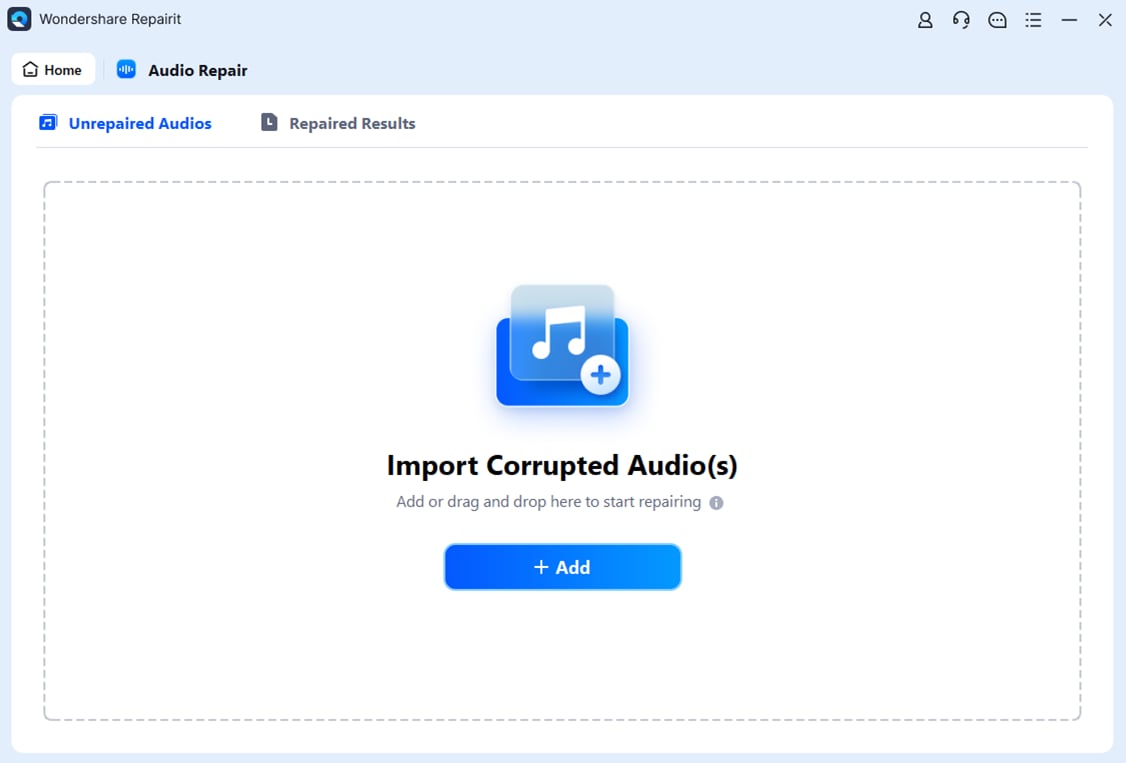
Step 1. Import the damaged audio files you want to fix into Repairit Audio Repair to begin the repair process smoothly.
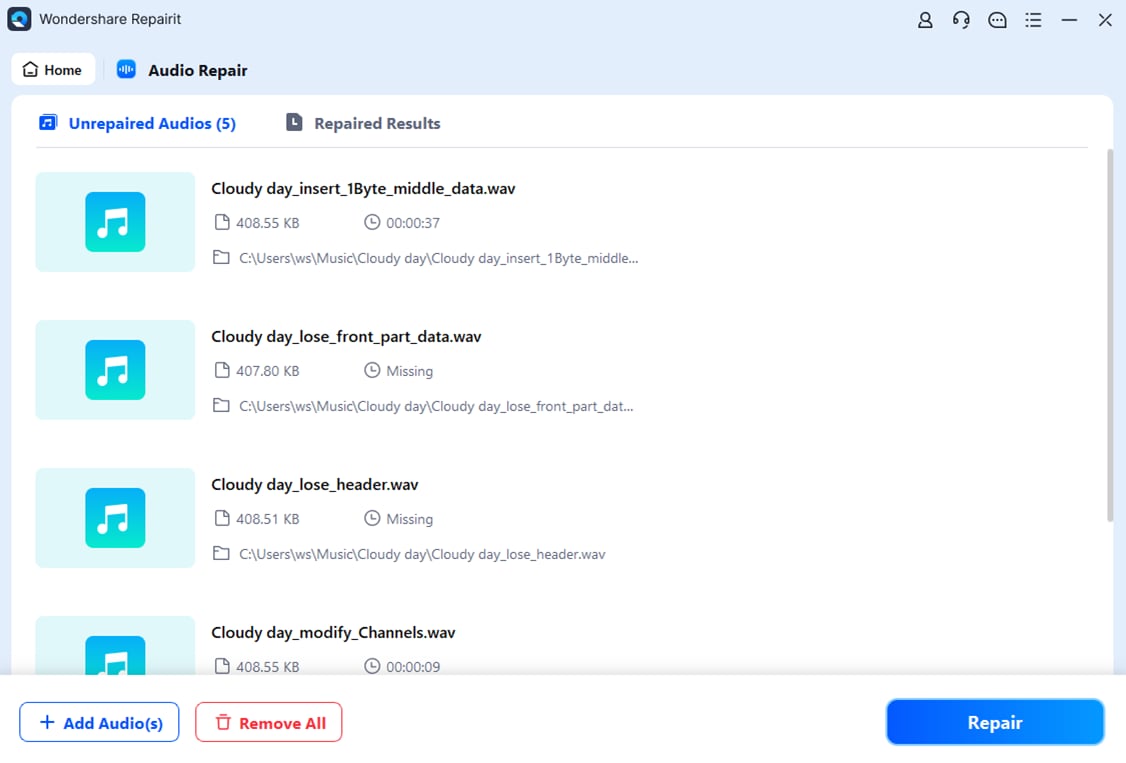
Step 2. Click the repair button to let Repairit Audio Repair automatically analyze and repair the corrupted audio files efficiently.
Step 3. Preview the repaired audio results, then save the successfully repaired files to your device.
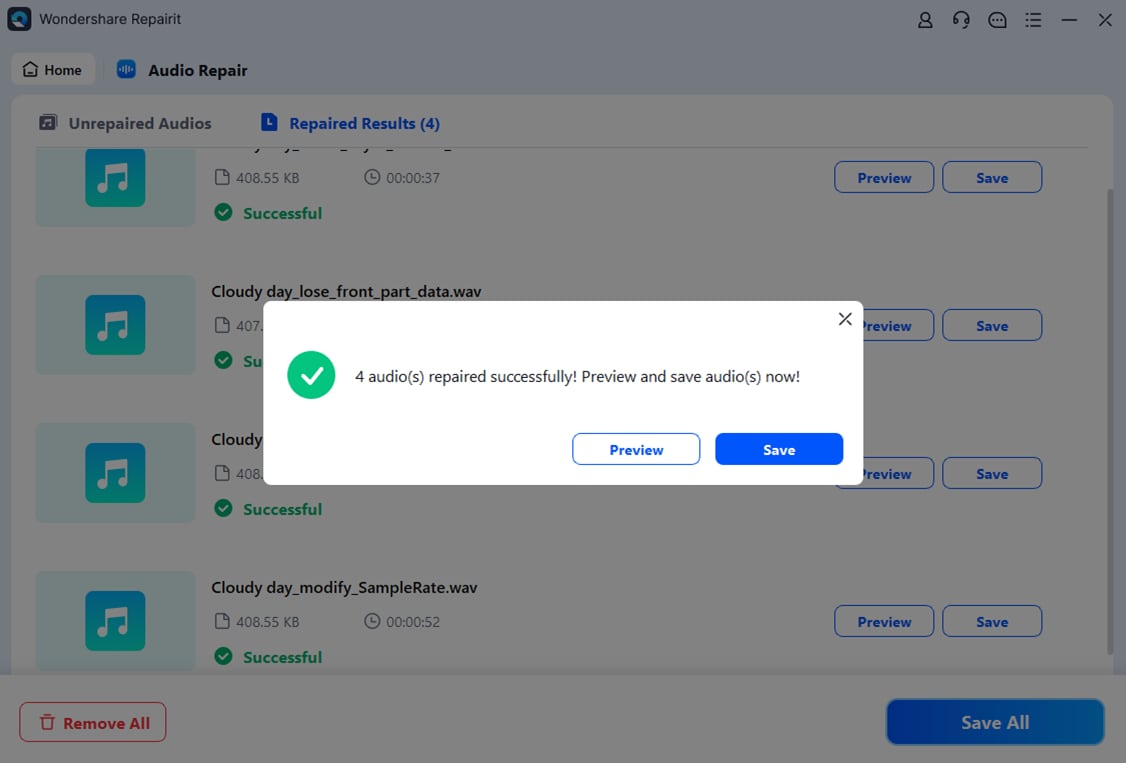
Once you have saved the repaired files, you can send them to any DAW, video editor, or restoration tool for further enhancement, including spectral cleanup if needed. This hybrid approach keeps file-level repair clear and contained while leaving room for deeper work later.
Final Verdict
The main difference between Repairit Audio Repair and CEDAR Studio is depth versus accessibility. CEDAR Studio is built for high-end, broadcast-grade restoration inside complex post-production workflows, where engineers need precise, spectral-level control and industry-grade reliability.
Repairit Audio Repair is more suitable when your priority is repairing corrupted or unplayable audio files quickly at the file level and moving on. If you run a professional post or broadcast facility, CEDAR Studio may be enough for deep, session-based restoration. If you need a practical way to fix damaged recordings without building a full post chain, Repairit Audio Repair fits more naturally into your daily work.
In many real-world scenarios, a hybrid workflow makes sense: use Repairit Audio Repair to restore basic playback on broken files, then handle any advanced cleanup or enhancement in a specialized environment. That way you match each task to the tool that handles it most efficiently.
Next: Repairit Audio Repair vs Wavelab Pro
FAQ
-
1. Is CEDAR Studio better than Repairit Audio Repair for audio repair?
Neither tool is universally better. CEDAR Studio is stronger for deep, broadcast-level restoration inside professional sessions, while Repairit Audio Repair is more suitable when you mainly need to repair corrupted or unplayable audio files with a guided, file-level workflow. -
2. When should I use Repairit Audio Repair instead of CEDAR Studio?
Use Repairit Audio Repair when your main problem is that a file will not play correctly, contains glitches, or seems structurally damaged. It provides a simpler workflow to repair corrupted files and restore playable audio before you move into editing, mixing, or enhancement in any other software. -
3. What is the difference between audio repair and audio enhancement or cleanup?
Audio repair focuses on fixing fundamental problems with the file or waveform, such as corruption, dropouts, or severe distortion that affects playback. Audio enhancement or cleanup, like denoise, de-click, de-hum, or voice enhancement, focuses on improving the quality of an already playable file rather than making a broken file playable again.