
Choosing between Repairit Audio Repair and Waves Restoration Suite starts with understanding whether you need file-level repair for corrupted audio files or plugin-based cleanup inside a DAW session. Both can help fix distorted or noisy audio, but they approach deep audio repair from very different angles.
In most real-world cases, Repairit Audio Repair is more suitable when you need to repair corrupted audio files, fix unplayable audio, or restore damaged playback before you ever open a DAW. Waves Restoration Suite may be enough if you are already mixing in a DAW and mainly need restoration plugins for hiss, hum, and clicks on individual tracks. This guide compares repair depth, workflow, and typical use cases so you can decide which tool fits your projects.
Repair Corrupted Audio Files With Repairit Audio Repair
 Security Verified. Over 7,302,189 people have downloaded it.
In this article
- Repairit Audio Repair vs Waves Restoration Suite: Quick Verdict
- Repairit Audio Repair vs Waves Restoration Suite: Key Differences
- Repairit Audio Repair vs Waves Restoration Suite: Comparison Table
- What Repairit Audio Repair and Waves Restoration Suite Are Best For
- Repairit Audio Repair vs Waves Restoration Suite: Audio Repair Capabilities
- Repairit Audio Repair vs Waves Restoration Suite: Supported Audio Formats and Use Cases
- Repairit Audio Repair vs Waves Restoration Suite: Workflow and Ease of Use
- Repairit Audio Repair vs Waves Restoration Suite: AI Processing and Automation
- Repairit Audio Repair vs Waves Restoration Suite: Pricing and Accessibility
- Who Should Choose Repairit Audio Repair
- Who Should Choose Waves Restoration Suite
- Pros and Cons of Repairit Audio Repair and Waves Restoration Suite
- How to Repair Corrupted Audio Files After Choosing the Right Tool
Repairit Audio Repair vs Waves Restoration Suite: Quick Verdict
The key difference is that Repairit Audio Repair focuses on guided file-level repair for corrupted or unplayable audio, while Waves Restoration Suite provides modular restoration plugins that live inside your DAW.
Repairit Audio Repair is more suitable when you receive damaged or glitchy files that may not play reliably and you just need a fixed version to deliver or import into a session. Waves Restoration Suite may be enough if you already work comfortably in DAWs and mainly need noise reduction, de-click, and de-hum tools across tracks in a mix.
In many professional workflows, engineers use both: Repairit Audio Repair to stabilize and repair badly damaged files first, then Waves modules for detailed cleanup and balancing during mixing.
Repairit Audio Repair vs Waves Restoration Suite: Key Differences
The main difference is that Repairit Audio Repair repairs corrupted audio files at the file level, while Waves Restoration Suite specializes in in-session cleanup and restoration inside a DAW environment.
Repairit Audio Repair offers a standalone, linear workflow: import a damaged file, let the tool analyze and repair it, then export a clean version. Waves Restoration Suite breaks restoration into several plugins that you insert on channels, stems, or busses, which gives engineers detailed control but assumes comfort with routing and plugin gain staging.
This matters if you are not a full-time mixer. For users who just need to fix unplayable audio from recorders, phones, or editors, the guided flow in Repairit Audio Repair is usually faster to learn. For post engineers who already rely on DAWs, Waves can be a better fit when restoration must be blended into complex sessions.
Repairit Audio Repair vs Waves Restoration Suite: Comparison Table
This comparison table summarizes how Repairit Audio Repair and Waves Restoration Suite differ in workflow, repair depth, and target users.
| Dimension | Repairit Audio Repair | Waves Restoration Suite |
|---|---|---|
| Best for | Users who need guided file-level repair to fix corrupted or unplayable audio without opening a DAW. | Engineers working in DAWs who need modular noise reduction and restoration plugins in a mix. |
| Ease of use | Simpler, task-focused interface for repairing damaged audio playback from standalone files. | Requires DAW knowledge and plugin routing, more complex for non-engineers. |
| Repair depth | Strong for targeted file-level repair of corrupted, clipped, or severely damaged audio files. | Deep control for noise, clicks, and hum inside a session, better for detailed mix restoration. |
| AI capability | Leans on guided and automated repair for corrupted files and severe artifacts. | Focuses more on manual and semi-automated plugin control than on end-to-end AI repair. |
| Workflow | Standalone, linear workflow: load a file, repair, then export a fixed version. | Plugin-based and modular workflow that fits into existing DAW projects and bounces. |
| Strengths | Clear file-level repair flow, good for turning unplayable or glitchy audio into usable material. | High-quality noise reduction modules and flexible usage across tracks and busses. |
| Weaknesses | Less suited to detailed per-track restoration within a large mix session. | Fragmented plugin workflow and a learning curve for those unfamiliar with DAWs. |
What Repairit Audio Repair and Waves Restoration Suite Are Best For
Repairit Audio Repair is more suitable when you need a focused tool to repair corrupted audio files and restore stable playback, while Waves Restoration Suite is better for engineers who want restoration modules integrated into their DAW sessions.
In practice, Repairit Audio Repair fits scenarios like client voice notes that will not play cleanly, exported interview audio that glitches, or archive material with structural issues. You import the file, run a guided repair, and export a clean version for delivery or further editing.
Waves Restoration Suite is aimed at situations where the files already play, but you need to reduce hiss, hum, crackle, or background noise across multiple tracks. Plugins can be placed wherever you need them in the signal chain, which is valuable when restoring complex sessions or broadcast mixes.
Repairit Audio Repair vs Waves Restoration Suite: Audio Repair Capabilities
The key difference is that Repairit Audio Repair focuses on deep file-level audio repair, while Waves Restoration Suite centers on in-session cleanup and restoration of already playable signals.
According to the shared capabilities, both options provide:
- Noise and hum reduction options for fixing persistent background problems that distract from the main source.
- De-click and de-crackle style repair for reducing pops and crackle from vinyl, broadcasts, or live recordings.
- Broadband hiss control that helps unmask dialogue or music buried under noise.
They also target deeper issues important in deep audio repair scenarios:
- Additional processing for clipped, distorted, or badly recorded material where basic cleanup is not enough.
- Spectral-focused adjustments that let you address problematic frequency regions without destroying the entire mix.
- Workflows that support before-and-after comparison so you can judge how aggressive the repair should be.
The main difference is how you access this power. Repairit Audio Repair concentrates these capabilities in a guided file-level interface that emphasizes repairing corrupted or unstable audio files. Waves Restoration Suite spreads its tools across several plugins that you combine inside the DAW, which can be more flexible for engineers but less direct for occasional users.
Repairit Audio Repair vs Waves Restoration Suite: Supported Audio Formats and Use Cases
Both tools work with common production formats, but Repairit Audio Repair handles them as standalone files while Waves Restoration Suite relies on whatever your DAW can host.
In most real-world cases, users are dealing with WAV, MP3, M4A, AAC, or FLAC files coming from recorders, phones, cameras, or editing software. Repairit Audio Repair lets you import these formats directly and repair corrupted audio files at the file level, which is ideal when a client sends you an isolated problematic asset.
Waves Restoration Suite, by contrast, processes audio that is already inside the DAW. As long as your DAW opens the file, you can insert the plugins on tracks, busses, or stems to clean hiss, clicks, or hum. This matters if your workflow is built around multitrack sessions and you want to keep everything inside the same project.
Repairit Audio Repair vs Waves Restoration Suite: Workflow and Ease of Use
The main difference is that Repairit Audio Repair offers a linear, guided workflow, while Waves Restoration Suite assumes comfort with DAW routing and plugin chains.
With Repairit Audio Repair, users often notice that the steps are straightforward: add a file, choose the repair type, let the tool process, then Preview and save. There is no need to manage sends, busses, or plugin ordering, which helps non-engineers repair damaged playback faster.
Waves Restoration Suite is more modular. Each plugin targets a specific problem, and you decide where to place it in the chain for each track or stem. This becomes important when you want surgical control over different noise sources, but it can feel fragmented if you just need to repair one corrupted audio file quickly.
Repairit Audio Repair vs Waves Restoration Suite: AI Processing and Automation
The key difference is that Repairit Audio Repair leans more heavily on automated analysis for corrupted files, whereas Waves Restoration Suite emphasizes manual and semi-automated control inside plugins.
For deep audio repair at the file level, Repairit Audio Repair uses guided and automated steps to assess corruption, instability, or severe artifacts, then applies suitable repair processing. You can still refine the outcome, but the tool aims to keep you out of low-level parameter tweaking when you just need a working file.
Waves Restoration Suite typically focuses on user-controlled repair. You dial in thresholds, reduction amounts, and frequency ranges for noise reduction and artifact control. This gives experienced engineers nuanced control, but it also means more time spent tweaking compared with a guided, end-to-end repair flow.
Repairit Audio Repair vs Waves Restoration Suite: Pricing and Accessibility
The main difference is that Repairit Audio Repair is a standalone desktop application, while Waves Restoration Suite is sold as a plugin bundle that requires a compatible DAW.
Repairit Audio Repair is licensed independently of any plugin host, so you can run it on a computer without additional audio software and focus only on repairing corrupted audio files. This makes it accessible to podcasters, interviewers, and support teams who may not own full DAW setups.
Waves Restoration Suite is typically purchased as part of Waves promotions or bundles, and it depends on having a DAW that supports the plugin formats. Users need to factor in not only the plugin cost but also the DAW platform and any ongoing update policies from Waves. For both products, checking current pricing, trials, and upgrade paths on the official sites is important before committing.
Who Should Choose Repairit Audio Repair
Repairit Audio Repair is more suitable when you primarily need to repair corrupted audio files and do not want to manage a full DAW session.
- You mainly need to repair corrupted audio files or fix unplayable audio exported from devices or editors.
- You prefer a guided, standalone workflow instead of stacking multiple restoration plugins in a DAW.
- You want to quickly repair damaged recordings without building complex sessions or plugin chains.
- You often receive problematic client files and simply need a clean, exportable version that plays reliably.
If this sounds like your day-to-day work, using Repairit Audio Repair as your first stop for deep file-level repair can streamline projects before you move into editing or mixing.
Who Should Choose Waves Restoration Suite
Waves Restoration Suite may be enough if you already live inside a DAW and mostly need restoration modules for playable audio rather than file-level repair for corrupted or unstable files.
- You mix or edit regularly in a DAW and want restoration tools directly on individual tracks.
- You need precise control over noise, hum, and clicks across multi-track sessions.
- You are comfortable with plugin chains and routing in platforms like Pro Tools, Logic, or Cubase.
- You want modular repair plugins that blend into your existing mastering or post-production workflow.
In these cases, Waves Restoration Suite integrates well into a DAW-centric environment where deep session control is more important than standalone file-level repair.
Pros and Cons of Repairit Audio Repair and Waves Restoration Suite
The main difference in pros and cons comes down to whether you prioritize guided, file-level repair or modular plugin flexibility inside a DAW.
Repairit Audio Repair Pros and Cons
Waves Restoration Suite Pros and Cons
How to Repair Corrupted Audio Files After Choosing the Right Tool
After comparing Repairit Audio Repair and Waves Restoration Suite, the next step is actually repairing the corrupted or unstable audio files that are blocking your project. The comparison above shows that file-level deep repair and in-session cleanup serve different needs, so it helps to start with a tool designed for stabilizing damaged playback.
For users who want a guided way to repair corrupted audio files before any mixing or detailed editing, Repairit Audio Repair offers a practical standalone workflow. You can repair a file until it plays reliably, then bring that repaired version into any DAW or editing software for further enhancement if needed.
Key Features
For deep audio repair scenarios, Repairit Audio Repair focuses on structural problems with the file rather than simple enhancement.
- Guided repair for corrupted, glitchy, or unplayable audio files exported from recorders, phones, or editors.
- Targeted processes that concentrate on deep audio repair instead of only cosmetic noise reduction.
- Standalone workflow that lets you fix distorted or noisy audio and export a clean, usable file for any player or DAW.
Step-by-step guide
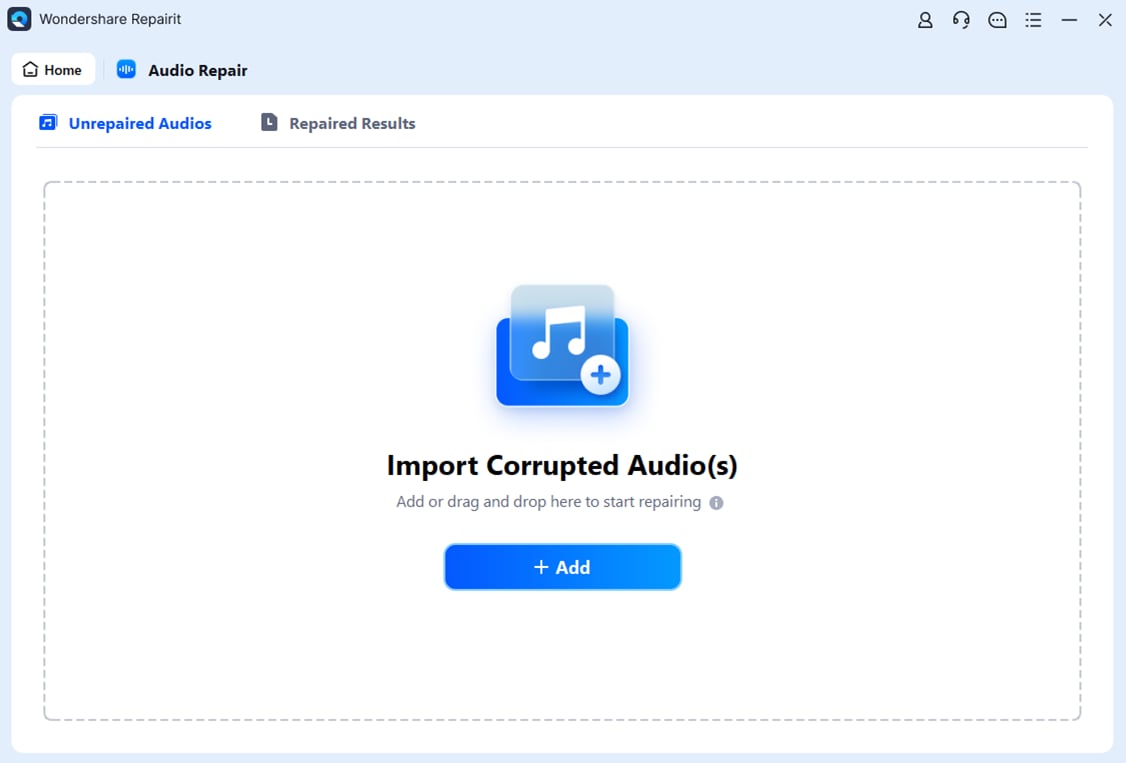
Step 1. Import the damaged audio files you want to fix into Repairit Audio Repair to begin the repair process smoothly.
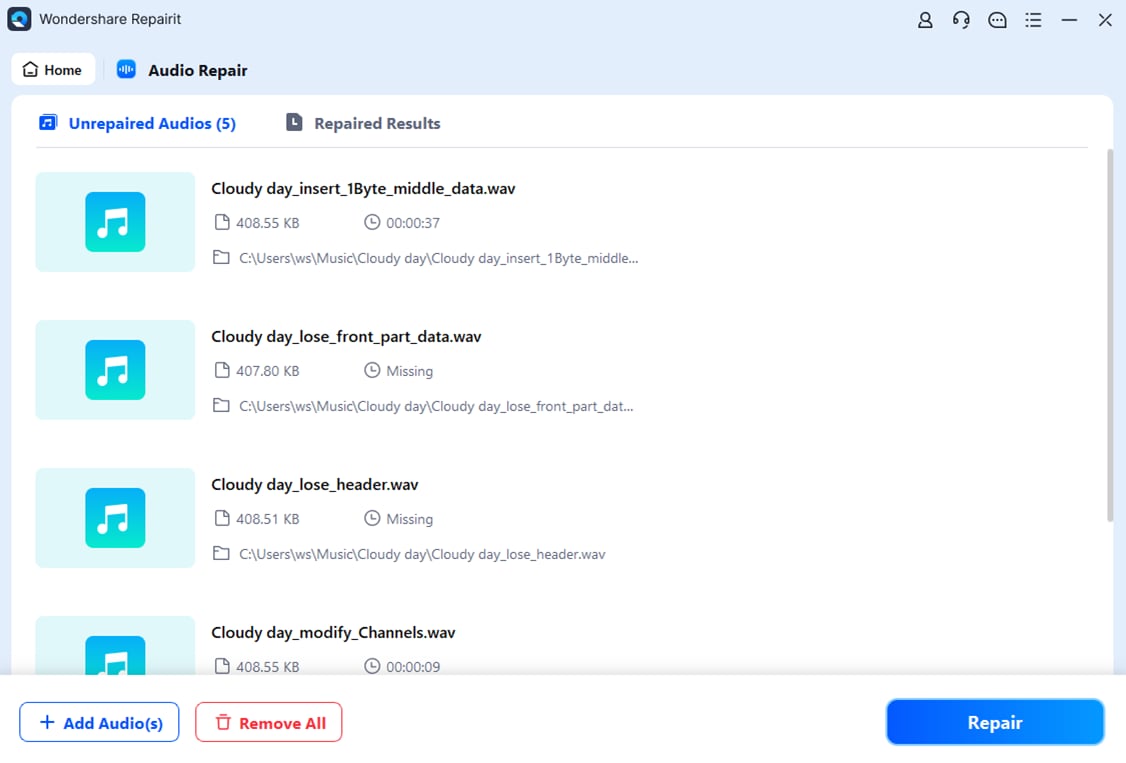
Step 2. Click the repair button to let Repairit Audio Repair automatically analyze and repair the corrupted audio files efficiently.
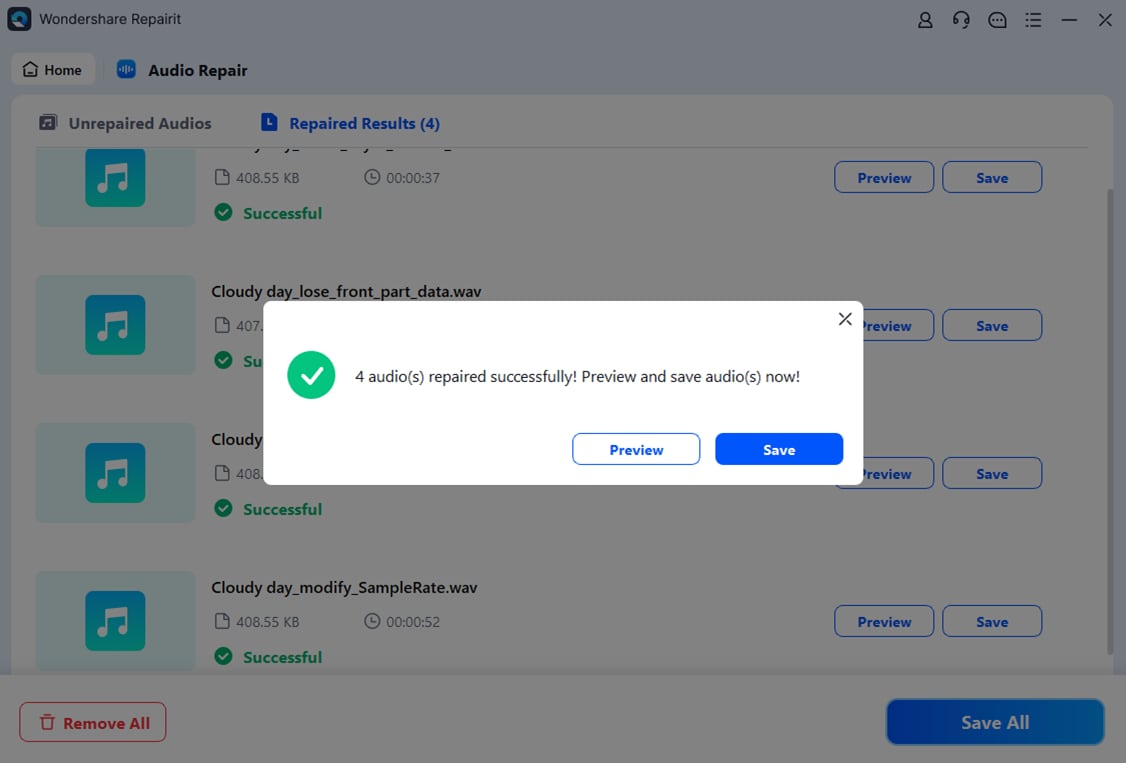
Step 3. Preview the repaired audio results, then save the successfully repaired files to your device.
Final Verdict
The key difference between Repairit Audio Repair and Waves Restoration Suite is where they live in your workflow: Repairit Audio Repair focuses on repairing corrupted or unplayable audio at the file level, while Waves Restoration Suite focuses on plugin-based cleanup inside DAW sessions.
Repairit Audio Repair is more suitable when you are handed unstable, glitchy, or corrupted files and need a guided process to restore damaged audio playback before mixing. Waves Restoration Suite may be enough if your audio already plays inside the DAW and your main goal is to reduce noise, clicks, or hum in a multi-track context.
In most real-world cases, engineers benefit from combining both approaches: use Repairit Audio Repair first when a file is too damaged or unstable to handle smoothly in the DAW, then rely on Waves Restoration Suite or other plugins for detailed mix-level cleanup, shaping, and enhancement.
Next: Repairit Audio Repair vs Cedar Studio
FAQ
-
1. Is Repairit Audio Repair a replacement for Waves Restoration Suite?
Repairit Audio Repair is not necessarily a replacement for Waves Restoration Suite, because they target different stages of the workflow. Repairit Audio Repair focuses on file-level deep repair for corrupted or unplayable audio, while Waves Restoration Suite provides modular restoration plugins inside a DAW. Many engineers keep Waves for in-session cleanup and rely on Repairit Audio Repair when a file is too damaged or unstable to work with smoothly in the DAW. -
2. When should I use Repairit Audio Repair instead of Waves Restoration Suite?
Use Repairit Audio Repair when you receive a corrupted, glitchy, or unplayable audio file that needs to be stabilized first. This matters if the file will not import cleanly into your DAW, drops out during playback, or you prefer a guided process that focuses on turning one damaged file into a reliable, exportable version before any detailed mixing or editing. -
3. How is audio repair different from audio enhancement or cleanup?
Audio repair addresses structural problems with the file or recording, such as corruption, dropouts, severe distortion, or unstable playback. Enhancement or cleanup, like noise reduction, de-click, or de-hum, improves an already playable recording. Waves Restoration Suite is strong for cleanup inside a DAW, while Repairit Audio Repair is aimed at repairing damaged playback at the file level so that you can then enhance the audio further if needed.