
When you record, edit, or export a video, the video pixel format quietly decides how color and brightness are stored in every frame. You will see it in camera menus, screen recorders, and video editors as options like RGB, YUV 4:2:0, or 4:2:2. Understanding this setting helps you balance quality, file size, and compatibility for streaming, sharing, and professional post-production.
Repair Corrupted Files To Save Your Data
 Security Verified. Over 7,302,189 people have downloaded it.
In this article
What Is Video Pixel Format?
Video pixel format is a technical setting that describes how each pixel in a video frame stores brightness and color information. It defines whether color is saved as RGB or YUV, how chroma (color) is sampled or subsampled (for example, 4:2:0 vs. 4:2:2), and how many bits are used per channel (bit depth).
In other words, it is a video parameter that controls the internal structure of your image data, not the resolution or frame rate. The pixel format decides how detailed colors can be, how large the files are, and how efficient compression will be for recording, editing, exporting, streaming, and playback across different platforms.
Most modern cameras, capture cards, screen recorders, and video editors handle several pixel formats, then convert them as needed for delivery to sites like YouTube, Vimeo, or social media apps.
What Does Video Pixel Format Affect?
The choice of video pixel format has a direct impact on how your footage looks, how heavy your files are, and how smoothly they move through your workflow.
| Aspect | How pixel format influences it |
|---|---|
| Color detail and accuracy | Formats like RGB or YUV 4:4:4 keep full color data, while YUV 4:2:2 and 4:2:0 reduce color resolution to save space, which can soften edges and fine gradients. |
| Bit depth and banding | Higher bit depths (10-bit, 12-bit) allow smoother gradients and better grading flexibility than 8-bit, reducing visible banding in skies or walls. |
| File size and compression | More color information and higher bit depth increase file size. Heavily subsampled formats like YUV 4:2:0 keep files smaller and easier to compress for streaming. |
| Editing and VFX workflow | Rich pixel formats (RGB 4:4:4, 10-bit+) are preferred for green screen, heavy color grading, and professional finishing; lighter formats are fine for quick edits and social posts. |
| Compatibility and playback | Most consumer devices and platforms expect YUV 4:2:0. Exotic formats or high bit depths may fail on older players or cause conversion issues. |
For example, a game capture in RGB 4:4:4 10-bit can look extremely clean but create huge files and require powerful hardware. The same content in YUV 4:2:0 8-bit will be much smaller and easier to stream, at the cost of some color precision that many casual viewers will not notice.
When you upload to streaming platforms, your video is usually converted to a standard pixel format such as YUV 4:2:0 with a fixed bit depth. Knowing this helps you avoid surprises like banding or color shifts after export or upload.
How Does Video Pixel Format Work in Real Use?
In practice, video pixel format appears as a dropdown or hidden preset in your recording devices, capture tools, and editing software. It quietly shapes how your image data is stored from the camera sensor to the final file.
Typical pixel formats you will see
Here are some common pixel format options and where they show up.
- RGB (full color per pixel)
Each pixel stores full red, green, and blue values. Ideal for graphics, screen capture, and compositing, but heavier to record and store. - YUV / YCbCr 4:4:4
Separates brightness (Y) from color (U/V or Cb/Cr) with no chroma subsampling. Keeps maximum color detail while staying closer to broadcast standards. - YUV / YCbCr 4:2:2
Halves horizontal color resolution. Very common in professional cameras and capture cards; good balance between quality and data rate. - YUV / YCbCr 4:2:0
Reduces color resolution in both directions. Standard for consumer cameras, smartphones, and streaming platforms; excellent for saving bandwidth. - 8-bit, 10-bit, 12-bit
Bit depth options that define how many levels each channel can represent, which affects dynamic range and how smooth gradients appear.
Where do you choose the pixel format in your workflow
You will encounter video pixel format at several stages of production and delivery.
- Recording on cameras and phones
Some DSLRs, mirrorless cameras, and cinema cameras let you pick between 4:2:0 and 4:2:2, or between 8-bit and 10-bit. Higher settings help with color grading, but fill cards faster. - Screen recording and game capture
Capture tools often let you choose RGB vs YUV and different color depths. RGB is accurate for UI and text; YUV 4:2:0 is lighter and better for long recordings or streaming. - Video editing software
Apps like Premiere Pro, DaVinci Resolve, or Final Cut handle many pixel format types internally. You will mainly see them in media info, sequence settings, and export presets. - Exporting and encoding
Codecs such as H.264 and H.265 usually export in YUV 4:2:0, which is what YouTube and most platforms expect. High-end formats like ProRes or DNxHR can use 4:2:2 or 4:4:4 with higher bit depths. - Streaming and playback
Live encoders and streaming apps usually lock you to YUV 4:2:0 for compatibility. Hardware decoders in TVs, phones, and set-top boxes are optimized for these mainstream formats.
Sometimes your footage may be transcoded from one video pixel format to another automatically, such as when a platform recompresses uploads or when a converter tool changes color space. Poor conversions or incompatible settings can lead to wrong gamma, color shifts, or loss of detail.
Common Mistakes and Quick Tips
Misunderstanding pixel format can lead to avoidable quality issues. Here are frequent pitfalls and how to avoid them.
- Confusing pixel format with resolution
Resolution controls how many pixels you have; pixel format controls what is stored in each pixel. You can have 4K 4:2:0 8-bit or 4K 4:4:4 10-bit, and they will behave very differently in grading. - Assuming RGB is always "best"
RGB can offer clean color and is ideal for some workflows, but it is not always necessary and can be inefficient for long recordings or streaming. YUV 4:2:0 is often more practical. - Ignoring bit depth
Staying at 8-bit for footage that you plan to push hard in color correction can cause banding. When possible, choose 10-bit for projects with heavy grading or HDR-style looks. - Mismatching formats in the pipeline
Mixing very different video pixel format types in one timeline is fine, but exporting with the wrong color space or subsampling can cause washed-out or oversaturated results. - Overkill for social media
Recording everything in high-end 4:4:4 10-bit for short social clips may waste storage and processing power, with little visible benefit after compression.
Quick takeaways:
- For YouTube, streaming, and general sharing, YUV 4:2:0 8-bit or 10-bit is usually enough.
- For color-heavy work, greenscreen, or professional grading, consider YUV 4:2:2 or RGB with higher bit depth.
- Keep your capture and export settings consistent to avoid unexpected color changes.
How to Use Repairit to Fix a Corrupted Video File
Why use Repairit for corrupted videos?
When videos will not play, freeze, or show strange artifacts, the problem can be deeper than the visible image. Structures tied to encoding and video pixel format may be damaged. Wondershare Repairit is built to analyze and repair corrupted media across many formats and devices. You can learn more and download it from the Repairit official website.
Key features of Wondershare Repairit
- Repairs multiple corrupted video files from various cameras and formats in one session.
- Automatic analysis of file structure to fix playback, freezing, and audio sync issues.
- Simple interface with preview options before exporting the repaired videos.
Step-by-step: Fix a corrupted video with Repairit
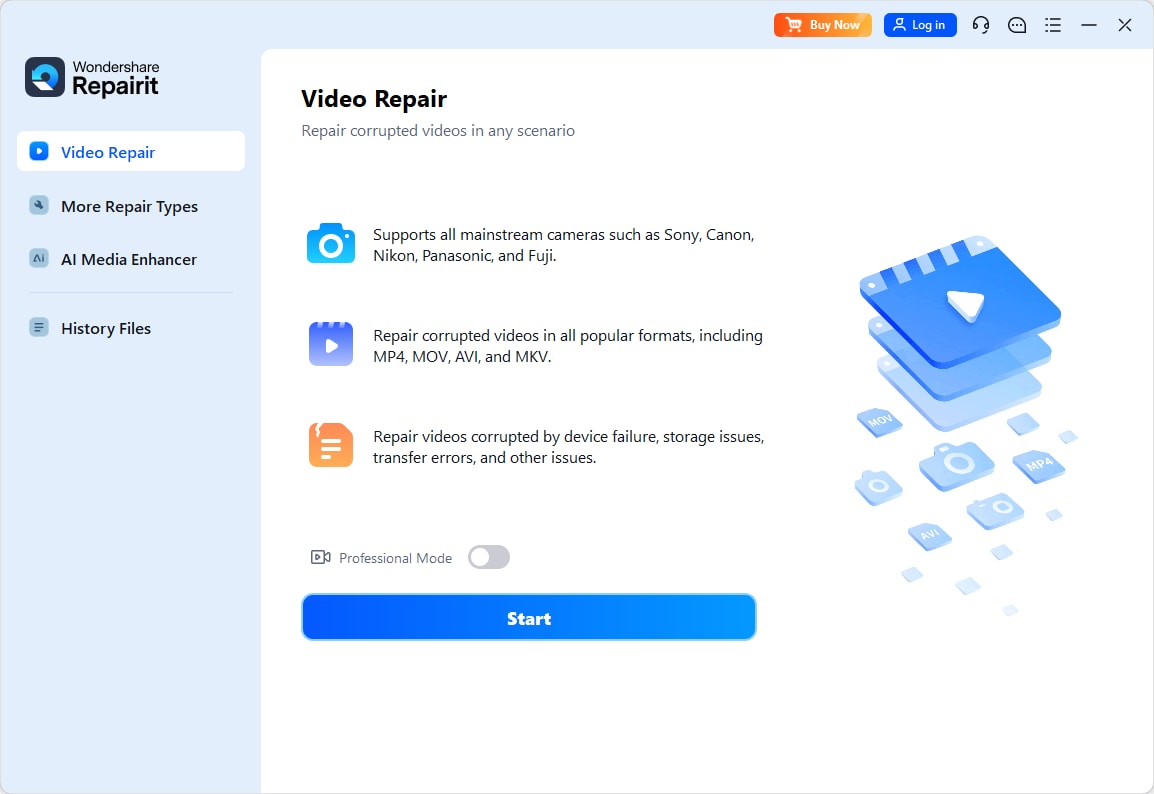
- Add corrupted video files
Install and launch Wondershare Repairit on your computer, then go to the Video Repair module. Click the "Add" button and navigate to the folder containing the damaged clips. Select one or several videos, including those with unusual video pixel format settings, and load them into the repair list.
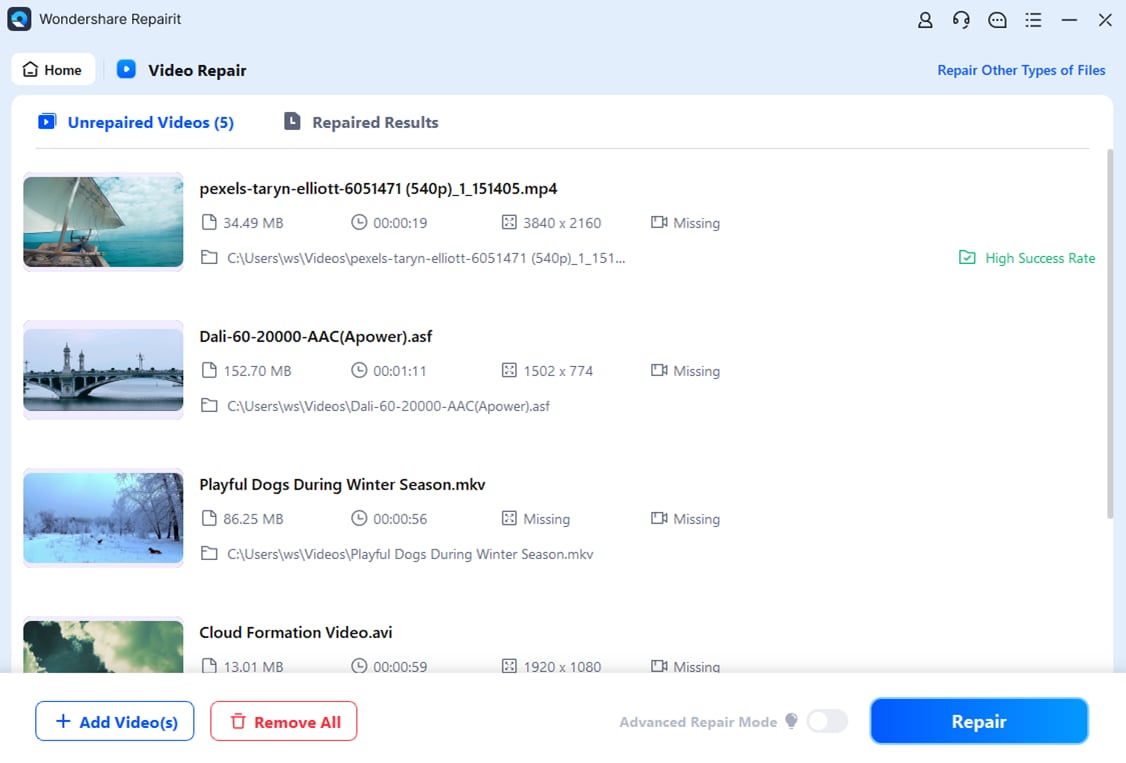
- Repair video files
After the videos are listed, start the repair process. Repairit will scan the internal structure of each file, looking at containers, encoding, and pixel format-related data to resolve playback errors, freezes, or missing audio. When the initial repair completes, use the built-in preview window to check that the motion, colors, and sound behave as expected.
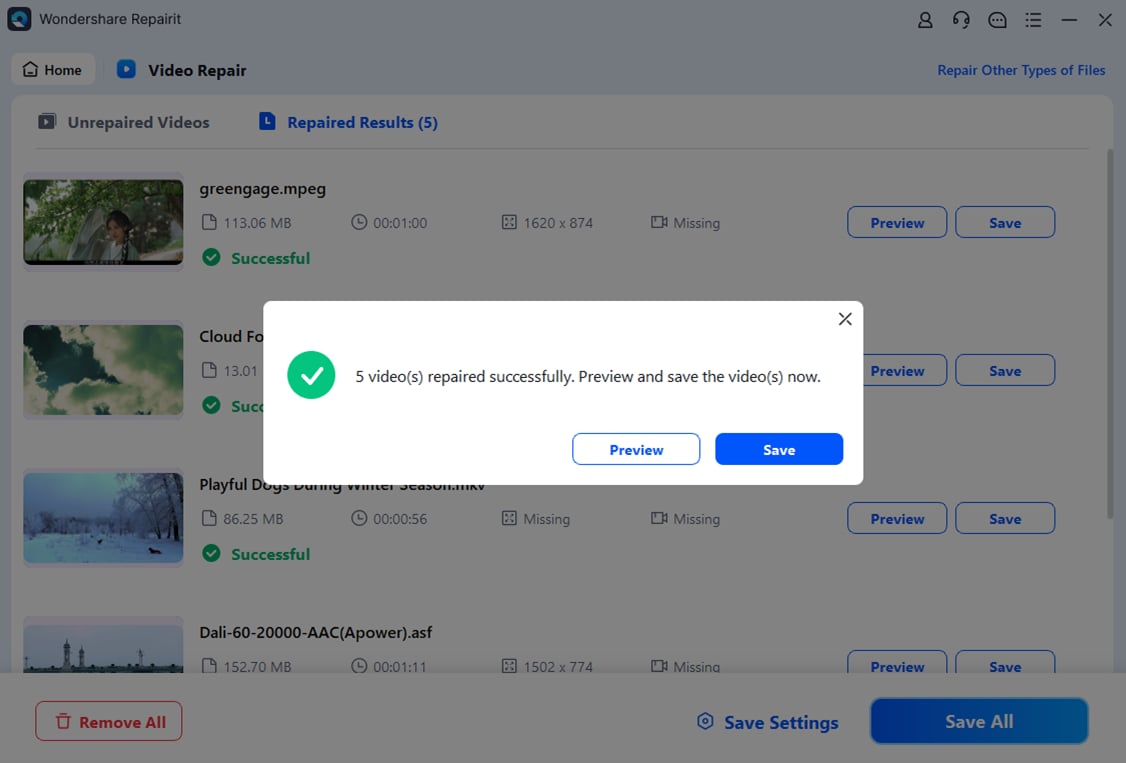
- Save the repaired video files
If the preview looks correct, choose a secure destination folder that is different from the original file location. Click "Save" to export your repaired clips. Repairit will keep the fixed versions in the new folder, so you can archive them safely, re-edit them, or upload them to streaming platforms without worrying about the earlier corruption.
Conclusion
Video pixel format determines how each pixel in your footage stores color and brightness. Choices like RGB vs YUV, 4:4:4 vs 4:2:0, and 8-bit vs higher bit depths shape image quality, file size, and how flexible your footage is for editing and grading.
By understanding which pixel format fits your camera, editing style, and delivery platform, you can avoid banding, color shifts, and bloated files. And if a video becomes corrupted along the way, using a dedicated repair tool such as Wondershare Repairit helps you restore unplayable clips and keep your projects on track.
Next: What is Video Dynamic Range?
FAQ
-
1. What is video pixel format in simple terms?
Video pixel format is the rulebook that tells your video file how to store brightness and color in each pixel. It specifies whether data is saved as RGB or YUV, how much color detail is kept (for example, 4:2:0 vs 4:2:2), and how many bits are used. Together, these choices affect image quality, file size, and how well your video survives editing and compression. -
2. Is RGB better than YUV for video quality?
RGB can deliver very accurate color and is often preferred for graphics and compositing, but it creates larger files and heavier workloads. YUV with chroma subsampling, such as 4:2:0, is more efficient and is standard for cameras, streaming, and web delivery. For most viewers, well-encoded YUV 4:2:0 looks excellent and is more practical than RGB for everyday use. -
3. What pixel format should I use for YouTube uploads?
YouTube expects videos in a YUV 4:2:0 pixel format, typically at 8-bit or 10-bit depth. Export using a common codec like H.264 or H.265 in 4:2:0 with a sufficiently high bitrate for your resolution. This matches YouTube's processing pipeline and helps avoid unnecessary conversions or quality loss. -
4. Can pixel format cause banding or color problems?
Yes. Low bit depth (for example, 8-bit) combined with heavy compression or aggressive chroma subsampling can increase banding in smooth gradients and reduce subtle color detail. Mismatched formats between capture, timeline, and export can also lead to washed-out, crushed, or oversaturated colors if color space and gamma are not handled correctly. -
5. How do I fix a corrupted video with an unusual pixel format?
First, try opening the file in a robust media player like VLC to rule out simple playback issues. If the video still fails to play, freezes, or shows heavy artifacts, use a repair tool such as Wondershare Repairit. It analyzes the damaged structure of the file, including encoding and pixel format-related data, and attempts to rebuild readable frames and audio so the clip becomes playable again.