Progressive scan sits behind almost every video you watch today, from streaming services and gaming to smartphone clips and 4K TVs. You will see it in camera menus, video editor export settings, and media player details as "P" or "progressive." Understanding how it works, and how it differs from interlaced video, helps you get sharper, smoother, more compatible results when you record, edit, encode, or troubleshoot playback issues.
Repair Corrupted Files To Save Your Data
 Security Verified. Over 7,302,189 people have downloaded it.
In this article
What Is Progressive Scan?
Progressive video is a way of drawing video frames where every line of the image is captured and displayed in one pass. In technical terms, progressive scan is a video scan type or display method used in recording, encoding, and playback. Instead of splitting each frame into two alternating fields (like interlaced scan), progressive scan treats each frame as a complete picture, shown one after another at a set frame rate (for example, 24p, 30p, 60p).
This concept belongs to the category of video parameters and playback behavior. It directly affects how clean motion looks, how sharp still details appear, and how well your footage matches modern screens, streaming platforms, and editing workflows.
What Does Progressive Scan Affect?
Image clarity and detail
Because each frame in a progressive scan video is complete, still areas of the image look very sharp and stable. Fine details such as text, UI elements, or thin lines render clearly without the horizontal "combing" that can appear in interlaced footage.
On high-resolution monitors and TVs, progressive content generally appears:
- Sharper at the same resolution compared with interlaced video
- More stable for screenshots, freeze-frames, and thumbnails
- Cleaner when zooming or cropping in editing software
Motion, artifacts, and file handling
Progressive scan also influences how motion is captured and displayed. When objects move quickly, interlaced fields can misalign and create comb-like artifacts. Progressive frames avoid this, which improves motion clarity and reduces flicker.
In real use, progressive scan affects:
- Motion clarity: Fast action and sports look smoother and more natural when recorded and displayed progressively, especially at higher frame rates like 50p or 60p.
- Artifacts: There is no need for deinterlacing, so you avoid many common jagged edges and ghosting issues.
- Compatibility: Streaming platforms, web players, and mobile devices are optimized for progressive frames, so uploads transcode and play more reliably.
- Editing and effects: Progressive footage behaves better for slow motion, frame-by-frame work, stabilization, and visual effects, because every frame is complete.
- File size and compression: Modern codecs (such as H.264 and H.265) often compress progressive material more efficiently, which can mean better quality at the same bitrate compared with interlaced sources.
| Aspect | Progressive Scan |
|---|---|
| Frame structure | Full frames, all lines drawn in one pass |
| Typical label | 1080p, 720p, 2160p (the "p" stands for progressive) |
| Artifacts | Less combing and flicker, especially in fast motion |
| Best for | Modern TVs, monitors, streaming, gaming, and web video |
How Does Progressive Scan Work in Real Use?
In day-to-day workflows, progressive scan appears as a selectable scan type or mode on cameras, capture cards, encoders, and video editors. It directly shapes how you record, edit, export, and stream your content.
On cameras and recording devices
Most modern cameras, smartphones, and action cams default to progressive video. In the resolution and frame-rate menu you might see choices like 1080p30, 1080p60, or 4K30. The "p" numbers tell you the device will capture full frames at that frame rate.
- Use 24p or 25p when you want a more "cinematic" motion feel.
- Use 50p or 60p when you need smoother motion for sports, gameplay, or handheld shots.
- Avoid mixing interlaced and progressive modes in the same project unless you know how to deinterlace properly.
In editing, encoding, exporting, and streaming
Video editors like Premiere Pro, Final Cut Pro, and DaVinci Resolve allow you to set your project sequence as progressive. When you match your project settings to your video scan type, you avoid unnecessary conversion and quality loss.
Common real-world scenarios include:
- Export settings: When exporting, you pick "progressive" or "none" in the interlacing field options to keep every frame complete. This is ideal for YouTube, Vimeo, social platforms, and most OTT services.
- Streaming encoders: Tools like OBS or hardware encoders usually recommend progressive formats (for example, 1080p60) because platforms like Twitch and YouTube Live expect progressive inputs.
- Playback and compatibility: Modern TVs, monitors, and mobile screens are inherently progressive displays, so they show progressive content natively without extra processing.
- File exchange: Progressive clips are easier to share between systems, apps, and operating systems with fewer surprises in how motion appears.
Common Mistakes and Quick Tips
People often misunderstand how progressive scan works or when to use it. Clearing up a few myths can save you time and improve your results.
Frequent misunderstandings
- "Progressive always fixes choppy video." Smoothness depends on frame rate, shutter speed, motion blur, and playback power. A low-frame-rate progressive clip can still look stuttery.
- "Interlaced is fine because everything deinterlaces perfectly." Automatic deinterlacing varies by device and player; it can soften the image, introduce ghosting, or create artifacts.
- "1080i and 1080p look the same." On fast motion and large screens, 1080p usually looks cleaner and more stable than 1080i.
- "I can freely mix scan types." Dropping interlaced clips into a progressive timeline without proper conversion can create jagged lines and strange motion.
Quick tips for better progressive video
- When possible, choose a progressive mode on your camera (look for "p" in the resolution and frame-rate options).
- Match your sequence settings in the editor to your recorded video scan type and frame rate.
- Export in a progressive format for web, mobile, and streaming platforms to avoid deinterlacing issues.
- Use higher progressive frame rates (50p or 60p) for fast motion, sports, or gameplay capture.
- If you must use interlaced archives, deinterlace them carefully before mixing with progressive footage.
- Keep reliable storage and safe transfer habits to avoid fix corrupted video situations later.
How to Use Repairit to Fix a Corrupted Video File
Why choose Repairit
Even well-shot progressive video can become corrupted due to power loss, bad SD cards, transfer errors, or crashes during editing and export. When your progressive footage will not play, freezes, or shows strange artifacts, Wondershare Repairit offers a simple way to bring it back. You can learn more and download it from the Repairit official website.
Repairit is purpose-built for video repair, including progressive scan files from cameras, phones, drones, action cams, and screen recorders. It guides you through importing broken files, repairing them, previewing the results, and saving healthy versions without complex technical steps.
Key features of Repairit
- Repairs various video formats from cameras, phones, and action cams
- Supports advanced repair for severely corrupted or unplayable clips
- Offers a clear preview before you save the repaired video files
Step-by-step: repair corrupted progressive videos
- Add corrupted video files
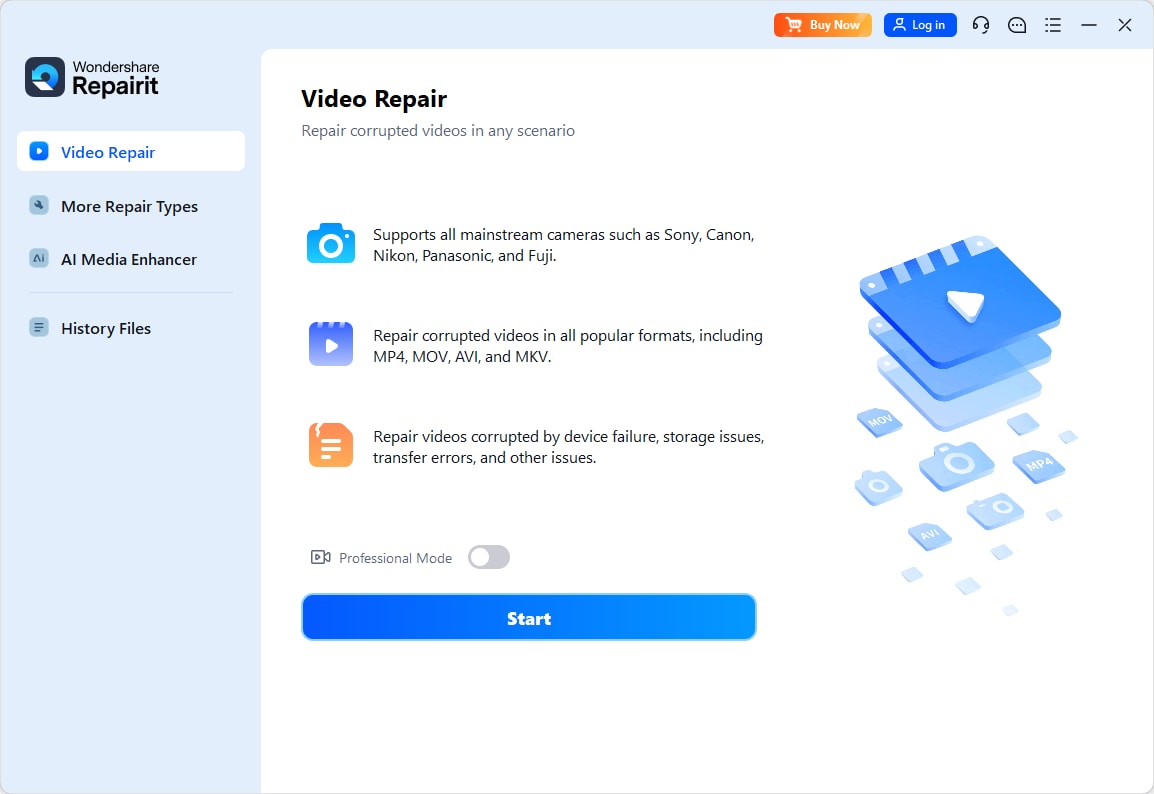
Open Repairit on your computer and go to the Video Repair section. Click the add button or drag and drop to import one or more corrupted progressive scan video files from your hard drive, SD card, or external storage. You can load clips from different cameras and formats in a single batch.
- Repair video files
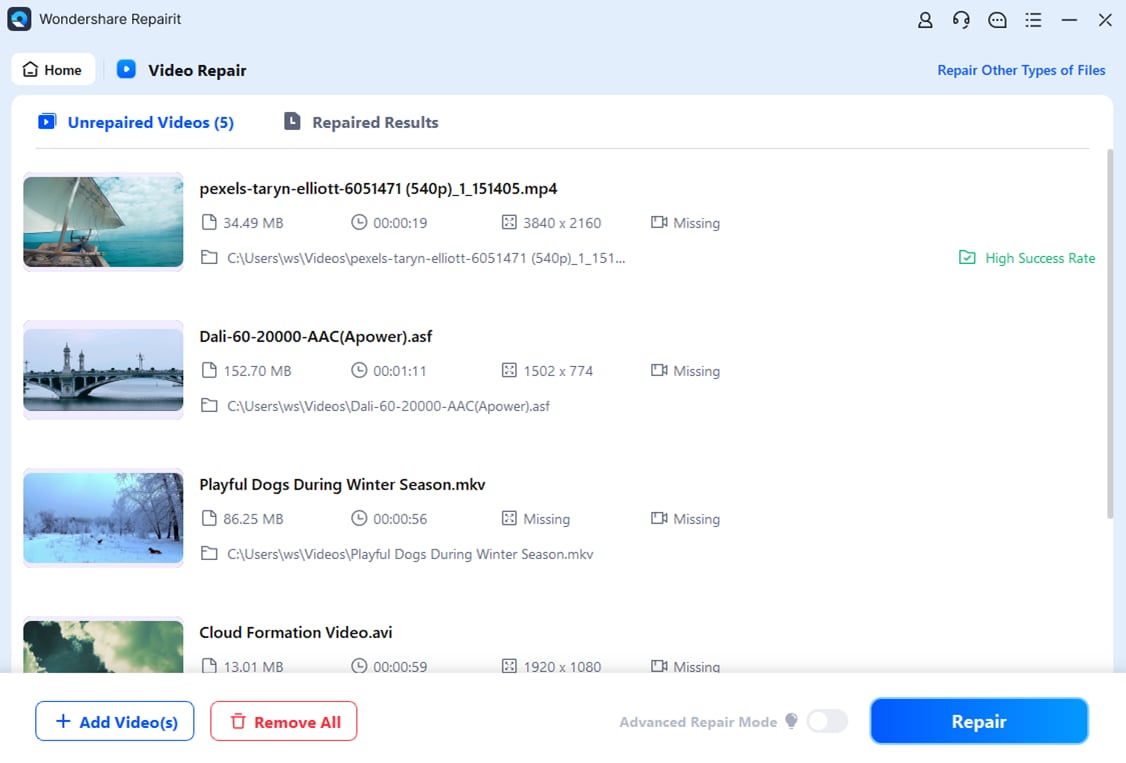
After your files are listed, start the repair process. Repairit scans the structure of each file, analyzes headers, frames, and metadata, and then reconstructs damaged sections where possible. For heavily corrupted clips, you can enable advanced repair and provide a sample video from the same device to improve the repair quality.
- Save the repaired video files
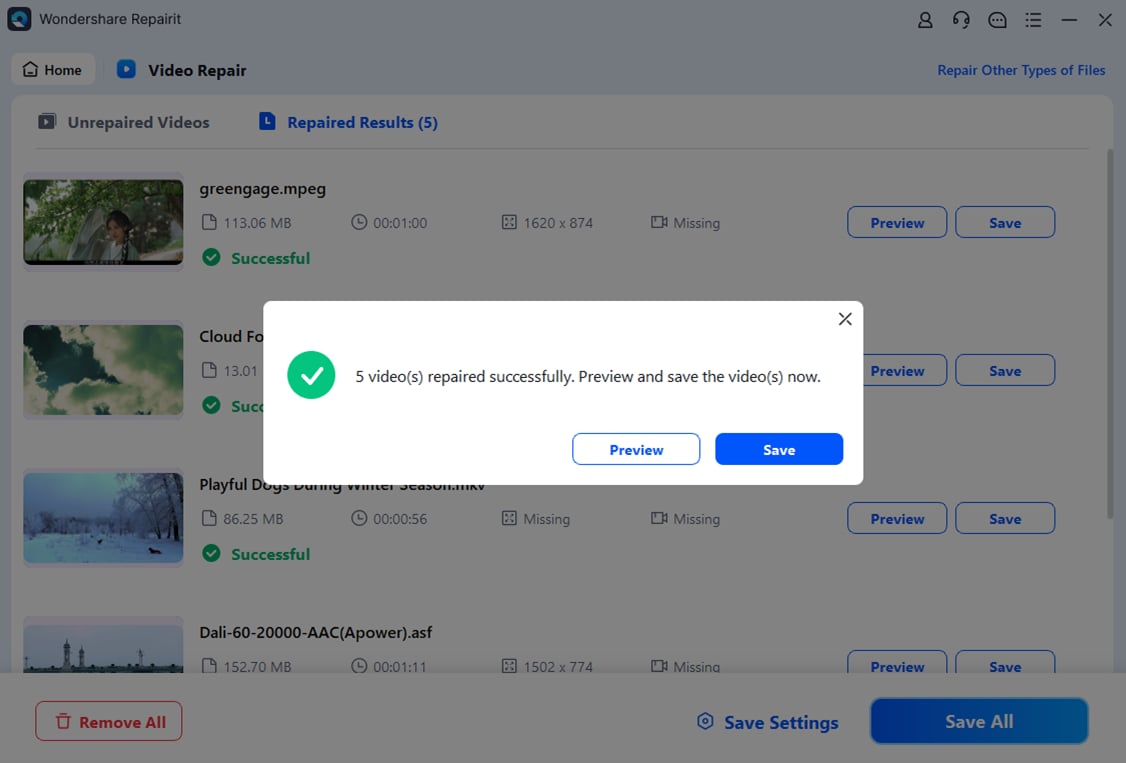
When the repair completes, use the built-in player to preview each fixed video and confirm that playback, motion, and audio are back to normal. Select the clips you are satisfied with, click Save, and choose a safe destination folder. Repairit exports new, playable files while keeping your original corrupted versions unchanged.
Conclusion
Progressive scan records and displays each frame as a full picture, which is why it produces sharper images, cleaner motion, and fewer artifacts than older interlaced formats. It underpins most modern cameras, screens, and streaming platforms, and it is now the default choice for web video, gaming, and professional production.
By understanding how interlaced vs progressive scanning works, you can choose the right modes on your devices, set up editing timelines correctly, and export compatible videos that look great everywhere. When progressive footage becomes damaged or unplayable, specialized tools like Repairit help you repair progressive video files so your projects do not go to waste.
Next: What is Video Pixel Format?
FAQ
-
1. What is the main difference between progressive scan and interlaced scan?
The key difference is how each frame is drawn. In progressive scan, every frame is a full image drawn line by line in order. In interlaced scan, each frame is split into two fields: one with odd lines and one with even lines, shown alternately. Progressive generally delivers sharper, more stable images and avoids the combing artifacts that can appear with interlaced footage. -
2. Why does progressive scan look better on modern TVs and monitors?
Modern TVs, monitors, and mobile screens are inherently progressive displays, designed to show complete frames. When they receive progressive video, they can display it directly without extra processing. With interlaced content, the screen must deinterlace first, which can soften the image or introduce artifacts. That is why progressive content typically looks cleaner and more consistent. -
3. Does progressive scan always mean smoother video?
No. Progressive scan removes interlacing artifacts but does not guarantee smoothness by itself. Motion smoothness depends largely on frame rate, shutter speed, and playback performance. A 24p progressive clip may feel less smooth than a 60i or 60p clip, especially during fast camera moves, even though it is free from interlacing artifacts. -
4. Which is better for online video, progressive or interlaced?
For online platforms, interlaced vs progressive is not a close contest: progressive is strongly preferred. Streaming sites, browsers, and mobile apps are optimized for progressive frames and will often deinterlace or re-encode interlaced uploads anyway. Starting with progressive footage helps you maintain quality, reduce artifacts, and simplify encoding. -
5. How can I fix corrupted progressive scan video files?
If a progressive file becomes damaged due to a bad transfer, card error, or sudden power loss, a dedicated video repair tool such as Wondershare Repairit can help. Repairit analyzes the structure of the file, rebuilds damaged headers and frames where possible, and outputs repaired clips that play correctly. This lets you fix corrupted video without re-shooting or losing important footage.