
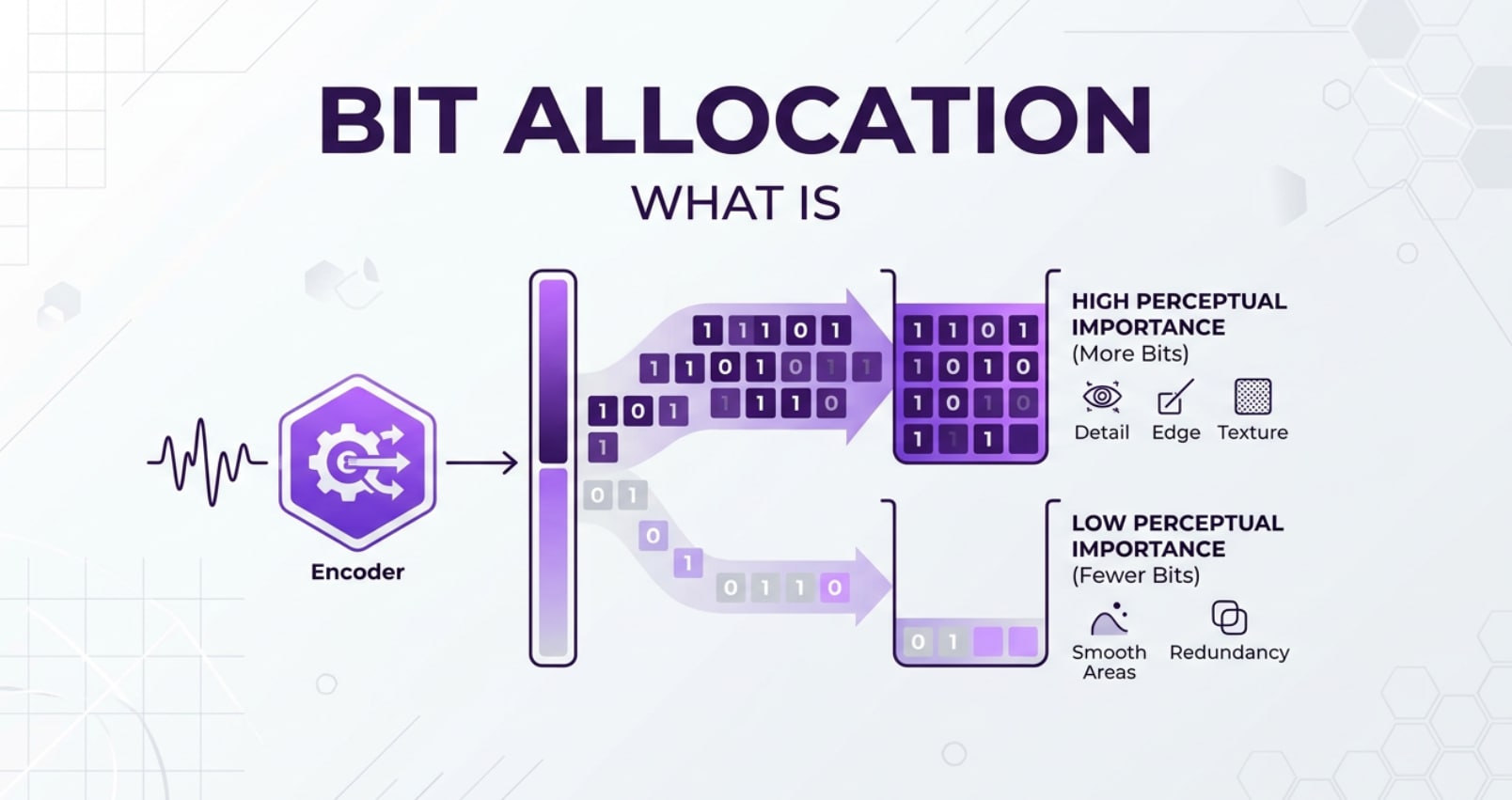
If you have ever tweaked export settings in Premiere, set a streaming bitrate in OBS, or dived into codec options in FFmpeg, you have already bumped into the idea behind bit allocation. It controls how many bits are spent on different parts of a video. Understanding it helps you balance video quality, file size, and playback stability across editing, encoding, exporting, streaming, and even mobile viewing.
Repair Corrupted Files To Save Your Data
 Security Verified. Over 7,302,189 people have downloaded it.
In this article
What Is Bit Allocation?
Basic definition of bit allocation
Bit allocation is the process of deciding how many bits are used to encode different parts of a video, such as frames, macroblocks, or transform coefficients. In simple terms, it is how the encoder chooses where to spend data and where to save it. You can think of it as a budget planner that distributes a limited number of bits across the entire clip so the video looks as good as possible for a given bitrate.
Bit allocation as a bitrate control strategy
Technically, bit allocation is part of a bitrate control strategy in video compression. It belongs to the family of encoding workflow settings that decide data usage, alongside rate control modes like CBR, VBR, and CRF. Its basic role is to balance detail between easy scenes (like static talking heads) and hard scenes (like fast sports or noisy low-light shots), ensuring that the encoder does not waste bits where they are not needed and does not starve complex scenes of data.
Why Is Bit Allocation Important in Video Compression?
Quality, file size, and motion handling
Bit allocation tackles a core compression problem: how to get the best possible visual quality with a limited bitrate. Without smart allocation, an encoder might give equal data to every frame, causing simple scenes to be over-compressed and action scenes to fall apart into blocky artifacts.
Good bit allocation affects:
- Bitrate efficiency and file size – More bits are given only where they significantly improve quality, lowering wasted data.
- Image quality – Fine textures, edges, and gradients are preserved better in challenging areas of the frame.
- Motion handling – Fast movement, camera pans, and detailed action sequences receive extra bits to avoid smearing and macroblocking.
- Streaming performance – Streams stay closer to the target bitrate, improving stability for limited or variable bandwidth connections.
- Editing and playback – More balanced quality between frames reduces visual jumps when scrubbing and cuts between scenes.
Benefits and limitations of bit allocation
When bit allocation is tuned well, you get several benefits:
- Better quality at the same bitrate compared with naive, uniform distribution.
- More consistent visual experience across quiet and action-heavy scenes.
- Improved compatibility with platforms that impose strict bitrate caps for streaming or uploads.
However, there are limitations:
- Encoder dependence – Different codecs and encoders implement bit allocation differently; results vary between H.264, HEVC, AV1, and hardware encoders.
- Complex tuning – Manual control via advanced parameters (e.g., in x264/x265 or FFmpeg) can be confusing and prone to misconfiguration.
- Hard constraints – If the overall bitrate is too low, even perfect allocation cannot fully prevent artifacts in difficult content.
How Does Bit Allocation Work in the Encoding Workflow?
Where bit allocation sits in the pipeline
In the encoding workflow, bit allocation usually happens after analysis stages and before entropy coding. A simplified pipeline looks like this:
- Frame is captured or imported from your timeline (recording or editing stage).
- Encoder analyzes motion, complexity, and noise in each frame or block.
- Rate control decides the overall target bits for the current frame or GOP.
- Bit allocation distributes those bits across blocks, macroblocks, or coefficients.
- Quantization and entropy coding compress the data based on the assigned bit budget.
During this process, bit allocation interacts with:
- Quantization parameters (QP) – Higher QP means fewer bits; allocation may increase QP in flat areas and reduce it in detailed or high-motion areas.
- Prediction modes – If prediction is efficient, fewer bits are needed, freeing budget for harder areas.
- Buffer models – For streaming, allocation must also respect VBV or HRD constraints so the decoder buffer does not overflow or underflow.
Bit allocation in real tools and platforms
You will encounter bit allocation indirectly in many tools:
- FFmpeg – When you select CRF, CBR, or 2-pass VBR and adjust options like maxrate, bufsize, and qcomp, you are guiding how FFmpeg-based encoders allocate bits over time and across scenes.
- x264/x265 – Advanced flags such as rc-lookahead, aq-mode, and aq-strength control adaptive quantization and scene complexity analysis, which are tightly linked to bit allocation.
- OBS Studio – Setting output bitrate, CBR vs. CQP, and enabling features like psycho-visual tuning for NVENC influences how bits are spread between static overlays and fast gameplay.
- HandBrake – Options like Constant Quality vs. Average Bitrate, plus encoders presets and tune settings, adjust how the encoder spends bits on grainy films, animation, or clean web video.
- Premiere Pro / Media Encoder – Export presets such as VBR 1-pass, VBR 2-pass, target bitrate, and maximum bitrate all shape temporal and spatial bit allocation.
- Hardware encoders in cameras – Profiles such as IPB vs. All-I, Long GOP length, and bitrate modes define how bits are spent between frames in-camera, affecting editing flexibility later.
When Should You Care About Bit Allocation? Common Mistakes and Quick Tips
Who needs to care and when it matters
Bit allocation matters most to:
- Editors and colorists – Poorly allocated bits from camera or export settings can cause banding and blockiness that become obvious during grading.
- Streamers and gamers – Fast motion plus limited upload bandwidth requires smarter bit allocation to keep the image readable.
- Encoding specialists – Distributing a catalog across multiple platforms (YouTube, OTT, social) under strict bit caps depends heavily on efficient allocation.
- Content creators – When balancing mobile-friendly file sizes with decent quality, allocation-driven settings like CRF or 2-pass VBR are key.
It matters less when:
- You are working with mezzanine or intermediate codecs (e.g., ProRes, DNxHR) that use very high bitrates and simpler compression, where allocation is not tightly constrained.
- Your delivery has generous bitrate headroom, such as local playback from fast storage at near-lossless bitrates.
Mistakes to avoid and quick tips
Common misunderstandings about bit allocation include:
- Assuming higher average bitrate alone guarantees better quality, even if the encoder distributes bits poorly.
- Using strict CBR with too low a bitrate for dynamic content, leaving no room for allocation to rescue complex scenes.
- Ignoring profile, level, and VBV limits that restrict how aggressively bits can be borrowed between scenes.
Quick, practical tips:
- Use CRF or VBR 2-pass for offline exports when possible; they generally enable more intelligent bit allocation than simple CBR.
- Raise bitrate for high-motion or noisy footage; even the best allocation cannot fix extreme under-bitrating.
- For streaming, combine CBR with reasonable buffer settings so allocation has a little room while staying within platform limits.
- Test on your actual platform (YouTube, TikTok, internal CDN); each may re-encode and re-allocate bits differently.
Takeaway: you do not need to micromanage bit allocation math, but choosing the right rate control mode and bitrate for your content lets modern encoders do their job more effectively.
How to Use Repairit to Fix a Corrupted Video File
What is Repairit?
Even when bit allocation and other encoding settings are perfect, your video files can still become corrupted due to crashes, power loss, storage errors, or transfer issues. Repairit official website offers a professional yet easy-to-use solution that focuses on fixing broken videos rather than re-encoding them from scratch. It can repair files that refuse to play, stutter, freeze, or show visual glitches, helping you recover recordings, edits, exports, and archived footage.
Key features of Repairit
- Wide format support for popular camera, phone, and editing outputs such as MP4, MOV, M2TS, MKV, and more.
- Smart repair engine that analyzes video structure and reconstructs headers, frames, and audio/video sync issues.
- Simple visual workflow with preview capability so you can check repaired results before saving.
Step-by-step: repair a corrupted video
- Add corrupted video files
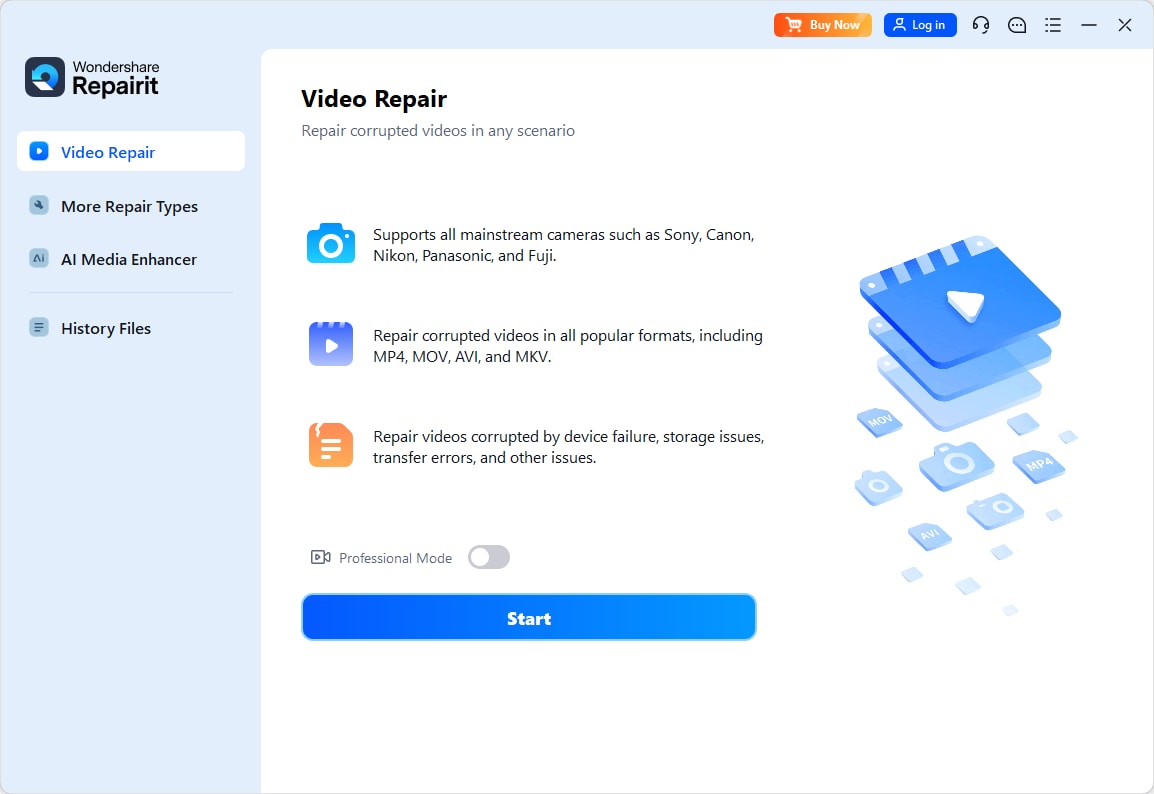
Launch Repairit on your computer and open the Video Repair module. Click the add button or drag and drop one or more corrupted clips into the window. Repairit will list key information like file name, path, and format so you can confirm you selected the correct recordings or exports.
- Repair video files
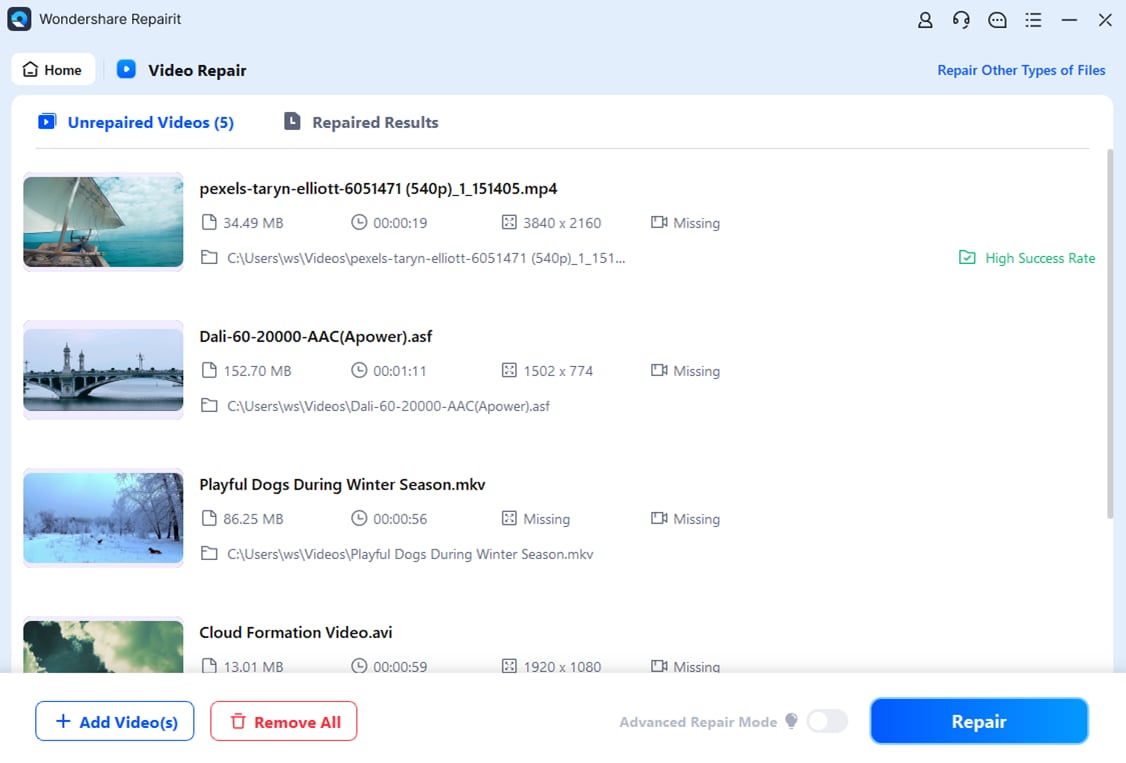
After importing your clips, select them and click the Repair button. Repairit scans each file, analyzes structural damage, and reconstructs video and audio streams. For severely damaged videos, you may be prompted to perform an advanced repair using a sample file from the same device or camera to improve accuracy.
- Save the repaired video files
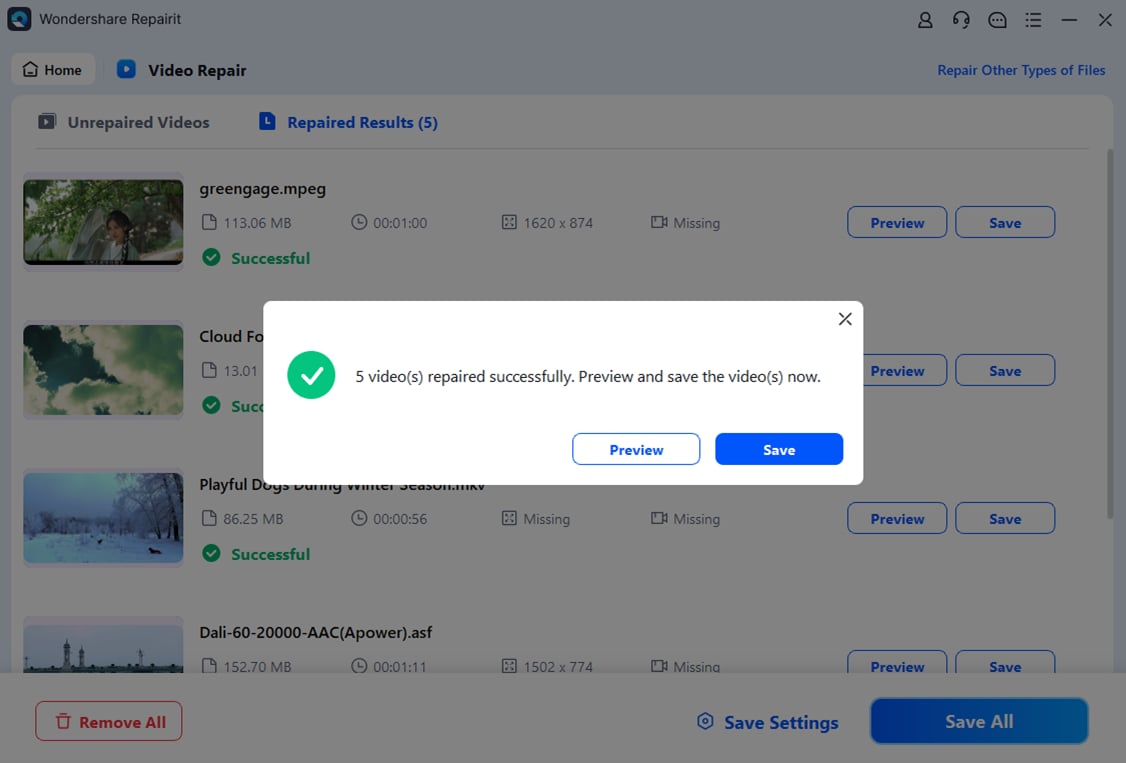
When the process finishes, preview the repaired videos directly inside Repairit to ensure they play smoothly and look correct. If you are satisfied with the result, click Save, choose a secure destination folder that is different from the original location, and confirm. Your repaired videos are now ready for editing, exporting, sharing, or archiving again.
Conclusion
Bit allocation is a core idea behind how modern codecs decide where to spend bits and where to save them. It sits at the intersection of bitrate, quality, and motion handling, influencing everything from camera recording to final delivery on streaming platforms.
You do not need to master every encoder flag, but understanding what bit allocation does helps you choose better rate control modes, bitrates, and presets for your projects. And if something goes wrong and your carefully encoded files become corrupted, tools like Repairit give you a practical way to bring those videos back without re-shooting or re-editing.
Next: What Is Rate Control and How Does It Affect Video Quality and Bitrate?
FAQ
-
1. Does bit allocation affect how my footage is recorded in-camera?
Yes. Many cameras use long-GOP codecs such as H.264 or HEVC, which rely on internal bit allocation to decide how many bits each frame and block receives. While you may not see a menu item named "bit allocation," choices like codec, bitrate, GOP length, and recording profile all influence how bits are distributed during capture. -
2. Is higher bitrate always better than smarter bit allocation?
Not necessarily. A poorly tuned encoder at a very high bitrate can still waste data and look worse than a well-configured encoder at a lower bitrate. Smart bit allocation plus an appropriate bitrate usually beats brute-force high bitrate, especially for streaming or storage-limited workflows. -
3. Which rate control mode is best for good bit allocation?
For offline exports, CRF (for x264/x265) or VBR 2-pass often delivers the best balance of quality and file size because they let the encoder vary bits intelligently between scenes. For live streaming, CBR with a suitable buffer and quality-optimized presets provides a good compromise between consistent network load and adaptive allocation. -
4. Can I manually control bit allocation in common editors like Premiere Pro?
You usually do not control bit allocation directly. Instead, you adjust export settings like CBR vs. VBR, target and maximum bitrate, profile, and quality presets. The underlying encoder uses these inputs to decide how to allocate bits within and across frames. -
5. Will repairing a corrupted video with Repairit change its bit allocation?
Repairit focuses on fixing structural and playback issues such as damaged headers, broken streams, or sync problems. It does not re-encode the entire file by default, so the original encoding decisions, including bit allocation, are generally preserved as much as possible while restoring playability.