
Repairit Audio Repair and CyberLink AudioDirector both promise cleaner, more listenable audio, but they approach audio problems differently. CyberLink AudioDirector focuses on consumer-friendly editing and enhancement, especially for video creators who need quick, simple fixes. Repairit Audio Repair concentrates on repairing corrupted or unplayable audio files and restoring damaged audio playback with a guided workflow. Understanding how each handles real-world noise, distortion, and file damage helps you pick the right tool for your next project.
Repair Corrupted Audio Files With Repairit Audio Repair
 Security Verified. Over 7,302,189 people have downloaded it.
In this article
- Repairit Audio Repair vs CyberLink AudioDirector: Quick Verdict
- Repairit Audio Repair vs CyberLink AudioDirector: Key Differences
- Repairit Audio Repair vs CyberLink AudioDirector: Comparison Table
- What Repairit Audio Repair and CyberLink AudioDirector Are Best For
- Repairit Audio Repair vs CyberLink AudioDirector: Audio Repair Capabilities
- Repairit Audio Repair vs CyberLink AudioDirector: Supported Audio Formats and Use Cases
- Repairit Audio Repair vs CyberLink AudioDirector: Workflow and Ease of Use
- Repairit Audio Repair vs CyberLink AudioDirector: AI Processing and Automation
- Repairit Audio Repair vs CyberLink AudioDirector: Pricing and Accessibility
- Who Should Choose Repairit Audio Repair
- Who Should Choose CyberLink AudioDirector
- Pros and Cons of Repairit Audio Repair and CyberLink AudioDirector
- How to Repair Corrupted Audio Files After Choosing the Right Tool
Repairit Audio Repair vs CyberLink AudioDirector: Quick Verdict
The main difference is that Repairit Audio Repair focuses on repairing corrupted, distorted, or unplayable audio files, while CyberLink AudioDirector is oriented toward everyday cleanup and enhancement of audio that already plays correctly. This matters if your file refuses to play, cuts out, or glitches in ways that basic denoise tools cannot solve.
Repairit Audio Repair is more suitable when you must restore damaged audio playback before editing, such as broken recordings from cameras, voice recorders, or exported files. CyberLink AudioDirector may be enough if you mainly need to remove background hiss, balance levels, and make timing tweaks directly on a video timeline.
Repairit Audio Repair vs CyberLink AudioDirector: Key Differences
The key difference is that Repairit Audio Repair is centered on file-level audio repair, whereas CyberLink AudioDirector leans toward timeline-based editing and sound design for video. In most real-world cases, users turn to Repairit Audio Repair when a file is corrupted or unplayable, and reach for CyberLink AudioDirector when the file is intact but sounds messy.
Repairit Audio Repair uses a guided workflow: import the problematic file, let the software analyze it, and export the repaired result. CyberLink AudioDirector expects you to work more manually, layering cleanup tools, level adjustments, and edits across tracks. This difference becomes important if you are not an audio specialist and simply need a broken file to play again.
In terms of depth, Repairit Audio Repair is positioned as a stronger choice for restoring damaged audio playback, while CyberLink AudioDirector can be a better fit for ongoing cleanup, mix tweaks, and integration with other CyberLink video tools once the file is stable.
Repairit Audio Repair vs CyberLink AudioDirector: Comparison Table
This comparison table highlights how Repairit Audio Repair and CyberLink AudioDirector differ across core decision factors like repair depth, workflow, and automation, so you can quickly see which one aligns with your situation.
| Dimension | Repairit Audio Repair | CyberLink AudioDirector |
|---|---|---|
| Best for | Users needing guided repair for corrupted, distorted, or unplayable audio files | Video creators needing simple, fast audio cleanup while editing footage |
| Ease of use | Straightforward, task-focused repair workflow with minimal setup | Beginner-friendly editor but with more manual controls and panels |
| Repair depth | Designed for file-level repair and restoring damaged audio playback | Suited to basic cleanup and enhancement rather than deep file repair |
| AI capability | Uses automated processing to analyze and fix corrupted sections | Focuses more on enhancement, noise reduction, and mix tools for creators |
| Workflow | Import, repair, then export with a guided, step-based process | Integrated directly into video editing workflows for quick touch-ups |
| Strengths | Good when audio will not play properly or is heavily damaged | Great for denoise, level adjustments, and quick edits tied to video |
| Weaknesses | Less suited to full timeline editing or detailed mixing | Limited when dealing with severely corrupted or unplayable audio files |
What Repairit Audio Repair and CyberLink AudioDirector Are Best For
The main difference is that Repairit Audio Repair is best for repairing corrupted or unplayable audio files, while CyberLink AudioDirector is best for straightforward cleanup and enhancement of audio that is already usable. Users often notice that they reach for these tools at different stages of a project.
Repairit Audio Repair is particularly helpful when:
- The audio file refuses to open or throws playback errors.
- A recording plays only partially or cuts off mid-sentence.
- You hear severe glitches, distortion, or artifacts that simple EQ cannot resolve.
- You need to stabilize a file before bringing it into an editor or DAW.
CyberLink AudioDirector, by contrast, fits better when:
- You are editing video and want quick access to denoise, de-hum, or level tools on the timeline.
- The audio is intact but has background hiss, room noise, or inconsistent volume.
- You want to visually trim, fade, and arrange clips while monitoring them alongside picture.
- You prefer a more traditional, track-based editing environment.
In many workflows, creators combine both: rely on Repairit Audio Repair for file-level issues first, then refine the sound inside CyberLink AudioDirector once the audio plays reliably.
Repairit Audio Repair vs CyberLink AudioDirector: Audio Repair Capabilities
The key difference in audio repair capability is that Repairit Audio Repair focuses on restoring damaged audio playback at the file level, while CyberLink AudioDirector focuses more on cleaning up noise and improving clarity in already playable clips. This distinction matters when basic cleanup tools cannot even access the audio properly.
Both tools can help with problems such as hiss, hum, clicks, and minor disturbances, but they prioritize different tasks:
- Repairit Audio Repair is oriented toward analyzing the file structure and attempting to repair corrupted audio files that may not open or that stop unexpectedly.
- CyberLink AudioDirector is oriented toward timeline-based noise reduction, EQ, and dynamics for intact recordings, often tied to video.
From the user perspective, Repairit Audio Repair behaves more like a repair stage: you send in broken or heavily distorted audio, let the software process it, then export a repaired version. CyberLink AudioDirector behaves more like an editor where you layer multiple cleanup tools manually, which is powerful for mild problems but less effective when the file itself is damaged.
In most real-world cases, if your audio file will not play, only partly plays, or is clearly corrupted, Repairit Audio Repair is the more suitable first stop. If the file plays fine and you simply hear noise, room tone, or level jumps, CyberLink AudioDirector may be enough for your needs.
Repairit Audio Repair vs CyberLink AudioDirector: Supported Audio Formats and Use Cases
The main difference is not the basic formats each can open, but how they handle those formats when something goes wrong. Both Repairit Audio Repair and CyberLink AudioDirector work with common formats such as MP3, WAV, M4A, AAC, or FLAC in everyday workflows.
In most real-world cases, users bring in audio from cameras, smartphones, screen recordings, or voice recorders, repair or clean it, and then export for editing, sharing, or archiving on desktop or laptop systems. The decision point is the condition of the audio file:
- Repairit Audio Repair is aimed at files where playback is compromised, regardless of whether the source is a camera, phone, or exported project.
- CyberLink AudioDirector fits better when the file imports cleanly into a video or audio project and you want to refine how it sounds rather than fix structural damage.
This becomes important if your camera or recorder produces files that occasionally get corrupted due to power loss, storage issues, or interrupted recording. In these cases, Repairit Audio Repair can act as a focused tool to try to repair the damaged audio so you can safely bring it into an editor afterward.
Repairit Audio Repair vs CyberLink AudioDirector: Workflow and Ease of Use
The main workflow difference is that Repairit Audio Repair uses a simple, guided process, while CyberLink AudioDirector uses a more traditional multi-panel editor with tracks and timelines. This difference strongly influences how quickly a non-specialist can resolve audio problems.
With Repairit Audio Repair, the typical flow is straightforward:
- Import the problematic audio file.
- Let the software analyze and repair it with minimal manual tuning.
- Preview and save the repaired version.
CyberLink AudioDirector, on the other hand, provides more granular control but expects more user input:
- Import audio or linked video with audio tracks.
- Use panels and modules for denoise, EQ, dynamics, and other adjustments.
- Edit clips on a timeline, manage levels, and sync with video.
For users who primarily need to repair corrupted or unplayable files, the guided workflow in Repairit Audio Repair reduces guesswork. For users who want ongoing creative control and deeper editing once the file is stable, CyberLink AudioDirector may feel more natural, especially if they already work inside a CyberLink-based video environment.
Repairit Audio Repair vs CyberLink AudioDirector: AI Processing and Automation
The key difference is that Repairit Audio Repair leans on automated repair logic to handle damaged sections, while CyberLink AudioDirector leans on user-driven cleanup controls like noise reduction and enhancement. Automation becomes critical when users do not know which specific parameter will rescue a corrupted file.
With Repairit Audio Repair, much of the heavy lifting happens under the hood: the tool analyzes the file, attempts to deal with corruption, and restores damaged audio playback with minimal manual adjustment. This suits users who know something is wrong but cannot pinpoint the technical cause.
CyberLink AudioDirector emphasizes tools you adjust yourself, such as denoise, EQ, and dynamics. These are effective when:
- The audio is simply noisy, with fans, room tone, or mild distortion.
- You want to fine-tune how aggressive noise reduction should be.
- You are comfortable auditioning different settings on the timeline.
A common limitation is that manual cleanup workflows, no matter how flexible, cannot fully fix a file that is structurally corrupted. In those situations, Repairit Audio Repair offers a more appropriate starting point, and CyberLink AudioDirector can then refine the result once the file is stable.
Repairit Audio Repair vs CyberLink AudioDirector: Pricing and Accessibility
The main difference in accessibility is that Repairit Audio Repair is focused exclusively on audio repair, while CyberLink AudioDirector is often positioned as part of a broader media and video ecosystem. This can influence both how you buy the tools and when you decide to use them.
Both Repairit Audio Repair and CyberLink AudioDirector are available as paid software, and each may offer trial options so you can test their workflows before committing. CyberLink AudioDirector is frequently bundled with or integrated into other CyberLink video products, which appeals to editors who want a unified environment.
Repairit Audio Repair is dedicated to audio repair as a standalone task. That focus makes it practical to download a trial and run it against the same corrupted file you test in CyberLink AudioDirector. In most cases, this side-by-side evaluation quickly reveals which tool better addresses your specific problem, especially when file-level damage is involved.
Who Should Choose Repairit Audio Repair
Repairit Audio Repair is more suitable when your primary problem is getting damaged or unplayable audio back into a usable state, rather than polishing an already clean recording. Users often choose it when other editors fail to open or properly play back their files.
- Users whose audio files are corrupted, unplayable, or fail midway through playback.
- Creators who need a guided way to repair damaged recordings without deep editing skills.
- People who want to fix distorted or noisy audio before importing it into a video editor.
- Anyone comparing tools and needing stronger file-level repair than basic cleanup alone.
If this sounds like your situation, trying Repairit Audio Repair on a problematic file is a practical step before investing time in complex manual cleanup inside another editor.
Who Should Choose CyberLink AudioDirector
CyberLink AudioDirector may be enough if you mostly work with audio that already plays correctly and you need convenient cleanup and editing inside a video workflow. In these scenarios, deep file-level repair is less important than speed and integration.
- Video creators who want quick audio cleanup directly inside a video editing workflow.
- Beginners who mainly need denoise, level balance, and simple enhancement tools.
- Users who work mostly with intact, playable audio that just sounds rough or messy.
- Creators who need an audio editor integrated with other CyberLink video products.
If your projects consist of screen recordings, camera audio, or voice-overs that import and play fine, CyberLink AudioDirector can handle most routine cleanup tasks without requiring a separate repair step.
Pros and Cons of Repairit Audio Repair and CyberLink AudioDirector
The main difference in pros and cons is that Repairit Audio Repair trades broad editing features for focused repair strength, while CyberLink AudioDirector trades deep file repair for a flexible editing environment. Understanding these trade-offs helps you avoid expecting one tool to do a job it is not designed for.
Repairit Audio Repair Pros and Cons
CyberLink AudioDirector Pros and Cons
How to Repair Corrupted Audio Files After Choosing the Right Tool
After comparing Repairit Audio Repair and CyberLink AudioDirector, the next step is actually repairing the corrupted or problematic audio file so you can continue your project with confidence. In most cases, this means using a dedicated repair stage before you move into detailed editing or mixing.
Repairit Audio Repair fits naturally into this stage-based workflow: you first restore damaged audio playback, then pass the repaired file to your preferred editor, including CyberLink AudioDirector if you rely on a timeline-driven setup. This approach avoids fighting with corruption inside an editor that is primarily built for cleanup and enhancement.
Key Features
The main difference between a focused repair tool and a general editor is that Repairit Audio Repair prioritizes getting your audio back into a usable state with minimal effort. Its core capabilities include:
- Guided repair process that focuses on file-level audio problems rather than just cosmetic cleanup.
- Automated analysis to help fix distorted or noisy audio with minimal manual tweaking.
- Export-ready repaired files that fit naturally into video, podcast, or music workflows.
Step-by-step guide
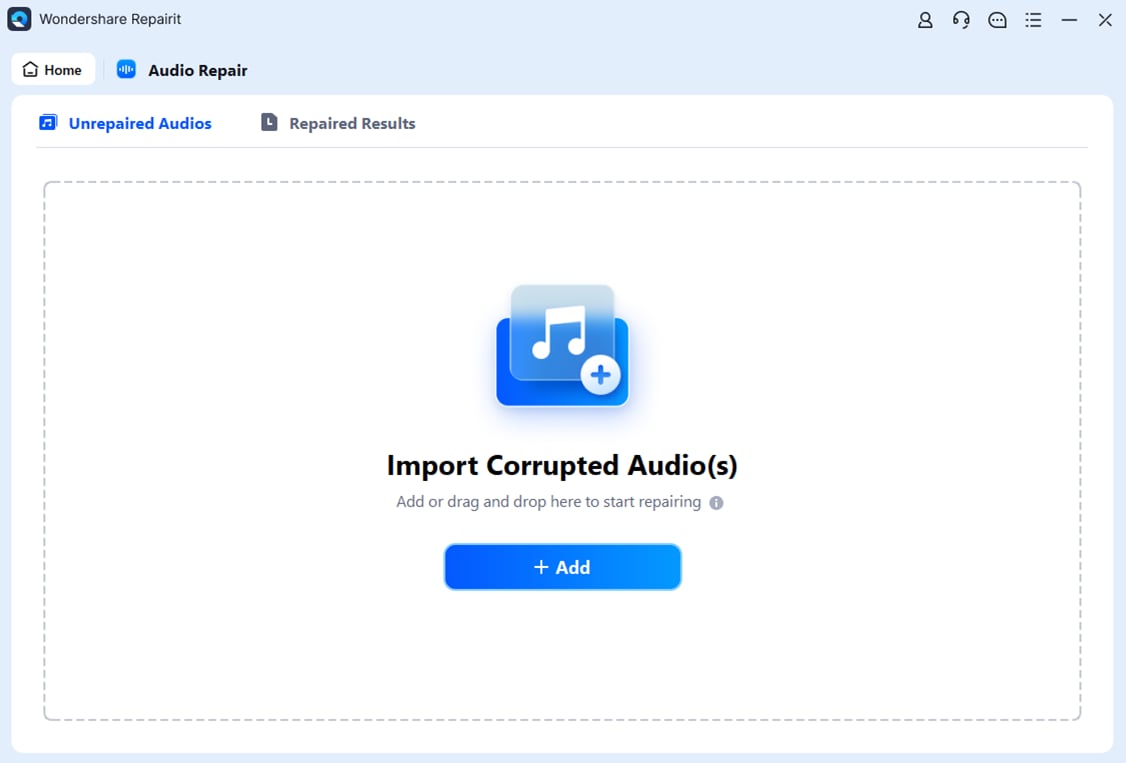
Step 1. Import the damaged audio files you want to fix into Repairit Audio Repair to begin the repair process smoothly.
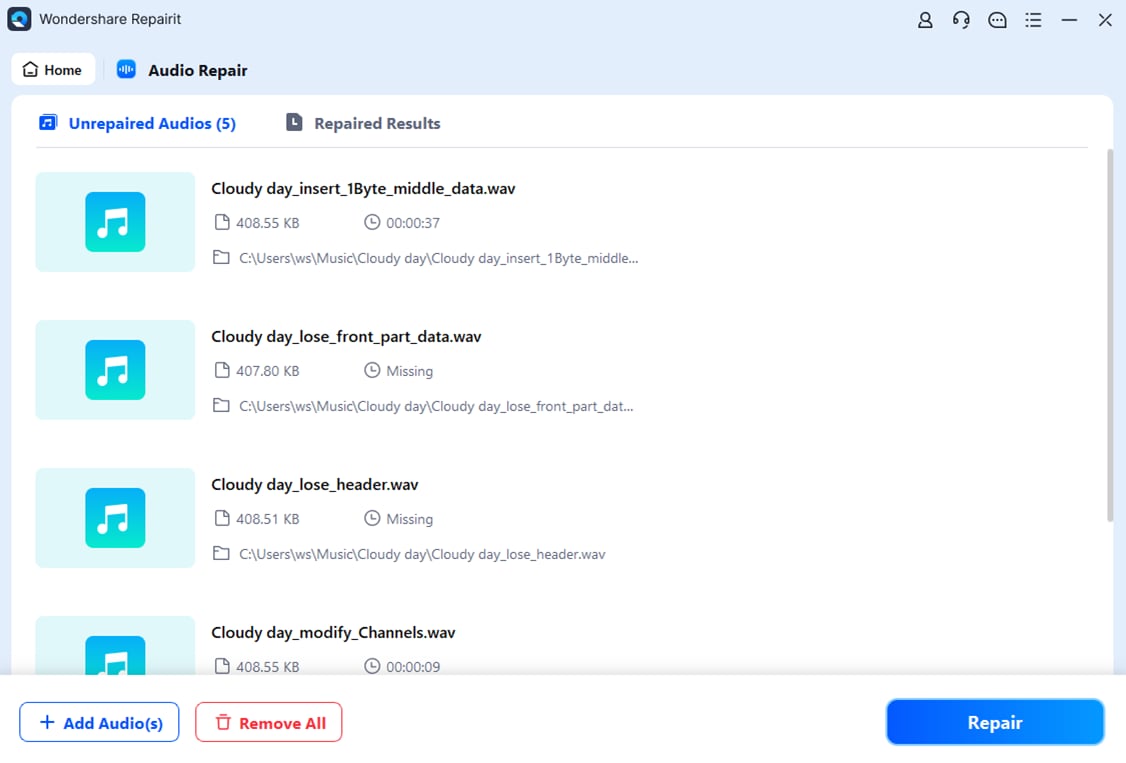
Step 2. Click the repair button to let Repairit Audio Repair automatically analyze and repair the corrupted audio files efficiently.
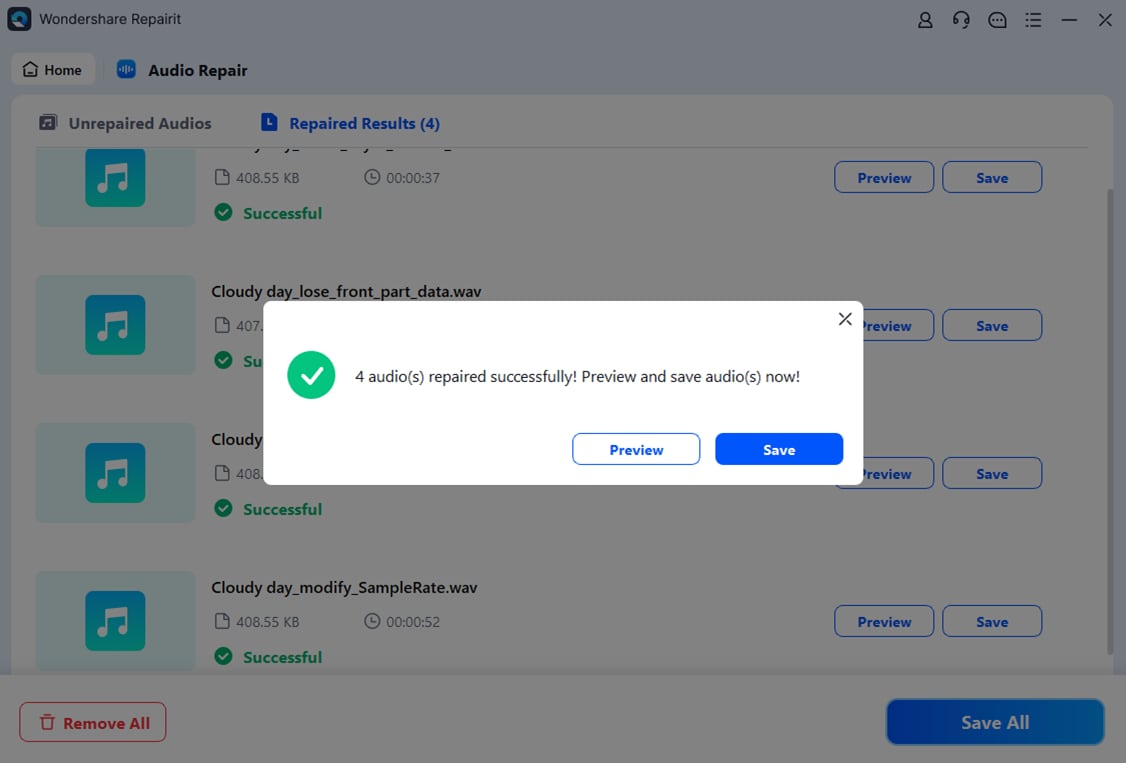
Step 3. Preview the repaired audio results, then save the successfully repaired files to your device.
Final Verdict
The key difference between Repairit Audio Repair and CyberLink AudioDirector is depth of repair versus convenience of editing. Repairit Audio Repair is more suitable when your main problem is corrupted, unplayable, or heavily damaged audio that basic denoise and EQ cannot rescue. It gives you a focused way to repair the file first, then send it on to your editor.
CyberLink AudioDirector may be enough if your audio already plays correctly and only needs simple cleanup, such as reducing background noise, balancing levels, or tightening timing inside a video project. In most real-world cases, creators can combine both approaches: use Repairit Audio Repair to fix serious file-level issues, then rely on CyberLink AudioDirector for ongoing editing and polish.
Next: Repairit Audio Repair vs Adobe Podcast Enhance
FAQ
-
1. Is CyberLink AudioDirector enough for fixing bad audio, or do I need Repairit Audio Repair as well?
CyberLink AudioDirector is often enough for basic cleanup like noise reduction and level fixes when your audio already plays correctly. If the file is corrupted, cuts out, or will not play, Repairit Audio Repair is more suitable because it focuses on file-level repair before you do any editing. -
2. What is the difference between audio repair and audio enhancement or cleanup?
Audio repair focuses on fixing corrupted or unplayable audio files and restoring damaged audio playback so the file can be used at all. Enhancement or cleanup, such as denoise, EQ, or compression, assumes the file already plays correctly and simply improves how it sounds. CyberLink AudioDirector leans toward enhancement, while Repairit Audio Repair is centered on repair. -
3. Can I use Repairit Audio Repair and CyberLink AudioDirector together in one workflow?
Yes. Many users repair corrupted or distorted audio in Repairit Audio Repair first, export the fixed file, and then bring it into CyberLink AudioDirector for denoise, level balancing, and integration with their video timeline.