AV1 is now a practical choice for creators who want smaller files at high visual quality, but choosing the right AV1 encoder still depends on your priority: ease of use, encoding speed, hardware acceleration, automation, or maximum control. If you are comparing AV1 encoder software, the four options below cover the most common workflows without forcing every user into the same tool.
Quick answer: HandBrake is the easiest all-around GUI option, FFmpeg gives advanced users the most control, SVT-AV1 is a strong software encoder for scalable CPU-based AV1 encoding, and Shutter Encoder is a convenient visual front end for users who want AV1 plus broader media-processing tools.
In this article
Part 1: What Is AV1 Encoding?
AV1 is an open video codec developed by the Alliance for Open Media. It is designed to deliver high compression efficiency for modern video distribution, including high-resolution and HDR content. The codec itself defines how AV1 video is represented; an AV1 encoder is the software or hardware implementation that converts source video into that format.
That distinction matters when you compare tools. A graphical application such as HandBrake may use SVT-AV1 or a hardware AV1 encoder underneath, while FFmpeg can expose several AV1 encoder libraries depending on how it was built. If your main goal is to compress video files while preserving visual quality, the encoder and its settings matter just as much as the AV1 codec itself.
AV1 is also one of several modern video codecs for compression and playback, so it is worth comparing compatibility, encoding speed, and decoding support before switching an entire workflow. AV1 can scale from lower-resolution delivery to 4K and 8K content, but if your actual goal is to enhance low-resolution video toward 4K, that is an enhancement task rather than an encoding task.
AV1 is increasingly relevant to streaming because it can deliver strong quality at lower bitrates, but encoding and decoding support still varies by device and platform. For a closer look at AV1 playback and streaming behavior, AV1 decoding for video streaming explains how encoded AV1 video is handled during playback.
| AV1 encoder option | Best for | Main strength | Learning curve |
| HandBrake | Most desktop users | Simple GUI with software and supported hardware AV1 options | Low |
| FFmpeg | Advanced users, automation, scripts | Flexible command-line control and multiple AV1 libraries | High |
| SVT-AV1 | CPU-based software encoding | Scalable software AV1 implementation with detailed presets | Medium to high |
| Shutter Encoder | Users who want a visual workflow | GUI-based AV1 encoding with broader conversion tools | Low to medium |
Part 2: 4 Best AV1 Encoder Tools for 2026
The best AV1 encoder is not simply the one with the highest theoretical quality. A better choice is the tool that matches your source material, available hardware, output target, and tolerance for longer encode times.
Best AV1 Encoder 1: HandBrake

HandBrake is a strong starting point for users who want AV1 encoding without working directly in a command line. Current HandBrake documentation lists SVT-AV1 for software encoding and supported hardware AV1 options including Intel Quick Sync, NVIDIA NVENC, and AMD VCN where compatible hardware is available.
That makes HandBrake especially useful when you want to compare software quality against faster hardware-assisted encoding from the same familiar interface. It also provides controls for quality, frame rate, filters, audio, subtitles, and container settings.
Best AV1 Encoder 2: FFmpeg

FFmpeg is the most flexible option in this list for scripting, automation, servers, and reproducible encoding pipelines. Official FFmpeg documentation describes support for AV1 through external libraries such as libaom, rav1e, and SVT-AV1 when those libraries are enabled in the build.
For example, a build with libsvtav1 can expose SVT-AV1 through FFmpeg, while a build with libaom can use the AOM reference encoder. This flexibility is valuable when you need command-line control over rate control, GOP structure, bitrate, CRF-style quality targets, filters, containers, and batch jobs.
Best AV1 Encoder 3: SVT-AV1

SVT-AV1 is an open-source AV1 implementation built for scalable software encoding. It is especially relevant when CPU-based AV1 performance matters and you want direct access to presets and encoder-specific parameters instead of a simplified interface.
As of November 2026, the SVT-AV1 project lists version 4.3.0, released on November 1, 2026. The release adds changes including low-delay improvements, new film-grain controls, lossless coding fixes, and additional real-time features. SVT-AV1 can also be used through applications such as HandBrake or compatible FFmpeg builds.
Best AV1 Encoder 4: Shutter Encoder

Shutter Encoder is a practical option for users who want AV1 encoding in a visual media-conversion application. Its current documentation lists AV1 output through libsvtav1 and also provides controls for bitrate modes, filters, color settings, subtitles, audio processing, and other conversion tasks.
The application is especially useful when AV1 encoding is only one part of a broader workflow. Current Shutter Encoder information also lists hardware-acceleration options for supported NVIDIA, AMD, and Intel GPUs, while noting that CPU encoding can provide better encoding quality in some cases.
Part 3: How to Choose the Right AV1 Encoder
Use the encoder that fits your workflow rather than choosing only by name.
- Choose HandBrake if you want a straightforward GUI and an easy way to compare software and supported hardware AV1 encoding.
- Choose FFmpeg if you need scripting, repeatable commands, server workflows, or direct access to several encoder libraries.
- Choose SVT-AV1 if CPU-based AV1 encoding performance and encoder-specific tuning matter more than a graphical interface.
- Choose Shutter Encoder if you want AV1 in a broader visual conversion workflow with filters and media utilities.
If your priority is playback compatibility instead of encoding efficiency, also consider whether your target devices support AV1. For comparison with older codecs, compare modern video codecs and their use cases before committing an entire library to AV1.
Part 4: What to Do If an Encoded Video Becomes Corrupted
An AV1 encoding error is not always file corruption. First confirm whether the problem is an unsupported player, an interrupted encode, a bad mux, a missing decoder, or a genuinely damaged video file. If the same output fails across multiple compatible players and the encode or transfer was interrupted, file corruption becomes more likely.
Current Repairit Video Repair supported formats list formats such as MP4, MOV, AVI, MTS, MKV, M2TS, MXF, FLV, WMV, MPEG, TS, BRAW, R3D, CRM, and others, but AV1 is not separately listed in the current technical specifications. Therefore, do not assume that every AV1-encoded file is supported solely because it uses an MP4 or MKV container.
If your damaged output is in a currently supported Repairit video format and the issue is true file corruption, Wondershare Repairit Video Repair can help repair supported corrupted videos. The broader Wondershare Repairit toolkit also includes additional repair and enhancement functions.
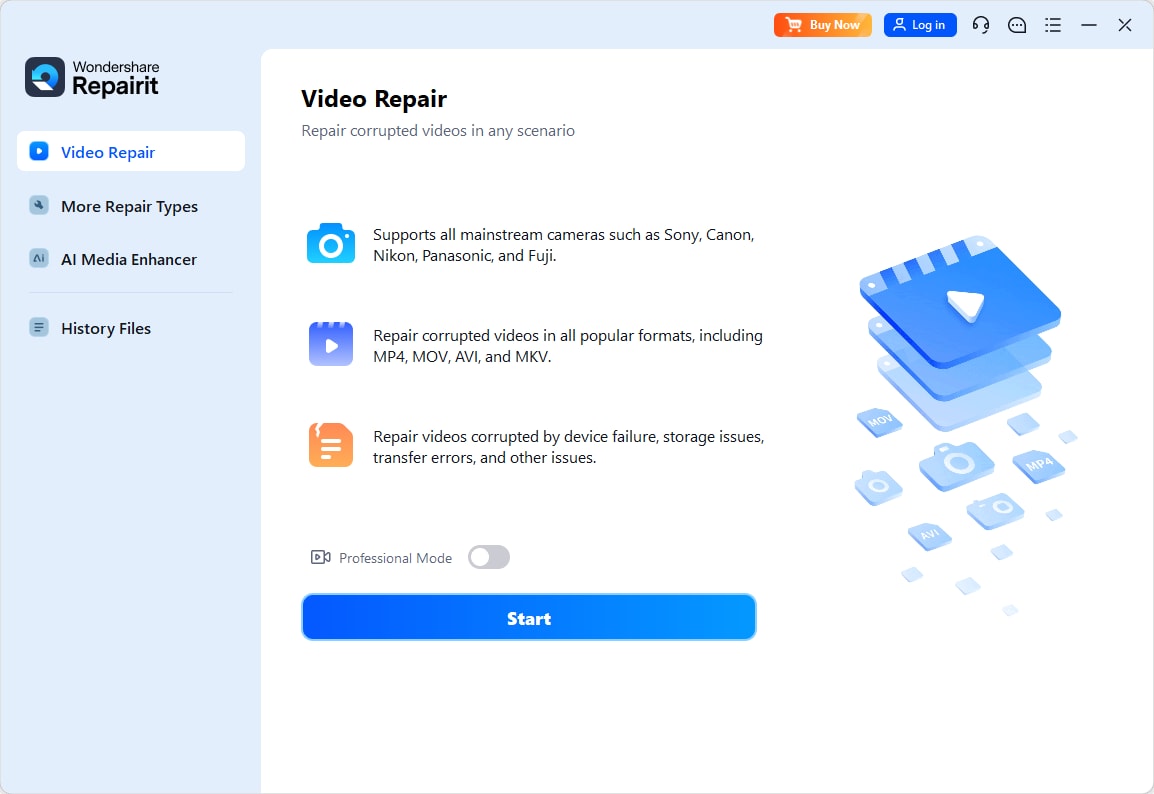
Step 1: Open Repairit and add the damaged video that matches a currently supported video format.
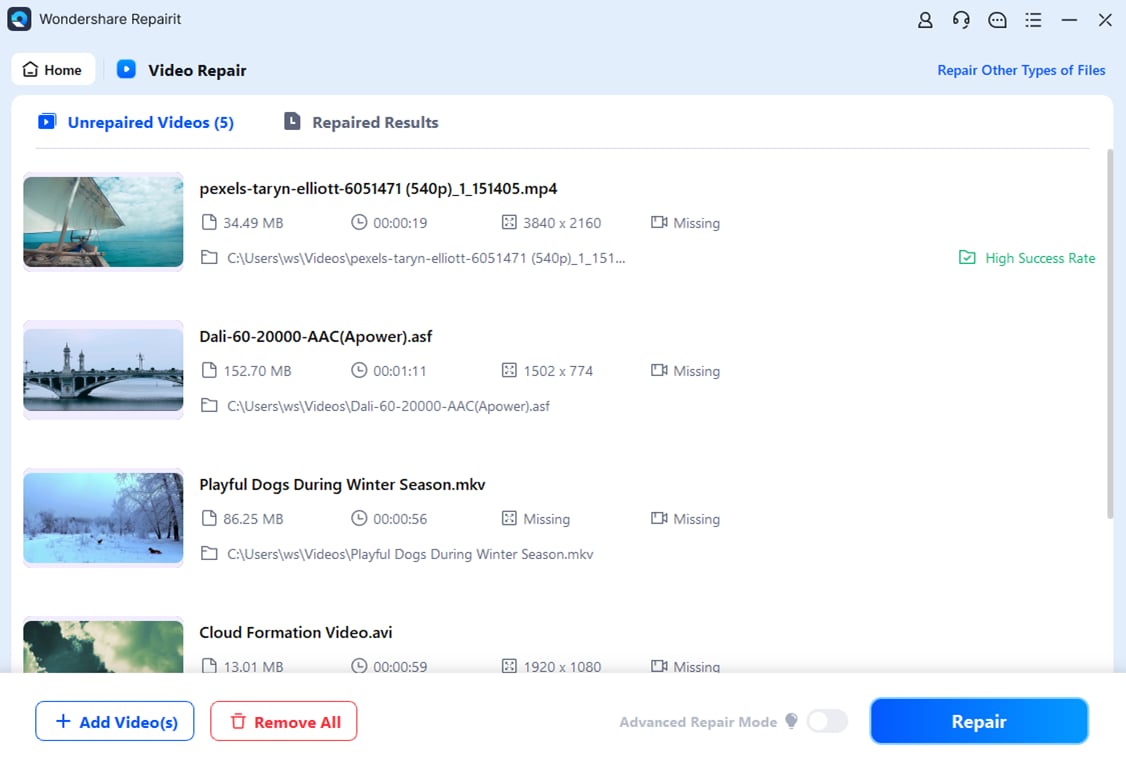
Step 2: Select Repair to start processing the damaged video.
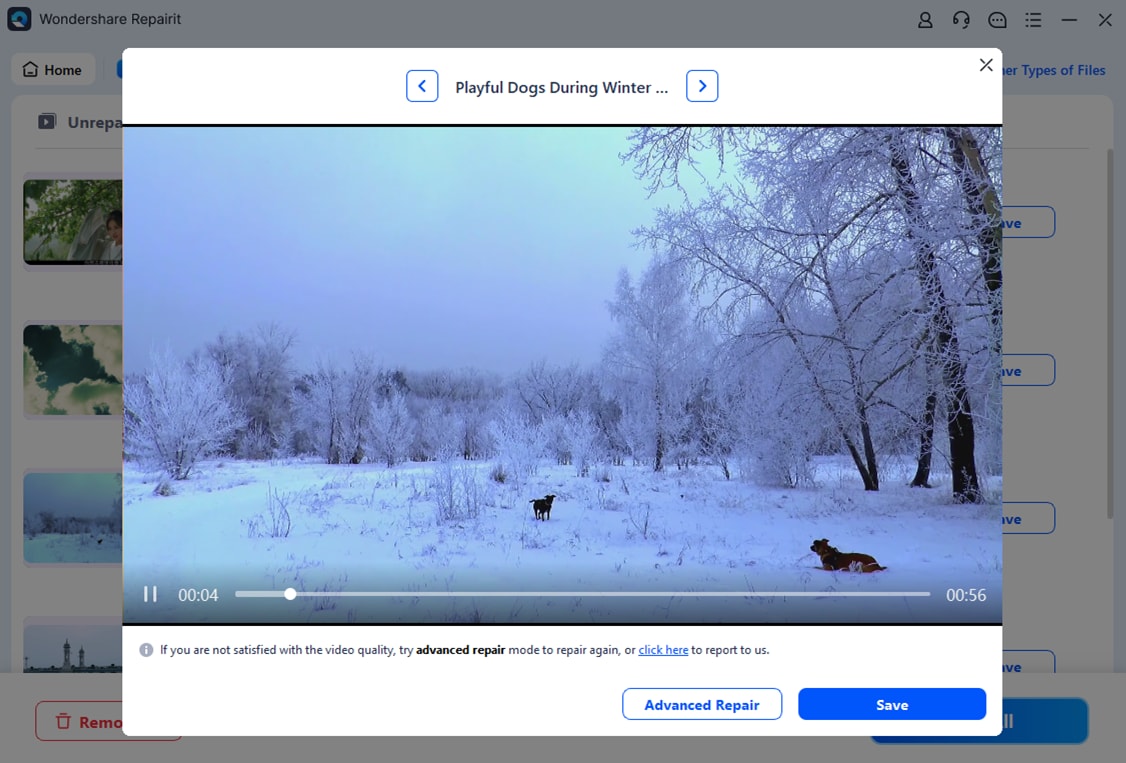
Step 3: Preview the repaired result. If the repaired video is usable, save it to a different folder from the damaged source file.
Part 5: Tips for More Reliable AV1 Encoding
- Run a short test encode before committing to a long 4K or 8K job.
- Keep enough free storage for the source, temporary files, and final output.
- Avoid shutting down the system or disconnecting the source drive while encoding.
- Use a quality or bitrate setting appropriate for the delivery target instead of copying one preset to every source.
- Confirm playback on the actual target device, browser, editing application, or streaming platform.
- For 10-bit, HDR, or grain-heavy material, verify encoder settings before starting the full batch.
- Keep the original source until the AV1 output has been fully verified.
Conclusion
For most users, the best AV1 encoder is the one that matches the workflow rather than the most complex tool. HandBrake is approachable, FFmpeg is highly flexible, SVT-AV1 gives direct software-encoding control, and Shutter Encoder offers a convenient visual workflow. Start with a short test encode, confirm compatibility on the target device, and only treat the result as corrupted after ruling out encoder settings, muxing, and playback support.
FAQ
-
Is AV1 encoding better than H.264 or HEVC?
Generally, yes. AV1 is designed to deliver higher compression efficiency than H.264 and can also outperform HEVC video compression in many scenarios. The actual file-size and quality difference depends on the encoder, preset, source footage, bitrate, and playback target. -
Do I need special hardware for AV1 encoding?
No. AV1 software encoding can run on many modern CPUs, but it may be computationally intensive. Supported GPUs and newer processors with hardware AV1 encoding can make the process much faster, especially for high-resolution or high-frame-rate video. -
Is AV1 encoding suitable for live streaming?
Yes, especially when hardware AV1 encoding is available. AV1 was initially more common for video-on-demand because software encoding could be slow, but newer GPUs and optimized encoders have made real-time AV1 streaming much more practical. -
What is the best AV1 encoder for beginners?
HandBrake is one of the easiest options for beginners because it provides a graphical interface and practical presets. Users who need deeper control over bitrate, filters, hardware acceleration, or batch workflows may prefer FFmpeg or Shutter Encoder. -
Which AV1 encoder gives the best quality?
There is no single best encoder for every file. SVT-AV1, libaom-based workflows, and other AV1 encoders can all produce high-quality results, but output depends heavily on preset, bitrate, resolution, source quality, and encoding time. -
Why does an AV1 video fail to play after encoding?
An AV1 video may fail to play because the player, browser, operating system, or hardware decoder does not fully support the codec or the specific AV1 profile used. If the file itself is genuinely corrupted rather than simply unsupported, confirm its container and codec details before attempting video repair.