
Global shutter is a camera sensor technology you will see mentioned in spec sheets, cinema camera launches, drone forums, and high-end sports or action setups. It decides how each frame is captured and whether fast motion looks natural or distorted. Understanding how a global shutter behaves when shooting, editing, encoding, exporting, streaming, and playing back video helps you avoid unwanted wobble and skew, and choose the right camera for clean, stable motion.
Repair Corrupted Files To Save Your Data
 Security Verified. Over 7,302,189 people have downloaded it.
In this article
Introduction
Modern cameras capture incredible detail, but fast motion can still ruin a shot with wobble, skewed lines, and strange flash bands. The way your sensor reads each frame, whether it uses a global shutter or a rolling shutter, determines how motion appears from capture to final playback on phones, TVs, and streaming platforms. Knowing the difference helps you plan cleaner shoots, reduce artifacts in editing and encoding, and deliver sharper, more stable videos.
What Is Global Shutter?
Global shutter is a type of camera sensor readout where every pixel on the sensor is exposed and then read out at the same instant. Instead of scanning the image from top to bottom (like a rolling shutter), a global shutter grabs the whole frame in one go.
It is a core camera sensor and shutter technology used in photography, cinematography, broadcast, industrial, and scientific imaging. You will find it in specialized cinema cameras, high-speed cameras, security cameras, and some newer mirrorless bodies.
In practical shooting, global shutter controls how moving subjects and camera motion are rendered. It does not directly set exposure time (that is still shutter speed or angle), but it governs when the exposure starts and ends across the frame. That timing is crucial for avoiding geometric distortion, skewed lines, and partial flash exposure when recording, encoding, exporting, or streaming your footage.
How Does Global Shutter Affect Your Image or Footage?
Motion rendering and distortion
With a global shutter, every pixel is exposed simultaneously, so the geometry of the scene is preserved even when things move quickly:
- Straight lines stay straight: Fast-moving objects like race cars, propellers, or pans across buildings do not bend or lean as they often do with rolling shutter.
- No jello wobble: Handheld shots with rapid vibration (drones, action cams on vehicles) look more solid and stable, especially after stabilization and compression for streaming or social platforms.
- Cleaner flash and strobe capture: Because the whole frame is exposed at once, you avoid horizontal bands caused by partial flash exposure, which otherwise become even more distracting after color grading and export.
The result is motion that looks more natural and easier to stabilize, track, and composite in post-production. When your footage is encoded, compressed, or streamed, fewer artifacts are amplified by the codec because the base frames are cleaner.
Image quality, noise, and dynamic range
Historically, some global shutter sensors sacrificed a bit of sensitivity or dynamic range for speed. This is less of an issue with modern designs, but it can still show up in real-world results:
- Noise performance: At very high ISOs, some global shutter sensors may show slightly more noise than comparable rolling shutter sensors.
- Dynamic range: A few early global shutter chips offered less highlight headroom, affecting how far you can push log footage in grading.
- Bitrate and codec: Cleaner motion means your encoder does not have to waste bits on correcting distorted edges, which can improve perceived sharpness and reduce compression artifacts when you export or upload to streaming platforms.
On the positive side, the consistent per-frame exposure of a global shutter keeps edges crisp and detail stable, making sharpening, denoising, and upscaling more effective in editing apps and AI enhancement tools.
How Does Global Shutter Work in Real Shooting?
In a camera with a global shutter sensor, each pixel has circuitry to store its charge during the exposure. When the chosen shutter time ends, the sensor "closes" all pixels together and then reads the stored charges. The exposure time is still set by your shutter speed or shutter angle, but it is applied uniformly to the whole frame.
Here is how that shows up in your workflow:
- Camera menus and specs: Product pages, manuals, and on-screen menus often call out "global shutter" or "rolling shutter." Some cinema cameras let you toggle between modes or offer dedicated global-shutter recording formats.
- Shooting high-speed action: When tracking sports, drones, or cars, panning looks natural and easy to stabilize in post. You will notice fewer warped verticals while monitoring on an external display or during playback on a laptop.
- Lighting and flash sync: In stills or burst modes, you can synchronize strobes at much higher shutter speeds without dark bands. For video, LED billboards and strobes create fewer banding artifacts, which makes grading and encoding more predictable.
- Post-production and VFX: Clean geometry helps motion tracking, rotoscoping, and compositing. Tracking markers do not smear across the frame, saving time during editing and reducing surprises after export.
From capture to editing, encoding, and playback on phones, TVs, or projectors, a global shutter gives you frames that are easier to process and more consistent across platforms.
Best Uses, Common Mistakes, and Quick Tips
When global shutter matters most
- Fast sports, motorsports, and wildlife, where skew and wobble can ruin critical moments.
- Drones, gimbals, or handheld rigs exposed to vibration.
- Sets with strobes, flashes, bright LED screens, or high-frequency lighting.
- Scientific, industrial, and motion-analysis recording, where accurate geometry is essential.
Common mistakes and misunderstandings
- Assuming global shutter removes motion blur: it removes distortion, not blur. Motion blur still depends on shutter speed or shutter angle.
- Thinking global shutter always has worse image quality: many recent sensors are extremely close to rolling shutter performance.
- Ignoring shutter speed: even with global shutter, a long shutter time will smear fast motion, which becomes more obvious once the footage is compressed and streamed.
Quick tips for best results
- Use global shutter for shoots where distortion is unacceptable, and rolling shutter for maximum dynamic range if your scene is relatively static.
- Test your camera under the exact lighting, frame rate, and shutter settings you will use for delivery (e.g., 24p for cinema, 60p for streaming) to spot issues early.
- For action, combine global shutter with faster shutter speeds to get crisp frames that survive heavy editing, VFX, and online compression.
Takeaway: Global shutter is a powerful tool for clean motion and reliable geometry, especially when your footage will be heavily edited, stabilized, and shared across multiple platforms.
How to Use Repairit to Fix a Corrupted Photo File
Repairit overview and key features
After demanding shoots with a global shutter camera, heavy data rates, fast bursts, or constant card swaps can occasionally leave you with corrupted photos. Instead of reshooting or giving up on damaged files, you can turn to dedicated repair software. Wondershare Repairit, available on the Repairit official website, is designed to repair broken or unreadable image files so you can recover important shots from sports events, commercial sets, or drone flights.
- Repairs various photo formats from different cameras and devices
- Offers an intuitive interface suitable for beginners and pros
- Provides preview before saving the recovered, repaired files
Step-by-step: Repair corrupted photos with Repairit
- Add corrupted photo files
Install and launch Repairit, then go to the Photo Repair module. Click the add button and select the corrupted image files from your computer, memory card, or external drive. You can load multiple photos from a demanding global shutter shoot in one go to save time.

- Repair photo files
Once the files are listed, start the repair process. Repairit will scan each photo, detect typical corruption patterns caused by sudden power loss, card errors, or interrupted transfers, and then reconstruct the data so the images become viewable again.

- Save the repaired photo files
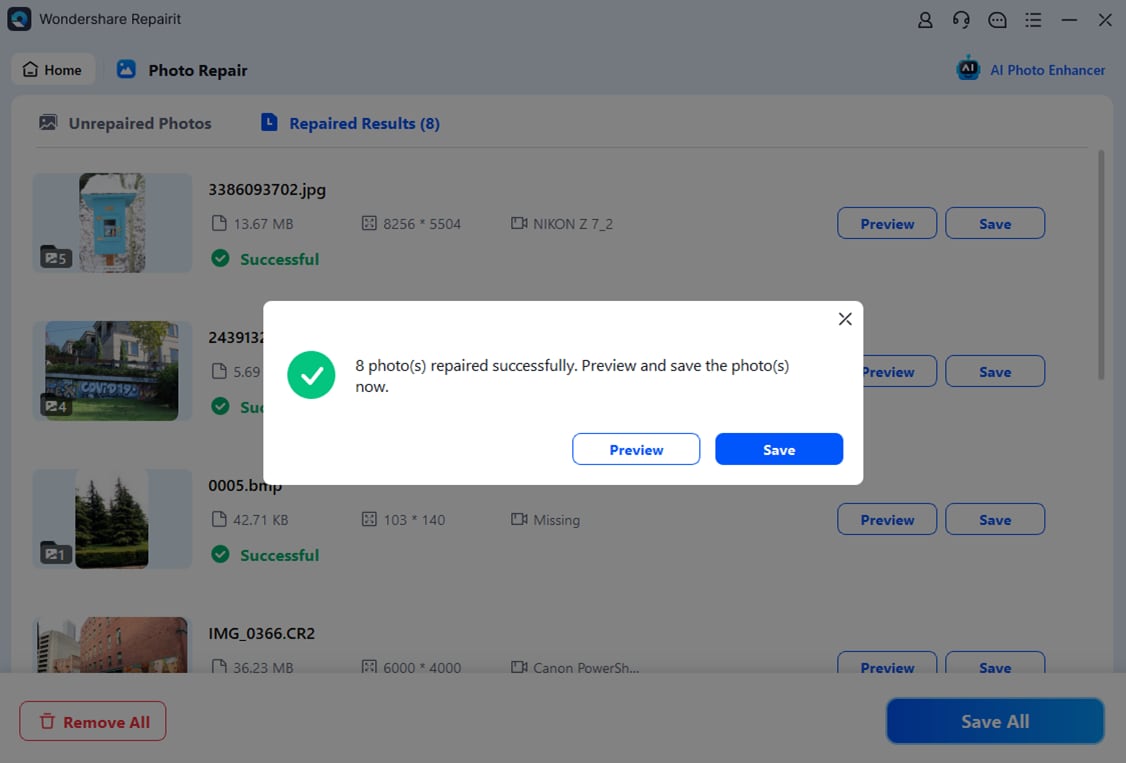
After the repair completes, preview the recovered photos to confirm that important details and colors look right. When you are satisfied, choose a safe output folder on your computer or another drive, and save the repaired images so they are ready for editing, grading, and delivery.
Conclusion
A global shutter sensor exposes the entire frame at once, delivering cleaner motion, accurate geometry, and dependable flash behavior that carry through from capture to editing, encoding, and final playback. For fast action, drones, and complex lighting, it can be the difference between warped, unstable footage and professional-looking results.
Understanding when to prioritize global shutter over rolling shutter, how it interacts with shutter speed, and how it affects workflows across different platforms helps you make smarter gear and setting choices. Combine that knowledge with good backup habits and a reliable repair tool like Repairit so unexpected corruption does not compromise your most important shoots.
Next: Neutral Density (Nd) Filter
FAQ
-
1. What is the main difference between global shutter and rolling shutter?
The main difference is how the sensor is read. A global shutter exposes and reads all pixels at the same time, while a rolling shutter scans the frame line by line from top to bottom. Global shutter avoids skew, wobble, and partial flash exposure that rolling shutter often introduces with fast motion. -
2. Does global shutter reduce image quality or dynamic range?
Early global shutter sensors sometimes traded a bit of dynamic range or added noise for speed. Modern designs have narrowed this gap significantly, and many global shutter cameras now deliver image quality that is very close to comparable rolling shutter models. The actual impact depends on the specific sensor and processing pipeline. -
3. When should I prioritize a global shutter camera?
Choose a global shutter camera for situations with intense motion or vibration: sports, drones, handheld documentary work with rapid moves, vehicle rigs, scientific imaging, or any shoot where rolling shutter skew and wobble could ruin the shot or complicate VFX and stabilization. -
4. Can global shutter completely remove motion artifacts?
Global shutter removes rolling-shutter-specific artifacts such as skew, jello wobble, and partial flash bands. It does not remove motion blur, which is still controlled by shutter speed or shutter angle, frame rate, and how fast the subject or camera moves. -
5. What can I do if my global shutter footage or photos become corrupted?
Stop recording on that card immediately to avoid overwriting data. Copy any readable files to a safe drive, then use specialized repair software like Wondershare Repairit to attempt to repair and recover damaged photo or video files before restarting your project.